Languages
Monday, November 16, 2026



News and Views from the Global South
Financial Crisis
ECONOMY: "Patching Up Bretton Woods Makes No Sense"
The world community must take immediate action to overhaul the current global financial system – that's what a vast majority of political leaders and policymakers from the developing world who are attending a three-day U.N. conference on the global economic crisis are saying.DEVELOPMENT: Western Aid Declines, Financial Bailouts Mount
As the world's poorer nations warn about the gravity of the global financial crisis on their fragile economies, the United Nations has exposed the hypocrisy of Western donors who cry poverty even while they raise trillions of dollars to rescue their beleaguered financial institutions.
ECONOMY: More Democracy the Cure for Broken System, U.N. Says
The United Nations General Assembly kicked off a three-day conference on the world financial crisis Wednesday with calls for a substantial overhaul of the decades-long model under which the world's richest countries set the terms of global fiscal and trade policy.
ECONOMY-AFRICA: Deny Neoliberal Consensus
Africa should ‘‘deny consensus'' at multilateral level to ensure that the region's interests are taken seriously, says Professor Patrick Bond speaking on how Africa should approach this week's high-level United Nations' meeting on the global economic crisis.DEVELOPMENT: China Lends Support to U.N. Finance Summit
China has lent its support to a U.N. finance summit where developing countries are pressing to air their grievances over how the global economic crisis has affected the world’s poorest. Yet, for the largest developing country the crisis remains a debacle with a silver lining - a matchless opportunity to accomplish its dream of regaining the regional and global clout it once held, and fast forward its ambitions.DEVELOPMENT: UN Meet May Short-Change the Poor
As United Nations members gather for talks on how best to end the global financial crisis, anti-poverty campaigners fear that instead of addressing poverty in the developing world, governments will work to prop up financial structures.
Q&A: U.N.’s Enormous Potential Being Marginalised
An international conference on the global financial crisis - hosted by the United Nations - is being marginalised by Western countries which have refused to send any of their political leaders to the meeting.ECONOMY-CUBA: Holiday Blues in Times of Crisis
Anxieties about making ends meet in Cuba are heightened at the start of the summer holiday season, when there is increased demand for food, transport and electricity, all of which are affected by restrictions intended to ease the country's economic problems, intensified by the global recession.POLITICS: World Bank, IMF Heads Skip Summit on Global Crisis
When a major international conference on financing for development took place in the Qatari capital of Doha last November, the heads of both the World Bank and the International Monetary Fund (IMF) skipped the meeting.ALBANIA: Poll Brings Old Recipes, New Expectations
The Jun. 28 general election in Albania is being seen as a crucial test in the country's evolution towards a democratic future. The two main parties that have dominated the post-communist period both have ambitious agendas whose top priority is European integration.
POLITICS: Will Women Be an Afterthought at U.N. Crisis Meet?
A groundbreaking U.N. General Assembly conference on the global economic crisis and its impact on development, set to begin Wednesday, may sideline women's numerous concerns, civil society groups say.
ECONOMY-ZAMBIA: Hard Times on the Copperbelt
Nowhere in Zambia is the impact of the global financial crisis being felt harder than in the copper and cobalt-rich province of the Copperbelt.
Q&A: Financial Crisis Unprecedented Since 1930s*
Since the Great Depression of the 1930s, there have been more than 100 crises worldwide, says the secretary-general of the U.N. Conference on Trade and Development (UNCTAD), Dr. Supachai Panitchpakdi.
NICARAGUA: Women Bear the Brunt of the Crisis
"Don’t worry, your job will be here when you come back," Lorena Castillo’s supervisor reassured her when she asked to take a day off for a gynaecologist appointment. She had been working at the textile factory for the past six months and it was the first time she asked for a day off. It turned out to be her last.
Q&A: “Migrant Workers Bring Vibrancy to the Labour Movement”
Day labourers looking for casual work are familiar fixtures on corners outside home improvement and garden stores across the United States. Less visible are the workers centres that have grown up in many locales to serve and organise these mainly immigrant and undocumented workers.ASIA: Regional Railway Links Aim to Boost Trade, Cooperation
A train journey from Singapore to Shanghai may not be the stuff of dreams anymore. So too the prospect of travel by rail from Seoul to Samarkand.POLITICS: Women’s Groups Seek Gender Equity at U.N. Summit
An international coalition of non-governmental organisations (NGOs), mostly comprised of women’s groups, is calling for a "gender equitable" response to the global financial crisis, which is to be debated at a U.N. summit of world leaders next week.AFRICA: "Boost Development Through Labour-Intensive Farming"
Development in Africa should be boosted through labour-intensive production on small to medium-sized farms. To advance food security in Africa, governments should assist small farmers with credit lines and infrastructure while buffering them against fluctuations in world food prices.
POLITICS: Is West Undermining Summit on Financial Crisis?
When a Western diplomat was asked whether his country would be represented by a head of state at next week's U.N. summit meeting on the global financial crisis, his response was tinged with sarcasm and contempt.LABOUR: World Leaders, ILO Call For Urgent Reforms
A crisis summit organised by the International Labour Organisation (ILO) to halt millions of job losses across the world due to the global economic slowdown ended Wednesday with a ringing call by its host to act now and put "the workers first before anything else."DEVELOPMENT: Asia Pacific Tourism on Road to Recovery
As it battles to regain its stature, one of the world's most resilient industries - tourism - is expected to overcome the current global economic recession at least by next year.« Previous Page — Next Page »


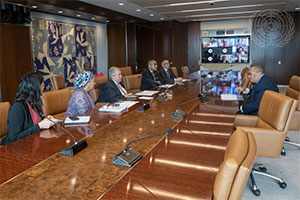 Secretary-General Meets with Members of Debt Expert Group. Credit: UN Photo/Eskinder Debeb
Financial crises are often defined by banking panics, recession, loss of market value, and deflation. Various financial crises at the turn of the 20th century, such as the Asian Crisis of 1997-1998 and the 2007-2008 Global Financial Crisis, have had immense impacts on the world economy. The COVID-19 pandemic also caused a financial crisis when mass lockdowns triggered staggering unemployment rates, a stagnation of economic growth, and led to the 2020 stock market crash. With the Russian invasion of Ukraine, the world has also witnessed a global energy crisis with shortages and increased prices in oil, gas, and electricity markets. According to UNCTAD’s World of Debt 2025, global public debt surpassed $100 trillion in 2024, with developing country debt growing twice as fast as developed economies since 2010. Burdens of debt servicing come with economic slowdowns and demands of austerity from lenders, with some economists arguing that this will lead to a new “lost decade” for the Global South. IPS brings you worldwide coverage of these financial developments and how we should manage these crises.

The Week with IPS

NEXT STOP - SDGs
Tracking global progress towards a sustainable world
Tracking global progress towards a sustainable world
