Languages
Monday, November 16, 2026



News and Views from the Global South
Financial Crisis
GUATEMALA: Crisis Hits Local Governments in Pocketbook
Incomplete infrastructure works and development projects and dismissals of teachers and municipal employees are some of the consequences of the global economic crisis in rural Guatemala, due to the central government’s decision to cut the budget for the country’s 333 municipal administrations.EGYPT: Workers Reeling Under Financial Crisis
The global financial crisis has forced Egyptian companies to lay off thousands of workers, and provided cover for firms to evade their legal and financial obligations to their workers, labour rights groups warn.
Q&A: "The Global Crisis Is Really About a 140-dollar Barrel of Oil"*
Sitting in the restaurant of Vancouver's posh Fairmount Waterfront Hotel, the former chief economist for one of Canada's largest banks doesn't seem like the typical apocalyptic peak oil theorist.LABOUR: ILO Urges Action on Financial Speculation
World leaders, employers and trade unionists, meeting here at a crisis summit on employment, welcomed a new ‘Global Jobs Pact’, but warned that any delay in its implementation would worsen the problems created by financial speculation.U.S.: Crisis Must Reshape Economists’ Thinking, Krugman Says
It is too optimistic to say the United States is headed for a Japan-style recession, according to Nobel laureate Paul Krugman.BALKANS: Now Fighting to Invite Serbs
Two decades back many people in what was once Yugoslavia were fighting Serbs. Today some are fighting to invite them over.
DEVELOPMENT: Africa ‘Not Badly Hit’ Despite 16 Million More Poor
Former United Nations secretary general Kofi Annan believes that Africa has not been affected as ‘‘profoundly’’ by the global economic crisis compared to other regions in the world - despite the number of Africans living in poverty having increased by 16 million in the last year and annual growth dropping from six to one percent.SWAZILAND: Donor Support For Health Sector Drying Up
As the global economic downturn begins to take its toll on developing countries, Swaziland's health system - already strained by the burden of HIV/AIDS - has come under severe threat. The third of the national health budget which comes directly from donor agencies is abruptly drying up.GHANA-ECONOMY: Credit Crunch Starts To Bite
When the news of the global financial crisis broke in Ghana last year, the then-President John Kufuor said the country’s economy was insulated against the effects of the credit crunch being reported in Europe and the United States. There now seems to be an admission now that ripples are being felt.DEVELOPMENT: ‘‘19th WEF on Africa Just About Elite Agendas’’
The 19th World Economic Forum (WEF) on Africa, which kicks off tomorrow, is a space ‘‘for the rich and powerful elites who control the global economy and who seek to further open Africa’s economy in collaboration with a tiny minority of corrupt elites in Africa.
DEVELOPMENT: Thousands March as Food Crisis Deepens
An estimated 300,000 people across the globe hit the streets Sunday to support the World Food Programme (WFP) and its mission to feed hungry schoolchildren and battle malnutrition worldwide.
LABOUR-US: Unions Embrace Street Corner Solidarity
For Pablo Alvarado, the genesis occurred back in 1999 when janitors in Los Angeles were on strike. Some of the cleaning companies came to the corners and workers' centres where day labourers gathered and tried to hire workers to cross the janitors' picket lines, he recounted to IPS.U.S.: GM Gets Billions, Says No Money for Crash Victims
U.S. taxpayers have given 50 billion to rescue General Motors, but the company says it should not have to pay a penny to people harmed by known defects in its vehicles.
CLIMATE CHANGE: Twilight of the Fossil Fuel Era?
The world has turned a green corner toward a more sustainable future, with investments in clean energy outpacing fossil fuel power generation for the first time.
MIGRATION-US: Grassroots Labourers Plough Common Ground
The hiring hall for Hod Carriers and General Labourers Local 242 is in the basement of the Seattle Labour Temple, a two-story tan-brick building of early-20th century vintage. You walk down a flight of well-worn red-tile stairs and through the double doors.ECONOMY-US: One in Five Children Sinking Into Poverty
U.S. children’s quality of life is expected to decline through 2010 due to the impacts of the financial crisis, said a new report by the Foundation for Child Development (FDC), released on Wednesday.POLITICS: Developing Countries Fight for Say at U.N. Crisis Meet
The postponement of a major U.N. General Assembly conference to address the global economic crisis and its impact on development is seen by some civil society groups and analysts as a sign of the conflicting interests between the world's richest and poorest countries.POLITICS: Economic Crisis Making for More Unstable World
The world has become a slightly more dangerous place in the past year, said the new Global Peace Index (GPI) released Tuesday, which points to the economic crisis as the main factor.
TOURISM: ‘‘Uganda Not Just About Idi Amin, Civil War and AIDS’’
Ugandans are unhappy with their tourism authority as they believe that their country’s warm climate and exceptional species, such as the mountain gorilla, should attract as many tourists as neighbouring Kenya. To compound matters, the global economic crisis has shrunk tourist arrivals from Europe.
ZAMBIA: Controversial Chinese Firm Given Another Copper Mine
The desperate need to find an alternative investor for the closed Luanshya Copper Mines (LCM) in Zambia’s Copperbelt has not prevented some Zambians from fiercely opposing the government’s decision to let Chinese-owned Non-Ferrous Metals Mining Company (NFCA) run the mine.ECONOMY: 'Crisis Must Lead to Greater Voice for Workers'
The compensation for managers must be capped at 15 times that of workers, civil society groups demanded Sunday following a conference in Florence.« Previous Page — Next Page »


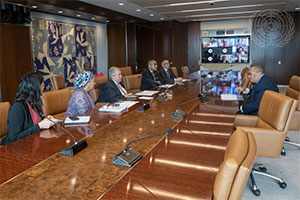 Secretary-General Meets with Members of Debt Expert Group. Credit: UN Photo/Eskinder Debeb
Financial crises are often defined by banking panics, recession, loss of market value, and deflation. Various financial crises at the turn of the 20th century, such as the Asian Crisis of 1997-1998 and the 2007-2008 Global Financial Crisis, have had immense impacts on the world economy. The COVID-19 pandemic also caused a financial crisis when mass lockdowns triggered staggering unemployment rates, a stagnation of economic growth, and led to the 2020 stock market crash. With the Russian invasion of Ukraine, the world has also witnessed a global energy crisis with shortages and increased prices in oil, gas, and electricity markets. According to UNCTAD’s World of Debt 2025, global public debt surpassed $100 trillion in 2024, with developing country debt growing twice as fast as developed economies since 2010. Burdens of debt servicing come with economic slowdowns and demands of austerity from lenders, with some economists arguing that this will lead to a new “lost decade” for the Global South. IPS brings you worldwide coverage of these financial developments and how we should manage these crises.

The Week with IPS

NEXT STOP - SDGs
Tracking global progress towards a sustainable world
Tracking global progress towards a sustainable world
