Languages
Tuesday, September 1, 2026



News and Views from the Global South
Food and Agriculture

Beyond the Farm: How Empowering Women Farmers Drives Change in Jordan and Beyond
Dr. Zeinab Al-Momany, a prominent social entrepreneur, sheds light on the journey of empowering women farmers in Jordan and the Arab world, where women often work long hours for low pay and lack labour recognition.
Climate Change Is Taking a Major Toll on Agriculture. Here’s How to Support Farmers
Half the world eats rice. In Bangladesh, everyone eats it. The small, densely-populated nation is the third-highest rice-producing country in the world.
New Era: Unlocking Africa’s Agriculture Potential Through CGIAR TAAT Model
As hunger and food insecurity deepen, Africa is confronting an unprecedented food crisis. Estimates show that nearly 282 million people on the continent, or 20 percent of the population, are undernourished. Numerous challenges across the African continent threaten the race to achieve food security; research and innovative strategies are urgently needed to transform current systems as they are inadequate to address the food crisis.
Cooperative Farming Makes Bangladesh’s Coastal Women Farmers Climate-Resilient
In the past, Salma Begum, 40, lost her crops every year due to natural disasters. She lives with her five-member family in Ashabaria village under Rangabali upazila, a remote coastal island in Patuakhali district. “We did not have enough livelihood options in the coastal area where we live. Cyclones, coastal floods, and tidal surges have been having adverse impacts on agriculture, making it difficult for my wage-laborer husband to find work regularly,” she said.
What’s in Store for Indian Farmers After Cop 28’s Conclusion in Dubai?
Durga Das*, a 59-year-old farmer from the Indian state of Maharashtra, committed suicide last year by ingesting a poisonous substance. He was unable to repay the loan he had taken from the bank for the renovation of his single-story house. This year, his 32-year-old son, Pradeep Das, a father of two children, is equally desperate. The family owns half an acre of cultivated land where they grow cotton. The harvest has been devastated due to intense heat waves, leaving farmers like Dass and his son Pradeep in dire straits. The loan the family had taken is yet to be paid, and the land they had mortgaged in the bank is about to be confiscated. This means no crops, no cultivation, no business, and no food.
Caribbean Confidence High Post COP28, But Vigilant Follow-Through on Key Deals Needed
Buoyed by USD 800 million in pledges to the Loss and Damage Fund and an unprecedented agreement to transition away from fossil fuels, but grounded in the reality of the work ahead to meet key climate targets, the Caribbean will need to maintain its focus on sustainable agriculture, renewable energy, and climate resilience.
Peru’s Andean Peoples ‘Revive’ Water that the Climate Crisis Is Taking From Them
"The rich world has caused the climate change that is drying up our water sources, and here we are doing everything we can to recover them because otherwise we will die," said Juan Hilario Quispe, president of the small farming community of Muñapata, just over 50 kilometers from the Peruvian city of Cuzco.
IFAD’s Record-Breaking Pledges: Lifeline for Rural Communities Cornered by Climate, Hunger
The world is not on track to end hunger and poverty as a future of growing food insecurity and climate challenges beckon. Small-scale farmers are the backbone of food production, producing one-third of the world’s food and up to 70 percent of the food consumed in Africa and Asia, yet they are often cut off from the services they need to pull themselves out of poverty and food insecurity.
Clean Energies Underpin Self-Sustainable System at Cuban Farm – VIDEO
 The combined use of clean energies allows Finca del Medio, a farm in central Cuba, to practice a unique system of family farming production that guarantees self-sufficiency based on permaculture, agroecology and care of the environment.
Africa’s Negotiators Urged to Leverage on African Science at COP28 High Table
African scientists and researchers are concerned that the data shows that the continent is being cornered by the spiraling effects of climate change, that the real impact of climate devastation is yet to unfold, and that the region is on the cusp of more severe and catastrophic consequences.
U.S. Misuses Trade Agreements to Undermine Food Sovereignty
The dispute mounted by the U.S. government over Mexico's policies to restrict the use of genetically modified corn is the latest example of the misuse of a trade agreement to impede social programs in Mexico and other countries. The U.S. government has been doing this for years.
Farm to Fork: COP28 Provides RoadMap to Fix Africa’s Broken Food Systems – IFAD
In the absence of sufficient urgency to curb greenhouse gas emissions, it is becoming too hot to farm in Africa. Confronted by extreme, intense, and frequent climate events such as record-breaking prolonged dry spells, current agriculture and farming systems are ill equipped to adapt to or alleviate climate change.
Emerging Climate Finance Infrastructure to Match Africa’s Green Bankable Solutions
Although long profiled as the face of climate change, a high-risk continent with a pipeline of unbankable green projects, there are areas where Africa is leading the world. The 1987 accidental discovery of the first deposit of natural hydrogen during a water drilling campaign in Bourakebougou village, Mali, is today proving that Africa can export viable green solutions.
Electrifying Cooking: Decarbonizing Africa’s Electricity Grid Towards Net Zero
Across the African continent, many first-born children in poor and vulnerable households do not go to school as they spend their school days collecting biomass fuel. The regional average of the amount of time spent collecting firewood is 2.1 hours, robbing women and girls in particular of hundreds of hours in a year and crippling their capacities to engage in learning and productive activities.
Why the UN COP28 Climate Talks Must Serve Farmers to Achieve a “Just Transition”
Food and agriculture is a top agenda item at UNFCCC COP28, as the world considers how to tackle the climate impacts of what we eat and how we produce it. The stage has been set for COP28 to be a “food COP”, but for commitments to translate to action, it must also be a “farmers’ COP”.
Ten African Countries to Benefit From USD 100 Million Released by Green Climate Fund
The Green Climate Fund (GCF) has announced the release of USD 100 million at the ongoing United Nations Framework Convention on Climate Change (UNFCCC) 28th Conference of Parties (COP 28) in Dubai, UAE, to support 10 African countries in adapting food loss reduction solutions.
Pacific Leaders Announce Largest Conservation Effort in History
Pacific people live at the nexus of oceans, climate, and food systems, and the interaction of climate and ocean is raising sea temperatures and threatening habitats and resources vital to the region’s sustenance, Palau’s President Surangel Whipps, Jr., said at the launch of an effort to protect and rejuvenate the region's ecosystems and empower communities through to the year 2050—in what is considered to be the biggest single conservation effort in history—Unlocking Blue Pacific Prosperity.
Why Agroecology Should Be Considered as Key for Climate Negotiations
Students of St Denis Libolina Primary have used agroecology farming techniques to transform the entire school garden and any free space into food forests and gardens for different vegetable varieties, legumes, and herbs. Now the students, who are physically challenged, have challenged their parents, villagers, and farmers in the outskirts of Myanga Township, in Kenya’s Bungoma County, in the Western region, to do the same.
Salvadoran Rural Communities Face Climate Injustice
For decades, poor fishing and farming communities in southern El Salvador have paid the price for the electricity generated by one of the country's five dams, as constant and sometimes extreme rains cause the reservoir to release water that ends up flooding the low-lying area where the families live.
Tackling Agrifood Inequality Can Boost the Bottom Line
Objections to progressive policies are often based on cost. It would be great to have a fairer, more sustainable world, the argument goes, but where will the money come from to pay for it?
Call for Rural Agriculture Investment, Less Food Wastage to Address Global Hunger
The politics of global food consumption remain contentious, with the upcoming COP28 taking place against the backdrop of worsening food deficits in the Global South.« Previous Page — Next Page »


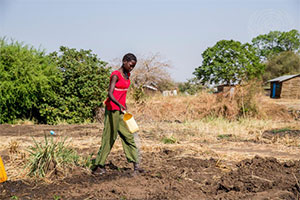 Farming on the Outskirts of Juba. Credit: UN Photo/JC McIlwaine
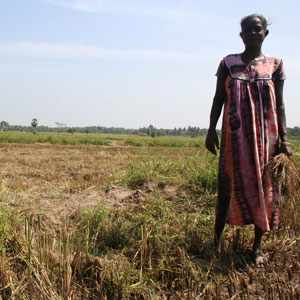
Promoting human and planetary health is a central focus of the United Nations, as laid out in the 2030 Sustainable Development Goals (SDGs). World hunger and unsustainable farming practices continue to be pressing concerns for the world. According to the 2025 State of Food Security and Nutrition in the World report by the Food and Agriculture Organization (FAO), 673 million people faced hunger in 2024. There are stark regional disparities, with the FAO projecting that 60% of the world population facing hunger will reside in Africa by 2030. Globally, the prevalence of food insecurity has remained consistently higher for women than men.
Sustainable and efficient national food systems are essential in preserving health, education, environmental well-being, peace, economy, and security. However, creating sustainable food systems can be a challenging endeavor, as food production takes a heavy toll on the environment. The agricultural sector accounts for a significant portion of greenhouse gases. Finding safe, sustainable, and ethical strategies to feed the world is crucial in ensuring planetary longevity. A recent initiative from 2023, the EU Regulation on Deforestation-free Products (EUDR), seeks to advocate for sustainable food systems. The main driver of deforestation is the expansion of agricultural land used to produce commodities like cattle, wood, cocoa, coffee, etc. The EUDR is part of the 2020 European Green New Deal and the EU Biodiversity Strategy for 2030 and aims to limit Europe’s consumption of products linked with deforestation by requiring that companies prove that their products are deforestation-free. Despite aiming to achieve major strides in sustainability, policies such as EUDR also raise socioeconomic concerns for targeted countries. Many emerging Latin American economies are impacted by the policy, and have raised the question of how developing countries can grapple with the tensions between economic development and advancing sustainability.
IPS has been at the forefront of providing compelling and insightful stories on communities facing hunger as well as the cost of food production. IPS uses statistics from FAO, the World Food Programme (WFP) and the International Fund for Agricultural Development (IFAD) to bring relevant and hard-hitting facts to readers. This gathering of information and data from such organizations helps bring the best stories from IPS journalists working in the different regions in consultation with experts on the ground.

The Week with IPS

NEXT STOP - SDGs
Tracking global progress towards a sustainable world
Tracking global progress towards a sustainable world