Languages
Thursday, October 8, 2026



News and Views from the Global South
Humanitarian Emergencies

Poor Countries Welcome Loss and Damage Fund’s Call for Requests, Warn It Falls Short of Needs
Least Developed Countries have hailed the debut call for proposals for the Loss and Damage Fund, which was launched on 11 November at the United Nations climate summit known as COP30 in Belem, Brazil.
Demonstrators Face-Off With Security as COP30 Activism Intensifies
In a departure from the past three COPs, in Egypt, Dubai and Azerbaijan, there have been increasingly intense demonstrations from activists at the COP30 venue in Belém, the capital of the northern Brazilian state of Pará.
Syria’s Fragile Transition Threatened by Severe Aid Shortfalls and Increasing Abductions, UN Warns
Eleven months after the fall of the Assad regime, Syria continues to grapple with severe instability as the country navigates a turbulent political transition. Rates of displacement have surged, and humanitarian organizations are struggling to support large numbers of refugees returning home. In recent weeks, the United Nations (UN) has documented numerous cases of enforced disappearances and abductions, calling for stronger accountability measures as the transition continues to unfold.
Displaced Farmers in Southern Lebanon Still Denied Access to Land
Food security and livelihoods in southern Lebanon are under severe threat as the repercussions of Israeli bombing continue to be felt across the region, a report released today (NOV 10) has warned.
Nuclear Disarmament Conversations Cannot Lose Traction
In recent days, nuclear state leaders have flouted the regulations and norms around nuclear non-proliferation and are flirting more openly with nuclear might in the name of projecting strength.
Global Emissions Falling Too Slowly, Expert Urges Renewables Push, Fair Finance
A decade has passed since the adoption of the Paris Agreement, and a United Nations synthesis report released ahead of COP30 in Belém shows that "Parties are bending their combined emission curve further downwards, but still not quickly enough."
Hurricane Melissa Devastates The Caribbean As The UN Distributes Lifesaving Aid
In late October, Hurricane Melissa, a powerful Category 5 storm, made landfall in the Caribbean, causing catastrophic damage to civilian infrastructure and a devastating loss of life. Humanitarian agencies have mobilized on the ground to deliver urgent assistance to affected communities facing widespread destruction of homes, mass displacement, fatalities, and severe shortages of essential services, including food, water, medicine, shelter, and electricity.
Rajagopal PV’s Blueprint for Another World: Peace
"If nations can have defense ministries, why not peace ministries?" asks Rajagopal PV, the soft-spoken yet formidable founder of Ekta Parishad. "We are told to see issues through a gender lens—why not a peace lens? Why can’t we imagine a business model rooted in non-violence or an education system that teaches peace?”
Lawmakers Urged to Consider Emerging Drivers of Child Marriage
Closing the chapter on child marriages is still a distant ambition in the Southern African Development Community (SADC) region, and despite great strides at developing and passing legislation to eradicate it, existing and emerging drivers are still at play, making youngsters vulnerable to the practice.
Challenging Elites, Defending Democracy: Oxfam’s Amitabh Behar Speaks Out
Speaking to IPS on the sidelines of the International Civil Society Week in Bangkok (November 1–5), Amitabh Behar, Executive Director of Oxfam International and a passionate human rights advocate, highlighted his concerns about rising inequality, growing authoritarianism, and the misuse of AI and surveillance. Yet, he expressed optimism that, even as civic spaces shrink, young people across Asia are driving meaningful change. He also shared his vision of a just society—one where power is shared, and grassroots movements lead the way.
Defending Democracy in a “Topsy-Turvy” World
It is a bleak global moment—with civil society actors battling assassinations, imprisonment, fabricated charges, and funding cuts to pro-democracy movements in a world gripped by inequality, climate chaos, and rising authoritarianism. Yet, the mood at Bangkok’s Thammasat University was anything but defeated.
The Biggest Single Contributor to the UN Budget is also the Biggest Single Defaulter
The United States, the largest single contributor to the UN budget, is using its financial clout to threaten the United Nations by cutting off funds and withdrawing from several UN agencies. In an interview with Breitbart News U.S. Representative to the United Nations, Ambassador Mike Waltz said last week “a quarter of everything the UN does, the United States pays for”.
Adaptation Finance Shortfalls Leave Developing World Exposed
Hurricane Melissa made landfall in Jamaica yesterday—the strongest hurricane to impact the island on record since 1851—with expectations of tens of thousands of people being displaced and devastating damage to infrastructure. The tropical storm, slightly downgraded but nevertheless devastating, made landfall in Cuba today as UNEP’s newly released Adaptation Gap Report 2025: Running on Empty shows that the finance needed for developing countries to adapt to the climate crisis is falling far behind their needs.
A Power Imbalance Frozen in Time: The Case for Security Council Reform
In June 2025, the international community celebrated the 80th anniversary of the signing of the United Nations Charter. On October 24, we celebrated UN Day, commemorating its ratification. This is an opportune moment to reflect on how far we have come, and the ground we have yet to traverse.
Tanzania’s Pandemic Fund Ushers in a New Era of Health Preparedness
When COVID-19 hit Tanzania in 2020, Alfred Kisena’s life was torn apart. The 51-year-old teacher still remembers the night he learned that his wife, Maria, had succumbed to the virus at a hospital in Dar es Salaam. He wasn’t allowed to see her in her final moments.
UN Agencies Calls for Urgent Action as Sudan’s Humanitarian Crisis Reaches Breaking Point
In recent weeks, Sudan’s humanitarian crisis has deteriorated considerably, as escalating hostilities, mass displacement, disease outbreaks, and a widespread lack of access to basic, essential services continue to endanger civilians across the country. The situation has been further compounded by a sharp increase in attacks on healthcare facilities throughout October, which has severely weakened the country’s already fragile health system and deprived thousands of people of lifesaving care.
The Only Remaining Colony in Africa Continues its Struggle for Independence
The African continent has long been monopolized by European colonial rulers, with France having the largest number of colonies, ruling over 35 territories, followed by Britain with 32. A bygone era of colonial rule on the continent, “once carved up and ruled by European powers hungry for imperial glory,” has virtually ended—almost.
World Food Programme Warns of Emergency Levels of Hunger Amid Severe Funding Cuts
In 2025, unprecedented cuts to foreign aid and humanitarian funding have exacerbated global hunger crises, leaving millions without access to food or basic services. Funding shortfalls have forced aid agencies to scale back or suspend lifesaving programs in some of the world’s most food-insecure regions, particularly across the Global South—exacerbating already dire conditions caused by conflict, displacement, economic instability, and climate shocks.
Is the UN “Bloated, Unfocused, Outdated and Ineffective”?
The US hostility towards the UN is threatening to escalate, as a cash-starved world body is struggling for economic survival. Addressing the UN’s Administrative and Budgetary Committee last week. Ambassador Jeff Bartos, U.S. Representative for U.N. Management and Reform said: “President Trump is absolutely right – the United Nations can be an important institution for solving international challenges, but it has strayed far from its original purpose”.
They Have Known Nothing but War—The Plight of Syria’s Out-of-School Children
The war has deprived thousands of Syrian children of their right to education, especially displaced children in makeshift camps. Amidst difficult economic conditions and the inability of many families to afford educational costs, the future of these children is under threat.
The Inescapable Reality the Israelis Must Face
The ceasefire agreement and the release of Israeli hostages and Palestinian prisoners are only the first steps on the long and treacherous road that could end the calamitous, decades-long Israeli-Palestinian conflict. In my recent article, “A Rare Alignment:The World Stands Ready, Are the Palestinians?”« Previous Page — Next Page »





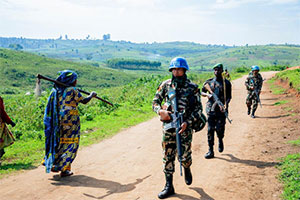 MONUSCO Peacekeepers and FARDC Soldiers Patrol Fataki Area. Credit: UN Photo/Jorkim Jotham Pituwa
Conflict, human rights violations, natural disasters, and famine have been at the forefront of concerns for humanitarian organizations. The escalation of humanitarian crises has led to over 239 million people in need of humanitarian assistance at the start of 2026, as estimated by OCHA’s Global Humanitarian Overview. The 2025 humanitarian appeal received only $12 billion, the lowest funding in over a decade, which has left 24 million fewer people reached in comparison to 2024. Conflict has remained the primary driver of crisis.
Humanitarian emergencies massively impact progress towards the Sustainable Development Goals (SDGs), adversely affecting economic development, inequality, education, planetary well-being, and poverty. Millions of people are faced with reduced access to essential services, including shelter, food, healthcare, and access to clean drinking water. UN Organizations such as UNHCR and the United Nations Children’s Fund (UNICEF) are committed to providing direct relief to affected communities when state governments cannot.
The United Nations 2024 Summit of the Future discussed measures that will be taken to reduce global inequality and promote peacekeeping efforts around the world. The recent UN Climate Change Conference (COP30) in Belém, Brazil, agreed to mobilize $1.3 trillion annually for climate action by 2035, operationalize the loss and damage fund, and triple adaptation finance. However, a fossil fuel transition commitment was not secured, despite climate change and the greenhouse effect being major contributors to humanitarian crises worldwide.
Countries across the world have also rallied to end humanitarian crises, as witnessed in conflicts such as Palestine and Ukraine. IPS is committed to providing relevant and in-depth reports of humanitarian emergencies around the world and their implications.

The Week with IPS

NEXT STOP - SDGs
Tracking global progress towards a sustainable world
Tracking global progress towards a sustainable world