Languages
Thursday, October 8, 2026



News and Views from the Global South
Humanitarian Emergencies

Global South Can Rebalance Climate Agenda in Belém, Says Gambian Negotiator
The Gambia's lead negotiator on mitigation believes that COP30 presents a unique opportunity to rebalance global climate leadership.
From Algorithms to Accountability: What Global AI Governance Should Look Like
Recent research from Stanford’s Institute for Human-Centered AI warns that bias in artificial intelligence remains deeply rooted even in models designed to avoid it and can worsen as models grow. From bias in hiring of men over women for leadership roles, to misclassification of darker-skinned individuals as criminals, the stakes are high.
Abusive Governments Set to Win Seats in Human Rights Council
Egypt and Vietnam are on track to secure seats on the United Nations Human Rights Council despite being woefully unfit for membership. The UN General Assembly will elect members to the UN’s premier rights body in a noncompetitive vote on October 14, 2025.
Civil Society on the Edge
The collapse of aid architecture is one of the greatest dangers for civic space. This shift is not accidental but systemic, reflecting deliberate policy choices – not only by the US but accelerated by its decisions- that prioritize security agendas over human rights and solidarity.
UNGA80: Climate and Health in the Mix of Hope and Despair
The Intergovernmental Panel on Climate Change (IPCC), the UN's body on climate science, has over the years, repeatedly and steadily reported on the science of global warming leading to the changing climate with visible impacts.
Two-Thirds of Climate Funding for Global South are Loans as Rich Nations Profiteer from Escalating Climate Crisis
New research by Oxfam and the CARE Climate Justice Centre finds developing countries are now paying more back to wealthy nations for climate finance loans than they receive—for every USD 5 they receive, they are paying USD 7 back, and 65 percent of funding is delivered in the form of loans.
Belarus Prisoner Release a Diversion, Say Rights Activists
As Belarusian president Alexander Lukashenko continues to pardon political prisoners in an apparently increasingly successful attempt to improve diplomatic relations with the US, rights groups have warned the international community must not let itself be ‘tricked’ into thinking repressions in the country are easing.
Our Teachers, Our Heroes
1 calls on people everywhere to provide teachers and the communities they serve with the resources they need to succeed in their crucial profession.
More than 42,000 Gazans Suffer Life-Changing Injuries as Health System Nears Collapse
In recent months, the humanitarian situation in Gaza has sharply deteriorated, with escalating hostilities driving mass civilian displacement and overwhelming the already fragile healthcare system, pushing it to the brink of collapse. UN officials are warning that thousands of civilians have been left with life-altering injuries without treatment.
Justice for Palestinians Can’t Wait for a Peace Deal
The calamitous situation in Gaza, with Palestinian civilians facing extermination and ethnic cleansing by Israeli forces, was a major focus of the annual United Nations General Assembly (UNGA) high-level week. Along with recognition of the state of Palestine by France, the United Kingdom, Australia, and Canada, among others, states made key commitments on human rights and accountability that were overwhelmingly adopted by the UNGA and now need to be fulfilled.
Israel, Gaza, and the Erosion of International Order
As a world leader and beneficiary of the international system, the United States should be at the forefront of efforts to enforce rules and laws to prevent the proliferation of weapons of mass destruction, protect civilians in conflict, and block weapons transfers to states that engage in war crimes or genocide.
Weaving Wisdom and Science: Pacific Voices Call for Ocean Protection
In the packed conference hall of the Heritage Hotel, the sound of Pacific voices filled the air—not just through speeches, but in song, rhythm, and poetry. The Dreamcast Theatre Performing Arts group opened the Second Pacific Island Ocean Conference with an evocative performance, reminding leaders and practitioners why they had gathered: to listen. To listen to science. To listen to communities. To listen to the ocean itself.
West Bank: Record Number of Demolitions over Building Permits as Israel Furthers Annexation Agenda
In less than nine months, Israel has demolished more Palestinian homes and structures in the occupied West Bank, including East Jerusalem, over building permits than in the whole of last year.
Multilateralism Minus the People: 80 Years of the UN’s Broken Promise
Last week, the United Nations (UN) marked its 80th anniversary against the backdrop of an unprecedented global crisis. With the highest number of active conflicts since 1946, trust in multilateralism is faltering.
Climate Finance Will Be the First Casualty of Rising Militarism: Ali T. Sheikh Warns Ahead of COP30
As the COP30 approaches amid darkening geopolitical clouds—marked by rising rightwing extremism, corporate backtracking and rising militarism—Ali T. Sheikh, Pakistan’s leading expert on sustainable development and climate change, views the world’s largest diplomatic gathering with a mix of apprehension and caution.
UNICEF Climate Advocate Urges World Leaders To ‘Include Children’ in Climate Discussions
The UN General Assembly High-Level Week (22-30 September) has been an opportunity for the world to convene on the most pressing issues of the day, from multilateralism, global financing, gender equality, non-communicable diseases, and AI governance.
Record Number of Women Living Within Striking Distance of Military Conflicts
The battlefield is no longer distant; for millions of women, it’s next door. An estimated 676 million women – nearly 17 percent of the global female population – lived within 50 kilometres of a deadly conflict last year, according to a new report from the Peace Research Institute Oslo (PRIO). That is the highest figure recorded since the end of the Cold War.
Food Insecurity Rising in Africa, Falling in Latin America and Caribbean
The 2025 State of Food Security and Nutrition in the World (SOFI) report shows a modest global decline in hunger since 2022, with 673 million people facing hunger in 2024, indicating a decrease of 22 million compared to 2022. While progress is seen in Asia and South America, hunger is rising in Africa and Western Asia.
Afghan Women Die Needlessly After Natural Disasters
In normal times, women in Afghanistan face dire living conditions relative to their counterparts in other parts of the world, given the iron grip of Taliban repression. However, the powerful 6.0-magnitude earthquake that struck the eastern Afghan provinces of Kunar, Nangarhar, and Laghman at the end of August was out of the ordinary.
Prospects for the Upcoming High-Level Conference on Rohingya
Last month marked eight years since hundreds of thousands of Rohingya were forcibly displaced from Myanmar’s Rakhine State to Bangladesh by the Myanmar military.
‘The State Cannot Pardon Itself for Violating Human Rights’
CIVICUS discusses Peru's new amnesty law with Nadia Ramos Serrano, founder and researcher at the Leadership Centre for Women of the Americas, a civil society organisation working on democratic development and the role of women in politics.« Previous Page — Next Page »





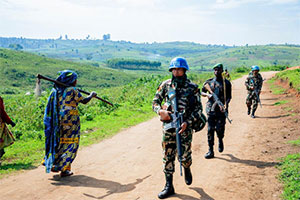 MONUSCO Peacekeepers and FARDC Soldiers Patrol Fataki Area. Credit: UN Photo/Jorkim Jotham Pituwa
Conflict, human rights violations, natural disasters, and famine have been at the forefront of concerns for humanitarian organizations. The escalation of humanitarian crises has led to over 239 million people in need of humanitarian assistance at the start of 2026, as estimated by OCHA’s Global Humanitarian Overview. The 2025 humanitarian appeal received only $12 billion, the lowest funding in over a decade, which has left 24 million fewer people reached in comparison to 2024. Conflict has remained the primary driver of crisis.
Humanitarian emergencies massively impact progress towards the Sustainable Development Goals (SDGs), adversely affecting economic development, inequality, education, planetary well-being, and poverty. Millions of people are faced with reduced access to essential services, including shelter, food, healthcare, and access to clean drinking water. UN Organizations such as UNHCR and the United Nations Children’s Fund (UNICEF) are committed to providing direct relief to affected communities when state governments cannot.
The United Nations 2024 Summit of the Future discussed measures that will be taken to reduce global inequality and promote peacekeeping efforts around the world. The recent UN Climate Change Conference (COP30) in Belém, Brazil, agreed to mobilize $1.3 trillion annually for climate action by 2035, operationalize the loss and damage fund, and triple adaptation finance. However, a fossil fuel transition commitment was not secured, despite climate change and the greenhouse effect being major contributors to humanitarian crises worldwide.
Countries across the world have also rallied to end humanitarian crises, as witnessed in conflicts such as Palestine and Ukraine. IPS is committed to providing relevant and in-depth reports of humanitarian emergencies around the world and their implications.

The Week with IPS

NEXT STOP - SDGs
Tracking global progress towards a sustainable world
Tracking global progress towards a sustainable world