Languages
Wednesday, November 18, 2026



News and Views from the Global South
Labour
CAMBODIA: Women Stitch an Economy With Garment Exports
It is no yarn that Cambodia's women hold in their fingers the fate of that poverty-stricken country's economy - in particular, the women who labour in some 270 garment factories spread in and around Phnom Penh, the nation's capital.DEVELOPMENT-LATAM: Workers Abroad Transform Life at Home
Rising migration and soaring remittances from abroad are creating the so-called "multiplying effects" that economists have long been waiting for, and they are influencing a range of economic activity.DEVELOPMENT-LATAM: Tapping the Power of Self-Determination
Nobody knows when remittances or migration will stop increasing or start declining, but one of the unwavering challenges presented by these flows of money and people is how to leverage them into sustainable development.CHILE: Musicians’ Strike Leads to Cancellation of Opera Season
The Santiago Municipal Theatre, one of Latin America's foremost orchestra halls, is facing its worst crisis ever: for the first time in its nearly 150-year history, it has been forced to cancel its opera and concert season because of a strike by musicians.DEVELOPMENT-LATAM: Influx of Dollars, Exodus of People
The social effects of remittances from migrant workers and the growing business of microfinance may not lend themselves as easily to news headlines as their economic or financial impacts, but that does not make them any less significant.GUATEMALA: Civil Society – Look How It Has Grown
Civil society in Guatemala is coming of age, as non-governmental organisations seek to overcome the country's troubled history of armed conflict. Ten years have passed since the peace accords were signed, and social organisations have cut down on the rebellious lashing out in favour of cooperating with the State and setting forth proposals.BURMA: Forced Labour Under ILO Spotlight
Burma's military regime comes under the spotlight of the International Labour Organisation (ILO) this week when its practice of forced labour will be scrutinized and acted upon.POLITICS: India Seeks EU Investment in Farms, Infrastructure
India's economy can grow by ten percent a year, if it is able to attract massive investments in agriculture and infrastructure. And Europe can help, says India's finance minister Palaniappan Chidambaram.DEVELOPMENT-LATAM: Toward a New Financial Democracy?
Two multi-billion-dollar industries are converging in Latin America, driven entirely by lower-income citizens trying to improve their economic situations.RIGHTS: Child Labour – Slow Progress, Right Direction
Encouraging statistics pointing to a decline in child labour do not conceal the fact that the problem remains a major challenge in large parts of the world, said the International Labour Organisation (ILO) on the World Day Against Child Labour.SOUTH PACIFIC: Fijian Deaths in Iraq Revive Mercenaries’ Issue
The deaths of three Fijian security guards in a bomb blast in Iraq has revived concerns over private security agencies hiring former Fijian soldiers cheaply to work in the war-torn country and elsewhere.BRAZIL: Innovative Small Farmers Set to Redefine Development
While their protest marches and occupations of government and business offices recall the struggles of landless campesinos, this group of Brazilian farmers are drawing attention to a distinct facet of agrarian reform. These workers have mobilised to hold onto the land they own and build a more just and environmentally sound society.MIGRATION-US: The Myth of Low-Wage Warfare
How could it be that an influx of less-educated workers from poor countries would not significantly harm low-income U.S. workers?LABOUR: Workers Face Growing Violence for Demanding Rights
Workers are facing increasing attacks around the world for demanding their rights, the international workers union ICFTU says in a report released Wednesday.HEALTH-LATIN AMERICA: The Challenge of Paying for Unremunerated Work
María Angélica is a Chilean woman who could not work in her profession as a chef for nearly two years, because she had to look after her mother, who was ill. Including this kind of unpaid women's work in national budgets is one of the big challenges Latin America faces in order to make progress in gender equality.MIGRATION-US: Statistics Reveal More “Winners” Than “Losers”
Beneath the roar of enormous pro-immigrant rallies across the United States, and behind congressional debates over border walls and guest workers, lurks a knotty question: Who wins and who loses from illegal immigration?MIGRATION: South-South Flows on the Rise, Says U.N.
Traditional assumptions about international migration are gradually changing, as an increasing number of migrant workers and skilled professionals move from South to South - from one developing country to another, says a new U.N. study released Tuesday.TRADE-U.S./KOREA: Bigger Than NAFTA, Just as Controversial
The United States and South Korea kick-started the first round of talks in Washington Monday toward a bilateral free trade agreement amid cheers from business groups and denunciations from labour groups and farmers from both nations.RIGHTS-COLOMBIA: Some Hits, Some Misses on Int’l Report Cards
The Colombian government was able to soften an International Labour Organisation (ILO) sanction proposed to address the country's continued situation of impunity regarding the murder of dozens of trade unionists and workers, but it bore the full brunt of another multilateral body's harsh criticism of the toll that the country's armed conflict is taking on children.NEPAL: Revolution Reaches Out to Women
The revolution continues in Nepal. But more than a month after the people chased the king from power, sober second thought has taken its place on streets that once thronged with marching, chanting citizens.GUYANA/SURINAME: Surging Prices Spur New Gold Rush
When the Montreal-based Cambior Inc. closed its depleted gold mine in western Guyana last year, authorities feared that the country would disappear from the map of major gold-producing nations.« Previous Page — Next Page »


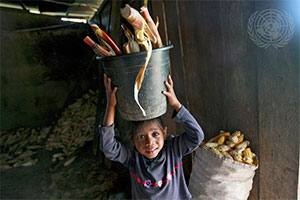 Timorese Girl with Fresh-Picked Corn. Credit: UN Photo/Martine Perret
A global common denominator is the need for a decent job. The economic realities of each country determine just how difficult it is to find one. Despite the labour movement's achievements, serious challenges persist: gender discrimination, child labour, worker migration, the digital divide and AI automation, evaporating pensions, unsafe workplaces, corporate pressure against union organising, negative impacts of trade agreements, and the precariousness of informal employment. The 2025 UN SDG Report identifies jobs and social protections as one of the six priority areas requiring urgent action, with progress either stalled or reversing in many developing nations.
In recent years, the fight to protect labour equality has taken on new dimensions with the rise of Environmental, Social and Governance standards. With the Social aspect aiming to promote equality and human rights, ESG principles have strengthened labour advocacy within corporate and governmental regulatory landscapes. In particular, ESG has become much more institutionalized in emerging economies such as Brazil and China. IPS follows the world’s workers as they confront these challenges - their setbacks and their successes.

The Week with IPS

NEXT STOP - SDGs
Tracking global progress towards a sustainable world
Tracking global progress towards a sustainable world
