Languages
Thursday, November 19, 2026



News and Views from the Global South
Labour
/INT’L MIGRANTS DAY/BANGLADESH: Women Learn Tough Lessons from Work in
With calm confidence and quiet reassurance, Mosammat Bedana Khatun encourages the women to open up. Outside it is raining heavily, the downpour splashing on the corrugated iron roof in a steady drone. The women, including Bedana, have one common context: their husbands have gone to Malaysia over the last decade in search of fortune. Many are still there.INT’L MIGRANTS DAY/ BANGLADESH: Wives at Home Worry about Husbands’ Fidelity
Hamida Begum (not her real name) of this district in northern Bangladesh has a startled look about her. She barely raises the veil from her face. The timid eyes look too prominent on her thin and sharp face./INT’L MIGRANTS DAY/PHILIPPINES: Migrant Workers’ Children Left Behind, Left Out
"Please come home this Christmas. We didn't talk the last time you were here. I was afraid of you; I didn't know how to talk to you. I want you to know that it's very difficult to grow up without a father'' - Your only girl, JessaBANGLADESH: Debate on Trade Union Activities Far from Over
The new year will see trade union activities finally being allowed in Bangladesh's export processing zones (EPZs), a step that labour rights campaigners hail as a victory but which some in the government and in business fear will be bad for business./INT’L MIGRANTS DAY/INDONESIA: Hard Knocks Turn Migrant Worker into Entrepreneur
Her years as a domestic worker overseas taught Nur Safinah one tough lesson - never to be one again. Returning to Indonesia, she then became an entrepreneur.ENVIRONMENT-COSTA RICA: From Invasive Plant to Handicraft Material
Cattails, which have invaded Costa Rica's Palo Verde National Park, an important migratory spot for birds in Central America, are now being used to produce handicrafts by a group of local women in the farming community of Bagatzí, whose efforts have contributed to the restoration of 350 hectares of marshland since 2002.TRADE: Broad Coalition Vows to Fight U.S.-Central America Pact
Representatives from trade unions, human rights and civil society groups joined U.S. legislators Tuesday in denouncing a free trade deal the United States is negotiating with five Central American nations as an official failure to address labour, environmental and public health concerns.LABOUR-KENYA: Union Leaders Enraged By Plans to Trim Civil Service
Bowing to donor pressure, Kenya has announced plans to trim its civil service by about seven percent in the next two years./INT’L MIGRANTS DAY/BANGLADESH: Dreams – and Hunger – Drive Trafficking into India
Thirty-year-old Safia Begum, a domestic worker at a high-rise apartment in the upwardly mobile Gulshan enclave of the Bangladeshi capital, has a little secret./INT’L MIGRANTS DAY/INDONESIA: Gov’t Draws Lessons from Abuse of Migrant Workers
When Hodijah left Indonesia to become a domestic worker in Saudi Arabia, all that she wanted was a way to stay away from her husband, who had forced her to marry him in exchange for rights to till a piece of land.TRADE: Report Damns El Salvador Labour Rights on Eve of U.S. Deal
Workers' rights guarantees in a proposed Central American trade pact must be strengthened, according to Human Rights Watch, which says it has documented systematic abuses by businesses of labour rights in El Salvador.DEVELOPMENT-VENEZUELA: ‘Sweet’ Ventures to Escape Poverty
Peasant farmers in Barlovento, a coastal region east of the capital where the Afro-Venezuelan culture is at its strongest, have found a sweet way to pull themselves out of poverty: producing fruit preserves and chocolate.RIGHTS-SRI LANKA: Shelter Welcomes Young Victims of Sexual Abuse
Among the homes that dot this picturesque town in Sri Lanka's central hill region is a building that has opened its doors to girls whose lives have been destroyed by their own relatives.ECONOMY-NIGERIA: Product Ban Elicits Limited Support
It has been business as usual in most Lagos markets during the past few days, even though several traders were on tenterhooks, after officials threatened to confiscate a variety of items that had been banned from sale./INT’L MIGRANTS DAY/LABOUR-SOUTH KOREA: Undocumented Workers Risk Lives to Stay
Five migrant workers are huddled together in an empty farmhouse on an isolated hill. The four men, aged in their 20s to 30s, have no light or warmth, and live on a few packets of 'ramyon' or instant noodles.JAPAN: Reports of Crime Fuel More Wariness of Foreigners
The Japanese government's wariness of foreigners in the wake of crime incidents has been rising, undercutting calls by activists for greater integration of immigrants and local businesses' demand for foreign migrant labour.ECONOMY-KENYA: Cut Debt – Not Jobs
A non-governmental organisation that lobbies for debt relief, Chambers of Justice, has renewed its appeal for cancellation of Kenya's massive external debt.CENTRAL AMERICA: Working Can Be Hazardous to Health
Occupational health protections are a mere fantasy for the 12.4 million workers in Central America, where two million work-related accidents occur every year, according to a study by the Health and Work Programme in Central America (SALTRA).ECONOMY-SOUTHERN AFRICA: A Challenging Road Ahead for Truckers
The road transportation business in Southern Africa is fraught with obstacles, in the shape of AIDS and crime. However, industry players say it is also providing opportunities for promoting black empowerment.POLITICS: U.N. Workers Question Headquarters Security
One of the first known terrorist attacks on the United Nations occurred when the late Ernesto Che Guevara, a disciple of Cuban President Fidel Castro, was at the headquarters building in New York City to address the General Assembly session in December 1964.LABOUR-SOUTH KOREA: Angry Unionists Say Protests Won’t Ease
During the day, 31-year-old Lee Yong-seok, a unionist at the Korean Labour Welfare Corp, worked as a contract worker. At night, he helped teach poor children in a community school.« Previous Page — Next Page »


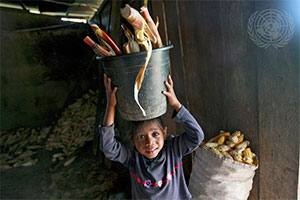 Timorese Girl with Fresh-Picked Corn. Credit: UN Photo/Martine Perret
A global common denominator is the need for a decent job. The economic realities of each country determine just how difficult it is to find one. Despite the labour movement's achievements, serious challenges persist: gender discrimination, child labour, worker migration, the digital divide and AI automation, evaporating pensions, unsafe workplaces, corporate pressure against union organising, negative impacts of trade agreements, and the precariousness of informal employment. The 2025 UN SDG Report identifies jobs and social protections as one of the six priority areas requiring urgent action, with progress either stalled or reversing in many developing nations.
In recent years, the fight to protect labour equality has taken on new dimensions with the rise of Environmental, Social and Governance standards. With the Social aspect aiming to promote equality and human rights, ESG principles have strengthened labour advocacy within corporate and governmental regulatory landscapes. In particular, ESG has become much more institutionalized in emerging economies such as Brazil and China. IPS follows the world’s workers as they confront these challenges - their setbacks and their successes.

The Week with IPS

NEXT STOP - SDGs
Tracking global progress towards a sustainable world
Tracking global progress towards a sustainable world
