Languages
Friday, November 20, 2026



News and Views from the Global South
Labour
LABOUR-VENEZUELA: General Urges Army not to Use Force
Two Venezuelan generals made public statements on the second day of a nationwide strike Wednesday - one of them urging President Hugo Chávez to resign, and the other calling for the government and the strike organisers to keep things calm.LABOUR-VENEZUELA: General Strike to Continue Wednesday
The general strike declared Tuesday by Venezuela's leading labour and business organisations against the government of Hugo Chávez, which enjoyed less support than the first nationwide stoppage, held last December, will continue Wednesday.LABOUR-VENEZUELA: Oil Lights Fuse of General Strike
Venezuela's biggest trade union and leading business association have joined forces once again to call a general strike in opposition to the government of Hugo Chávez, scheduled for Tuesday.LABOUR-VENEZUELA: Oil Conflict May Pave Way for General Strike
Work stoppages declared by white-collar employees of Venezuela's state-run oil industry may pave the way for a general strike demanding that President Hugo Chávez step down.LABOUR-JAPAN: Work Sharing Eases Pain of Losing Jobs
As Japan's labour market braces for more job cuts in the fiscal new year starting April, a much-touted "work sharing" system is emerging as an alternative to further corporate restructuring and job losses.LABOUR-CANADA: Public Workers Pension Fund Boosts Privatisation
Canada has so far resisted privatising public services on the scale of countries such as Great Britain, but there are signs that profit-makers are hungrily eyeing the huge rewards to be made, say union and NGO observers.LABOUR-SENEGAL: Arson Attack Revives Old Rifts within the Biggest Trade Union
A vicious arson attack at the headquarters of Senegal's biggest trade union organisation has revived old rifts and historical grievances.LABOUR-ARGENTINA: Workers Give New Life to Bankrupt Factories
Thousands of workers in Argentina have decided over the past two years to keep the factories where they worked running after the owners were forced into filing for bankruptcy by the acute economic crisis, in an experiment that has been tough but appears to provide a feasible long-term alternative.LABOUR/HEALTH-VENEZUELA: Doctors on Strike as Dengue Spreads
Some 23,000 Venezuelan doctors began a strike Monday to demand salary hikes and medical supplies, just when a dengue epidemic is looming and other diseases, such as malaria, are resurfacing.RIGHTS: Garment Giant Confronts Honduras Labour Allegations
North America's largest T-shirt maker is to hold talks with groups in Honduras next week on working conditions in its four factories there. The company says it has met international labour standards despite recent media reports.RIGHTS: Migrants, the Other Victims of the War on Terror
The possibility of strengthening the rights of immigrants, particularly those with "irregular" legal status, continues to diminish in the wake of the Sep 11 terrorist attacks on the United States, according to a study submitted to the United Nations Commission on Human Rights.HONG KONG: Migrant Workers Earn Extra from Sex Trade
It is Sunday night in one of the nightspots in Hong Kong's entertainment district of Wan Chai, and the place is thumping.MALAYSIA: Crackdown on Illegal Migrants in Sabah Draws Flak
They were on their way back to their homeland, but the 1,000 Filipinos deported from the eastern Malaysian state of Sabah earlier this month could hardly have been ecstatic about that trip.POPULATION-ITALY: Filipino Migrants Embrace Second Culture
Filindon was four years old and his mother Perlita, 27 when the glass doors of the Manila airport closed behind her, leaving him outside. They would meet again four years later.LABOUR-CARIBBEAN: British Come in Search of Soldiers
First they came for teachers, then nurses. Now they are in the region hunting for able-bodied men willing to serve in the British army.LABOUR-CUBA: Women Put to Test Every Day on the Job, at Home
More and more Cuban women hold executive and management posts in the workplace, but they have to prove every day that they can do the job better than any man, say women's groups and government officials.THAILAND: Work-Related Illnesses Leave Labourers with Few Options
"I had been in and out of the hospital for seven years before I found out what was really wrong with me, and my life has never been the same again," said 43 year-old Somboon Srikhamdokkhae, who worked for 20 years at a textile factory here in the Thai capital.LABOUR-JAPAN: Full-time Homemaking on the Way Out
Before leaving home for her part-time job as a shop assistant, Asako Mita, 33, completes a few domestic chores. These include waking up at 5 a.m. to cook breakfast and make four lunches for her children and husband.OIL-VENEZUELA: The Goose that Lays the Golden Eggs Rebels
The management of Venezuela's state-owned oil company, the "goose that lays the golden eggs," is staging a rebellion against President Hugo Chávez, who is already facing heavy opposition from a broad spectrum of society.VENEZUELA: Business, Trade Unionists Sign Anti-Chavez Pact
Venezuela's leading business association and trade union, with the backing of the Roman Catholic Church, signed a pact Tuesday demanding a radical shift in President Hugo Chávez's policies.LABOUR-SOUTH KOREA: Jobs Bring Income, but Splits Families
During the six years she worked in South Korea, Connie (not her real name) sent 400 U.S. dollars every month to her family in the Philippines, so they could invest it in a store that would finance their daily needs and help secure her children's future.« Previous Page — Next Page »


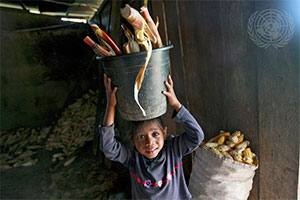 Timorese Girl with Fresh-Picked Corn. Credit: UN Photo/Martine Perret
A global common denominator is the need for a decent job. The economic realities of each country determine just how difficult it is to find one. Despite the labour movement's achievements, serious challenges persist: gender discrimination, child labour, worker migration, the digital divide and AI automation, evaporating pensions, unsafe workplaces, corporate pressure against union organising, negative impacts of trade agreements, and the precariousness of informal employment. The 2025 UN SDG Report identifies jobs and social protections as one of the six priority areas requiring urgent action, with progress either stalled or reversing in many developing nations.
In recent years, the fight to protect labour equality has taken on new dimensions with the rise of Environmental, Social and Governance standards. With the Social aspect aiming to promote equality and human rights, ESG principles have strengthened labour advocacy within corporate and governmental regulatory landscapes. In particular, ESG has become much more institutionalized in emerging economies such as Brazil and China. IPS follows the world’s workers as they confront these challenges - their setbacks and their successes.

The Week with IPS

NEXT STOP - SDGs
Tracking global progress towards a sustainable world
Tracking global progress towards a sustainable world
