Languages
Wednesday, November 11, 2026



News and Views from the Global South
Natural Resources

The Silent, Invisible Crisis Destabilising Communities Could be a Subject of Hope
New data show that globally two billion hectares of land—roughly twice the size of China—have been degraded. And of this amount, 500 million hectares are abandoned agricultural lands.
Desertification, Land Degradation and Climate Change Go Hand in Hand
The link between desertification, land degradation and climate change is among several issues occupying the attention of the 197 Parties to the United Nations Convention to Combat Desertification (UNCCD) for the next three days.
Bringing Greener Pastures Back Home
One month on since the Global Compact for Migration was approved, civil society has highlighted the need to turn words into action, supporting those who have been displaced or forced to migrate as a result of environmental degradation.
Asia’s Landlocked
Structural economic transformation and the expansion of international trade are among the most pressing issues to be addressed, if Asia’s landlocked developing countries (LLDCs) are to overcome the development challenges related to their geographical locations.
Eat Plants, Save the Planet
While the modern agricultural system has helped stave off famines and feed the world’s 7 billion residents, the way we eat and produce food is posing a threat to future populations’ food security.
Getting Sustainable Development Back on Track in Asia & the Pacific
2019 will be a landmark year for the United Nations 2030 Agenda for Sustainable Development. Four years will have passed since world leaders adopted the Sustainable Development Goals (SDGs). Four years since governments recommitted themselves to eradicating extreme poverty, improving universal health care coverage, education and food security, and achieving a sweeping set of economic, social and environmental objectives. Long enough to assess our direction of travel and then refocus work where progress is falling short.
Restoring Ghana’s Mangroves and Depleted Fish Stock
It was just three and a half years ago that the Sanwoma fishing village, which sits between the sea and the mouth of the Ankobra River on the west coast of Ghana, experienced perpetual flooding that resulted in a loss of property and life.
Costa Rica: First Country to Protect Sustainable Fisheries of Large Pelagics Species
Twelve years ago, in a restaurant in Puntarenas on the pacific coast of Costa Rica, a group of long line fishermen met with three UNDP conservation specialists.
Indonesia Commits to Low Carbon Development and a Green Economy at COP24
Although Indonesia has attained decent economic growth of over five percent in the last decade, in order to ensure sustainable growth in the future the switch to renewable energy (RE) will be critical, says the country’s government.
Middle Eastern Countries Can Overcome Pressing Challenges By Developing a Blue Economy
The Blue Economy is becoming an ‘El Dorado’, a new frontier for traditionally arid and water-stressed nations in the Middle East and North Africa (MENA), according to Christian Averous, Vice President of Plan Bleu, one of the Regional Activity Centres of the Mediterranean Action Plan developed under the United Environment Regional Seas Programme.
The Revolution of Renewable Energy Needs Political Leadership
The cost of renewable energy is low, and at times, less than fossil fuels. What are the barriers to switching to renewables? Where current energy systems exist, they will need to be upgraded to be able to draw power from modern renewables and to exploit storage solutions that they require.
Q&A: Creating an African Bamboo Industry as Large as China’s
The bamboo industry in China currently comprises up to 10 million people who make a living out of production of the grass. But while the Asian nation has significant resources of bamboo — three million hectares of plantation and three million hectares of natural forests — the continent of Africa is recorded to have an estimated three and a half million hectares of plantations, excluding conservation areas.
Climate Action Should be a Global Priority for World Leaders
The IPCC report says that it is not impossible to limit climate change to 1.5͒C? Do you think we can realistically achieve that? Politically, what needs to happen? History shows that when the human race decides to pursue a challenging goal, we can achieve great things. From ridding the world of smallpox to prohibiting slavery and other ancient abuses through the Universal Declaration of Human Rights, we have proven that by joining together we can create a better world.
Get Ready for COP24: Transition to a Sustainable Future
COP24 is the time for governments to act and increase their pledges to prevent global warming ensuring a just transition that leaves no one behind.
Limiting Climate Change to 1.5 C is not Impossible, Says IPCC Chair
When governments set a target in December 2015 of limiting global warming to well below 2ºC above pre-industrial levels while pursuing efforts to hold it at 1.5ºC, they invited the IPCC to prepare a report to provide information on this Goal.
Fish Farming Takes on Crime in Papua New Guinea
In the rugged mountainous highlands of Papua New Guinea in the southwest Pacific Islands fish farming has transformed the lives of former prisoners and helped reduce notorious levels of crime along the highlands highway, the only main road which links the highly populated inland provinces with the east coast port of Lae.
Marine Waste is Turning the Earth into a Plastic Planet
Africa risks being the worst plastic-polluted place on earth within three decades overtaking Asia, says a continental network calling for African contributions to solving the growing threat of marine waste.
Over Half of the World’s Tropical Forests Have been Destroyed, Say Conservationists
Biodiversity conservationists have revealed that at least 10 more percent of land than what is currently being used to grow green crops will be required to successfully replace fossil fuels with alternatives derived from natural sources such as biofuel.
Indigenous Leaders are Calling for New Global Agreement to Protect Amazon
Leaders of Amazon’s indigenous groups are calling for a new global agreement to protect and restore at least half of the world’s natural habitats.
Q&A: The Arrival of the African Blue Economy as a Real Prospect
The first every global conference to address the twin focuses on both conservation and economic growth of the oceans has fulfilled the broad range of expectations it set out to define.
‘What Fish Can Do for the WTO’
Fish will soon be off the menu, unless global leaders strike a deal ending multi-billion dollar harmful fisheries subsidies blamed for threatening world fish stocks and widening the inequitable use of marine resources.« Previous Page — Next Page »





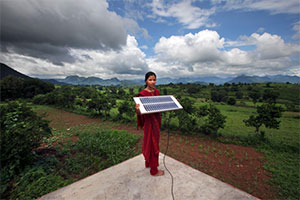 Bringing clean energy to rural India. Credit: Abbie Trayler-Smith / Panos Pictures / Department for International Development
Large reserves of oil, gas and minerals in developing countries generate opulent revenues. They could be used to stimulate economic growth and reduce poverty, but often result in environmental destruction and conflict, benefiting large companies and corrupt governments. Furthermore, competition over natural resources often manifests through geopolitical conflict. For example, before the US-Iraq war, Iraq’s domestic oil industry was nationalized. With US aggression came weakened Iraqi institutions and foreign intervention, thus eventually leading to the privatization of Iraqi oil, leaving the industry now largely dominated by Western companies. As another example, China’s rising investments within the lithium sector in South America are increasing the US-China rivalry across the Western Hemisphere. Notably, Bolivia has the largest reserves of lithium in the world, and the nation’s state-owned lithium extraction firm recently signed a contract with China’s CBC Consortium, while rejecting the entry of Western firms into the nation. In Bolivia’s case, rising Chinese investment in the nation’s lithium sector also raises concerns about environmental sustainability and the sociopolitical rights of Indigenous communities. More broadly, Sub-Saharan Africa holds nearly 30% of global reserves of critical minerals required for low-carbon technologies. Despite this, the region attracts less than 10% of global exploration investment, depicting a critical barrier to both the clean energy transitions and Sub-Saharan Africa’s economic development. Furthermore, resource wealth continues to fuel conflict like Sudan’s civil war, which has led to 9.1 million internally displaced people and is intensely connected to competition over gold, water, and agricultural land. IPS covers news about major oil, gas, and mining projects, their effects on the environment and local communities, and the ideas and actions of the interest groups involved.

The Week with IPS

NEXT STOP - SDGs
Tracking global progress towards a sustainable world
Tracking global progress towards a sustainable world
