Languages
Wednesday, October 21, 2026



News and Views from the Global South
Trade & Investment

NGOs Seeking a Monterrey+20 Summit on Financing for Development
This week, exactly 20 years ago, world leaders adopted the United Nation’s Monterrey Consensus. They committed to “Confronting the challenges of financing for development” with a global response and to creating a fully inclusive and equitable global economic system.
Stagflation Threat: Be Pragmatic, Not Dogmatic
“If your only tool is a hammer, every problem looks like a nail”. Still haunted by the clever preaching of monetarist guru Milton Friedman’s ghost, all too many monetary authorities address every inflationary threat or sign they see by raising interest rates.
Inflation Targeting Voodoo
All over the world, people expect policies by central bankers trained in economics to have a sound scientific base. But in fact, inflation targeting is an article of faith with neither theoretical nor empirical basis.
Financialization at Heart of Economic Malaise
COVID-19 has exposed major long-term economic vulnerabilities. This malaise – including declining productivity growth – can be traced to the greater influence of finance in the real economy.
Inflation Paranoia Threatens Recovery
Inflation hawks are winning the day. The latest ‘beggar thyself’ race to raise interest rates has begun. This ostensibly responds to the spectre of runaway inflation, supposedly retarding economic growth and progress, and thus threatening central bank ‘credibility’.
China Opens Embassy in Nicaragua for First Time since 1990 after Taiwan Ties Cut
For the first time since 1990, China has (re)opened an embassy in Managua, Nicaragua, less than a month after Nicaragua cut ties with Taiwan. The (re)opening of the embassy on January 1, 2022 comes amidst the backdrop of US-China tensions, particularly over trade and Taiwan, as well as worsening Cross-Straits relations.
Ecstasy as Zimbabwe’s Smallholder Farmers Secure European Pineapple Market
In her wildest dreams, smallholder farmer Sarudzai Sithole never imagined that her pineapples could someday stock the produce section of Europe’s finest supermarkets.
What Explains Vaccination Rates in EBRD Regions?
Officially reported deaths from Covid-19 started to rise again in autumn 2021 in a number of economies in the EBRD regions. While in advanced economies in Europe the mortality rate has remained low despite the pick-up in Covid-19 cases, in the EBRD regions the mortality and infection rates continued to move in tandem.
Africa Should Bargain Hard for COVID Vaccine Equity: Lessons from Indonesia during Avian Flu
Many countries around the world have punished most of the African continent for the scientific discovery of the Omicron variant through the imposition of travel bans.
Corporate Fear Drives Caribbean Vaccine COVID-19 Mandates
When face-to-face Cabinet meetings resumed in Jamaica following more than a year of virtual meetings due to COVID-19, Ministers lined up to have their immunisation cards inspected.
Experts call for Improved Protection of African Fisheries
With subsidies of global fisheries back on the World Trade Organisation’s agenda, experts are calling for African governments to upscale the protection of the sector long plagued by activities that continue to threaten the continent’s blue economy.
Fair Tax Plan Could Prejudice Global South
An agreement between 136 countries aimed at forcing the world’s biggest companies to pay a fair share of tax has been condemned by critics who say it will benefit richer states at the expense of the global South.
Stop Calling the Military Budget a ‘Defense’ Budget
It’s bad enough that mainstream news outlets routinely call the Pentagon budget a “defense” budget. But the fact that progressives in Congress and even many antiwar activists also do the same is an indication of how deeply the mindsets of the nation’s warfare state are embedded in the political culture of the United States.
The End of World Bank’s “Doing Business Report”: A Landmark Victory for People & Planet
The September 16, 2021 announcement from the World Bank that it had discontinued publication of the Doing Business Report (DBR) marked a major victory for people and planet.
With the World Bank’s “Doing Business” Out of Business, What Should Come Next?
Last week the World Bank announced it was “discontinuing” its “Doing Business” report, which ranks countries on the ease of opening and operating a company.
Allow Least Developed Countries to Develop
The pandemic is pushing back the world’s poorest countries with the least means to finance economic recovery and contagion containment efforts. Without international solidarity, economic gaps will grow again as COVID-19 threatens humanity for years to come.
World Bank Looks to Trains in Argentina’s Climate Battle
Argentina will receive a 347 million dollar loan from the World Bank to upgrade one of the most important suburban railway lines in the city of Buenos Aires. The operation is part of the multilateral lender’s new policy, which deepens its commitment to the fight against climate change.
African Farmers Could Benefit from More Friendly EU Agriculture Policies
Gilbert Bor manages a small farm in the western highlands of Kenya. Landscapes are hilly, village roads lined with pine trees, his cows mostly of the Friesian breed. He is up at 6:00am daily to lead his animals through the woods into the valley below.
China Struggles with Socio-environmental Standards in Latin America
In southeast Mexico, work on the Yucatan Solar Park, owned by the Chinese company Jinko Solar, has been halted since 2020 for lack of proper consultation with indigenous communities, after affected local residents filed an injunction against the project.
Stepping Up to Meet Low-Income Countries’ Pandemic Recovery Needs
Low-income countries have been hard hit by the pandemic. Their large financing needs are only likely to grow as they deal with the crisis and its economic aftermath.
Why is the UK Government Turning off the Tap During a Global Pandemic?
The UK government’s decision to reduce its Official Development Assistance (ODA) budget from 0.7% of gross national income (GNI) to 0.5% -- a cut of around £4 billion this year -- was confirmed last week by a majority of 35 votes in a House of Commons vote.« Previous Page — Next Page »





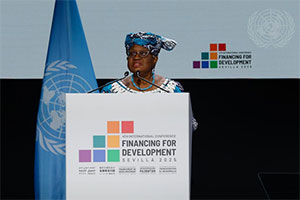 Opening of 4th International Conference on Financing for Development. Credit: UN Photo/Mariscal
International trade and investment are crucial elements of the world economy. While they can be powerful stimulators of development, they can also lead to global imbalances and dynamics of exploitation. In 2025, international trade entered a period of immense disruption, driven in part by a new wave of United States tariffs that reshaped global supply chains and investment flows. The increase in the US tariff rate, the highest since the 1930s, has forced bilateral renegotiations with global trading partners. Furthermore, the debt crisis in developing nations has accelerated while Official Development Assistance (ODA) has substantially dropped 7.3% in 2024.
In the 21st century, advancements in economic diversification in formerly colonized nations have propelled them into more central roles in the global economy. For example, both China and Mexico were able to develop their manufacturing sector and channel this development into booming export flows, thus advancing into the position of emerging economies. Foreign investment also plays an essential role in providing capital for developing countries, although they are oftentimes accompanied by social and environmental exploitation. For example, rising Chinese investments in natural resources in Latin America have often been met with tension as these investment projects fail to properly mitigate environmental risks and protect workers’ rights. In a more multifaceted vein, Sino-African relations have led to infrastructure development in Sub-Saharan Africa while also heightening the region’s economic dependency on China. IPS reports on global news in trade and investment, while shining a light on the nuanced nature of these endeavors.

The Week with IPS

NEXT STOP - SDGs
Tracking global progress towards a sustainable world
Tracking global progress towards a sustainable world
