Languages
Wednesday, September 30, 2026



News and Views from the Global South
Multimedia

Only Days Old and Fleeing for Their Lives
 A video of twin babies, not more than a few days old, brought along with the fleeting mass of Rohingyas has taken the internet by sympathy.

Europe, New Border of Africa’s ‘Great Desert’ – The Sahara
With the highest temperatures on record and unprecedented heat waves hitting Europe this year, Africa’s ‘Great Desert’, the Sahara, is set continue its relentless march on the Southern European countries until it occupies more than 30 per cent of Spain just three decades from now.

On Climate Finance, “The SIDS Can’t Wait”
Saint Lucia's Prime Minister Allen Chastanet warns that the clock is running out for small states such as those in the Caribbean as they struggle to develop infrastructure capable of withstanding changes in weather conditions - and that wealthier nations need to step up levels of aid. 
2017 World Water Week: ‘Water and Waste: Reduce and Reuse’
With a growing global population, a rise in energy and industrial production, the demand for water is reaching new levels. 
New Tool Separates Wheat from Chaff for Climate-Smart Ag Finance
Climate-smart agriculture seeks to achieve food security and broader development goals under a changing climate and increasing food demand. 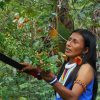
This Is How Indigenous Peoples Help Curb Gas Emissions, End Hunger
A third of global forests, crucial for curbing gas emissions, are primarily managed by indigenous peoples, families, smallholders and local communities, according to the United Nations.

Diving for a Living
Would you believe that some people still make a living out of diving in ponds and water bodies to recover jewellery or precious possessions lost by bathers?

Migrants Crossing US-Mexico Border Dying at Faster Rate. More Deaths in Mediterranean
While the number of migrants deaths in the Mediterranean Sea has so far in 2017 exceeded 2,350 victims for the fourth consecutive year, migrants crossing the United States-Mexico border are dying at a faster rate in 2017 than in past years, the UN migration agency reports.

International Day of the World’s Indigenous Peoples
Over the centuries, Indigenous peoples who have in-depth and locally rooted knowledge of the natural world , have been increasingly dispossessed of their lands, territories and resources and have lost control over their own way of life. 
A Green Energy Shift in Barbados, One Streetlight at a Time
The ever-escalating and volatile price of oil, and the high cost of importation, have left Barbados and other island nations in the unenviable position of having the highest electricity prices in the world. 
Migrants – The Increasingly Expensive Deadly Voyages
They borrow huge amounts of money. They sell all their modest properties. They suffer brutalities on the hands of their own countries “security” forces to prevent them from fleeing wars, droughts, floods, lack of food, extreme poverty.

Halting Sexual Exploitation of Children in Tourism, Mission Impossible
While the business sector jumps for joy as the number of tourists grew in 2016 for the seventh consecutive year to reach 1.2 billion, and as the first four months of 2017 have registered 6 per cent increase, the sheer speed, abetted by technology, of an atrocious crime—the sexual exploitation of children in tourism, has, to date, out-paced all attempts to put an end to it.

Not Just Numbers: Migrants Tell Their Stories
Every single day, print and online media and TV broadcasters show images and footage of migrants and refugees adrift, salvage teams rescuing their corpses--alive or dead, from fragile boats that are often deliberately sunk by human traffickers near the coasts of a given country. Their dramas are counted –and told-- quasi exclusively in cold figures.

‘Address African Rural Youth Unemployment Now or They Will Migrate’
In 2014 alone, about 11 million young Africans entered the labour market. But many see few opportunities in the agriculture sector and are constrained by a lack of skills, low wages, and limited access to land and financial services. Combined, this makes them more prone to migrate from rural areas.

Any Way to Help Slow Down Climate Change… Individually?
It is no secret that the biggest responsible for climate change is greed. The greed of the world’s largest private corporations, which blindly seek unlimited high financial benefits. And the greed of those politicians who are also blindly keen about holding their temporary power at any cost, thus not daring to challenge big business. Ordinary people can meanwhile help slow down such a hellish race.

SLIDESHOW: When Women Have Land Rights, the Tide Begins to Turn
 In Meghalaya, India’s northeastern biodiversity hotspot, all three major tribes are matrilineal. Children take the mother’s family name, while daughters inherit the family lands.
Deaths in Hills: Why and How
Hill cutting for illegal establishments is one of the key reasons behind the recent series of landslides in Rangamati, the worst in a decade that killed at least 120 people.

VIDEO: Yusra Mardini, A Young Refugee, Finds Safety in Her New Home
The United Nations Department of Public Information has launched a new animated video on the dramatic story of Yusra Mardini, a young refugee from conflict-torn Syria who achieved her dream to compete in the Olympics last year. Yusra Mardini was appointed as a Goodwill Ambassador for the United Nations High Commissioner for Refugees, the UN Refugee Agency (UNHCR) on 27 April 2017. The video was produced by the Education Outreach Section in support of the Together Initiative to mark World Refugee day on 20 June and highlight the advent of the International Day of Peace on 21 September. 
VIDEO: World Day to Combat Desertification
Today’s world is facing an unprecedented level of human mobility and migration is high on the political agenda all over the world. 
5 Devastating Cyclones in Bangladesh
Bangladesh, the delta country, has been in the line of a few devastating tropical cyclones. In their trail, the cyclones have left behind complete chaos, death and despair. As the country learns to adapt and respond to this natural disaster more efficiently, we take a look back at some of the worst tropical cyclones to have hit the country.

Change Maker: The Good Shepherd
Two months into her pregnancy, Farida Khatun suffered a fate all too familiar yet often glossed over; her husband, Atar Mia, left her and went off to marry another woman. Given this was sometime in the early 80s, Farida Khatun could have been forgiven for resigning to a future full of gloom. But like the rose that grows from concrete, Farida's resilience would spur her on to blossom to not only survive the odds stacked against her but resoundingly conquer them. And all that with a lamb purchased for Tk 80.
« Previous Page — Next Page »


The Week with IPS

NEXT STOP - SDGs
Tracking global progress towards a sustainable world
Tracking global progress towards a sustainable world
