Languages
Saturday, September 26, 2026



News and Views from the Global South
Arabs Rise for Rights
MIDEAST: How Israel Misses Mubarak
As Israel's public television aired live pictures of crowds of elated Egyptians celebrating the ousting of President Hosni Mubarak, the anchor suddenly had a telling twist of tongue.
EGYPT: Joy Erupts, Now for Change
The reaction across Egypt was explosive. The anger that had been simmering for decades and boiled over during 18 consecutive days of protests, was transformed by a single uttered sentence into pure jubilation.EGYPT-U.S.: The Brotherhood Bogeyman
While the many and far-reaching implications of Friday's transfer of power to what is apparently a military junta in Egypt have yet to be absorbed here, the role of the Muslim Brotherhood in any transition to a more democratic regime is certain to figure high on the political agenda.Gap Widens Between U.S. and Arab World
Arab public opinion will become increasingly difficult for the United States to favourably influence in light of recent regional unrest, according to experts speaking at a conference organised by the Brookings Institute on Wednesday.All Eyes on Egypt’s High Command
After 30 years in power, a handful of assassination attempts, the historical backing of five United States presidencies, 68 billion dollars in U.S. aid and 18 consecutive days of massive, pro-democracy demonstrations, Egyptian President Hosni Mubarak finally ceded power Friday, leaving observers in Washington wondering what happens next.Egypt’s U.S.-Armed Military in Transitory Commanding Role
When embattled Egyptian President Hosni Mubarak reluctantly called it quits after more than two weeks of mass demonstrations against his 30-year-old authoritarian regime, he temporarily turned over the country to an institution trained, armed and nurtured by the United States: the 350,000- strong military.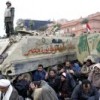
UPDATE: People Power Pushes Mubarak Out
Several hundred thousand protesters massed in Cairo's central Tahrir Square exploded into joy Friday, after Vice-President Omar Suleiman made the announcement that Hosni Mubarak had resigned as president of Egypt after three decades in office.EGYPT: Mubarak ‘Out of Touch With Reality’
In a televised address late Thursday night, embattled Egyptian President Hosni Mubarak delegated executive authority to his newly-appointed vice-president, but stopped short of stepping down. The announcement enraged anti-Mubarak demonstrators in Cairo's Tahrir Square, who say they will maintain their uprising - now in its 18th day - until Mubarak's unconditional resignation.
Arab Women Lead the Charge
Asmaa Mahfouz, a 26-year-old Egyptian woman who two weeks ago had only one name, now boasts at least three. These include "A woman worth 100 men", "The girl who crushed Mubarak" and "The leader of the Egyptian revolution".
EGYPT: Labour Unrest Feeds Growing Protests
President Hosni Mubarak's speech Thursday night in which he refused to quit has provoked anger and could spark further unrest. Massive demonstrations, and pitched battles between pro-democracy protesters and the regime’s security forces, have already been intensifying in every corner of the country.Jordan Feels a Jolt
The wave of political protests that has struck parts of the Middle East and North Africa over the past few weeks has also affected the Hashemite Kingdom of Jordan. The protest movement here, initiated in the wake of the Tunisian Jasmine revolution, underscores the population’s demand for political reform.EGYPT-U.S.: Washington Voices Impatience with Regime
Amid the continuing stand-off between protestors and the Egyptian government, the administration of U.S. President Barack Obama appeared Wednesday to be losing patience with both President Hosni Mubarak and his new vice president, Gen. Omar Suleiman.Environmental and Demographic Forces Threaten State Failure
Uprisings in Tunisia, Egypt, and across the Middle East at the start of 2011 have reminded the world just how politically fragile some countries are. But the focus of international politics has been shifting for some time now.
EGYPT: Muslims and Christians Protest as One
Over recent years, Egypt has witnessed mounting tension between its Muslim majority and its sizeable Coptic Christian minority. But in Cairo's Tahrir Square, the site of ongoing mass protests against the ruling regime, members of both faiths chant in unison: "Muslim, Christian, doesn't matter; We're all in this boat together!"Behind the Spin, Egypt Gives Tehran Political Heartburn
Judging from official propaganda in both Iran and much of the Arab world, the uprisings that toppled Tunisia's dictatorship and threaten Egypt's authoritarian regime are the direct descendent of the 1979 Islamic Revolution.Hungry Gazans Feed Egyptian Troops
Mustapha Suleiman, 27, from J Block east of the Rafah crossing with Egypt, crosses through gaps in the iron fence on the border carrying bread, water, meat cans and a handful of vegetables for Egyptian soldiers stationed on the other side.Brutal Crackdown in Belarus
Repressions in Europe’s last dictatorship show no signs of abating despite EU sanctions and international condemnation. International rights watchdogs warn that human rights abuses in Belarus have reached a "new low", and activists say that no one appears safe from Alexander Lukashenka’s brutal crackdowns in the wake of his controversial re-election as president.
EGYPT: Mubarak’s Fate in Military Hands
Make no mistake about it - Egyptian President Hosni Mubarak will stay in power only as long as his army generals deem it to be in their best interest.EGYPT-U.S.: Washington Fumbles Messaging
Only four days ago, the administration of President Barack Obama appeared to be siding with the hundreds of thousands of Egyptian demonstrators calling for a quick end to Hosni Mubarak's 30-year reign, even if it didn't call explicitly for the Egyptian president to resign.
Palestinian Streets Quiet as PA Suppresses Protests
The Palestinian Authority (PA) is using brute force and intimidation tactics - similar to those deployed in Cairo - to suppress pro-Egyptian and Tunisian protests in the West Bank.
EGYPT: Political Energy Powers Exhausted Protesters
Tens of thousands of protesters continue to occupy Cairo's Tahrir Square to demand the ouster of longstanding President Hosni Mubarak. The regime is waging a war of attrition aimed at exhausting demonstrators - and the population at large. But the protest is holding firm.« Previous Page — Next Page »


The Arab Spring has changed the Arab seasons that have followed; it had to. The struggle continues in Syria; in Tunisia, Egypt, Libya and in countries that did not change that dramatically, such as Bahrain and Yemen, the political world, and the tone of society itself has changed. IPS has not left these countries with the headlines that accompanied cataclysmic changes. We continue to track changes closely, always keeping in our sights first the rights of peoples, and then reporting changes from fresh, newsy and human perspective.

Middle East & North Africa


