Languages
Friday, November 20, 2026



News and Views from the Global South
North America
MIDEAST: A Good Time Not to Make Peace
Most analysts agree that the past week of Middle East diplomacy has actually set back the cause of peacemaking. If they are right that the intensive U.S.-led effort has actually diminished prospects for a breakthrough towards Palestinian-Israel peace, who is to blame?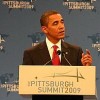
G20: Leaders Agree on Reforms, Poor Still "Out in the Cold"
World leaders at the two-day G20 Summit in the U.S. city of Pittsburgh agreed to work cooperatively to recover from the global economic crisis and create structural reforms with long-term growth as the goal.US-MIDEAST: A Week of Dimming Peace Prospects
Eight months after Barack Obama launched his presidency by promising a speedy push for Palestinian-Israeli peace, that effort has stalled badly. And there are now growing fears that the top levels of Obama's peace team are torn by internal disagreements that may undermine the whole peace effort.IRAN: New Nuke Charges Raise Stakes in Upcoming Talks
Charges by U.S. President Barack Obama and the leaders of France and Britain Friday that Iran is building a secret underground plant to enrich uranium appear certain to heighten tensions just days before critical talks between Tehran and its three accusers, as well as Germany, China and Russia.
G20: Rising Above the G8
Something that was perhaps only half-expected has happened in Pittsburgh: the G20 has moved on from being an event to becoming an institution.G20: Europeans Resist More Clout for South in IMF
An initiative to reform the International Monetary Fund (IMF) voting structure is causing tension at the G20 here as European delegations resist a U.S.-spearheaded effort to give greater clout to emerging economies, primarily because it would decrease European voting power.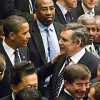
POLITICS: Obama Seeks U.N. Backing for Nuke-Free World
When Barack Obama chaired a summit meeting of the Security Council Thursday - a historic first for a U.S. president - his primary motive was to push for his ambitious, long-term agenda for "a world without nuclear weapons".POLITICS: Obama's Deal-Making Skills Tested at U.N., G20
U.S. President Barack Obama will make his way Thursday from the U.N. General Assembly in New York to "Steel City" – Pittsburgh, Pennsylvania - to host the G20 Summit in what has been billed as a week that will put his ability to lead in the international arena to its fullest test.G20: An Emerging Development
Almost before anyone knew it, a new language has become current leading up to the two-day G20 meet in Pittsburgh that divides the world in ways that seem suitable at the high table of the day. The new tiers are the developed, the emerging, and of course the poor.CLIMATE CHANGE: Time Running Out on Vows to Act, Scientists Warn
Promises are easy to make. But promises by world leaders will not halt the heat-trapping carbon emissions that are dialing-up global temperatures and altering the climate, say critics and climate researchers meeting in this U.S. Midwestern city.POLITICS: "World Must Move In a New Direction," Obama Tells U.N.
Is the United States willing to give up its role as the world's most powerful cop? The message delivered by U.S. President Barack Obama to the U.N. General Assembly suggests that it's quite likely.ENVIRONMENT: Women on Front Lines of Climate Week
Women's voices remain highly underrepresented in the climate change debate, say international civil society leaders attending events taking place around the United Nations Climate Summit Tuesday.US-MIDEAST: Has Netanyahu Out-Manoeuvred Obama or Vice Versa?
While Israeli officials claimed a major win in U.S. President Barack Obama's decision to shelve his long-held demand for a freeze on Israeli settlements on the West Bank and East Jerusalem, some analysts here believe it may yet prove a Pyrrhic victory for the hard-line government of Prime Minister Binyamin Netanyahu.POLITICS-ITALY: From Democracy to Videocracy
Italian Prime Minister Silvio Berlusconi, one of the world's most powerful media moguls, is being increasingly accused of using his six news organisations and television channels to manipulate the country's political life and public opinion.IRAN: Poll Finds Public Support for Nuke Power over Weapons
A poll released Tuesday shows that Iranians are still strongly in favour of continuing their government's nuclear programme, but are open to compromises which would permit uranium enrichment while allowing international inspectors access to ensure that no bomb-making activities are taking place if sanctions are dropped.POLITICS: U.S. Afghan Campaign Plan Says Key Groups Back Taliban
The leak of the "initial assessment" of the war in Afghanistan by Gen. Stanley A. McChrystal, the top commander in the war, with its blunt warning that "[f]ailure to provide adequate resources" is likely to result in "mission failure", was part of an obvious effort to force the hand of a reluctant President Barack Obama to agree to a significant increase in U.S. troops.MIDEAST: U.S. Pushing Beyond Settlement Freeze
"Nobody can usurp the right to determine the fate of the nation on their own - not the Palestine Liberation Organisation, nor anyone else. It is the will of the Palestinian people that must determine our future," declares Hamas political leader in Gaza Ismail Haniyeh.HONDURAS: U.S. Appeals for Calm, Repeats Support for Zelaya
Confirming that that exiled Honduran President Manuel Zelaya has secretly returned to Tegucigalpa, the U.S. State Department Monday appealed for calm and reiterated its recognition that he is the legitimate president.CUBA: Peace Concert Bridges Borders and Differences
Although it was the target of threats from radical Cuban exiles and the focus of controversy and opinion polls from the moment it was announced, Colombian musician Juanes' idea of staging his "Peace without Borders" concert in Cuba proved a success at promoting understanding, in spite of differences.US-CUBA: Five Decades of an Admittedly Failed Policy
U.S. citizens of Cuban descent are once again free to travel to Cuba and send an unlimited amount of money to their relatives on the island, but for the most part U.S. policy toward the communist nation hasn't changed under President Barack Obama.POLITICS: Obama to Prioritise Africa During U.N. Visit
When Barack Obama visits the United Nations on three consecutive days this week - a rare gesture by a U.S. president - he will be addressing delegates on subjects ranging from climate change and peacekeeping to nuclear non-proliferation and the global financial crisis.« Previous Page — Next Page »





The Week with IPS

NEXT STOP - SDGs
Tracking global progress towards a sustainable world
Tracking global progress towards a sustainable world
