Languages
Saturday, November 14, 2026



News and Views from the Global South
Education
JAPAN: Education Bill Sets Patriotism Over Individualism
Hiroo Miyamoto, 60, a retired businessman, follows with keen interest the ongoing debate on revising Japan's post-war education policy that emphasises individual rights and democracy over patriotism.LABOUR: Decent Work Still the Exception to the Rule
More than a decade after the U.N. World Summit for Social Development in Copenhagen, where leaders first voiced the need to put decent employment at the centre of development, joblessness continues to rise, reaching new heights of nearly 192 million people in 2005.INDIA: High Salaries Can Reverse Brain Drain
Talent hunters from the big global names in business and finance, who regularly scout India's top business schools, are suddenly finding themselves competing with local companies, ready to match the top dollar salaries.HEALTH: Half of World’s Underweight Children in South Asia
Poor nutrition remains a global epidemic that contributes to the deaths of some 5.6 million children under five every year - more than half of all child deaths, according to a new report launched by the U.N. children's agency UNICEF Tuesday.EDUCATION-LATIN AMERICA: A Great Opportunity
The countries of Latin America and the Caribbean should take advantage of the fact that they have achieved virtually universal primary education, and that the school-age population is shrinking, to better orient funding and improve quality, according to United Nations experts.CUBA: Bringing Theatre to Remote Communities
In a small village surrounded by Cuba's largest wetland, the Korimakao Community Arts Group puts on high quality performances combining theatre, dance, music, lights, sets and costumes, making the same effort they would make if they were in the most prestigious theatre in the capital.BRAZIL: Social Forum Points to Different Ways of Educating
Making full use of neighbourhood resources to educate youngsters and developing rural education that respects local values and knowledge are several new ways of educating that were demonstrated at various sessions of the Brazilian Social Forum on Friday, the first day of the three-day gathering.KENYA: Mother Tongue Education Both Effective and Elusive
A debate about the extent to which mother tongue schooling improves the quality of education is emerging in Kenya, with certain experts campaigning for children's mother tongue to be used as the language of instruction in schools.EDUCATION-LATIN AMERICA: Let’s (Not) Talk About Sex
Although many countries in Latin America have laws stating that sex education must be made available in primary and secondary schools, these are implemented in a haphazard way, and in some cases not at all.HEALTH-AFRICA: “An Opportunity to Change the Course of History”
An Africa-wide campaign has been launched to halt HIV infections, this as the continent continues to be the worst affected by AIDS globally.INDONESIA: Law Awaited to Protect Child Domestic Workers
''Every time my employer wanted to wake me up from sleep she would kick me,'' said 17-year-old Sayuti, speaking of relations between herself and her actress employer.EDUCATION-CHILE: Alarm over Violent Hazing in Universities
The Southern University of Chile in Valdivia has organised an internal contest for the most creative and positive proposals for the reception of new students, in response to the increasing violence of initiation rites that left ten students with acid burns this year.EDUCATION-AFRICA: Spare the Plough, and School the Child
Delegates to a workshop held recently in the Kenyan capital, Nairobi, have highlighted concerns about how child labour is undermining efforts to achieve universal primary education.EDUCATION: Women Key to Literacy in the Home
"A literate woman makes a literate family," says Cuban teacher Leonela Relys, who created a successful method for teaching reading and writing, which can be adapted to different languages and cultures.CHILE: Comprehensive Care for Victims of Domestic Violence
Experts applauded the Chilean government's decision to provide comprehensive care for victims of domestic violence, although they warned of the enormous challenges remaining in this country and the rest of Latin America, where a large proportion of women have experienced violence at some time in their lives.EDUCATION: Respect the Right to Schooling – Honour Teachers
An educational system that truly honours the universal right to education must value its most direct agents: teachers. But the profession is in crisis in many countries, said experts taking part in the World Education Forum in this industrial suburb of Rio de Janeiro.EDUCATION: Universal Coverage No Guarantee of Equity or Inclusion
The goal of truly universal education is far from a reality around the world, because government policies do not take all social sectors into consideration, according to the educators, students and activists who met in this southern Brazilian city for the World Education Forum.AFRICA: Concern Grows Over Brain Drain to Europe
Academic groups in Britain have expressed concern over the growing brain drain of African researchers and professionals.PAKISTAN: Free at Last, From Generations of Bonded Labour
Just 22, Jai Kumar, a teacher, knows what he wants for his students at the informal school for 'freed' bonded labour near this southern Pakistani city. ''I'm going to make sure that none of them ever end up working at the young age I was forced to. Each one of them will enroll in the government school once I'm through with them,'' he asserts.MOROCCO: The ‘Original’ Speak Out, In Their Language
When king Mohamed VI opened the international book fair in Casablanca last month, he entered the stand of the Royal Institute of the Amazighe Culture (IRCA) and took from it a book on learning Tamazight, the language of the 'Berbers'.MADAGASCAR: ‘Education for All’ Not Yet All-Embracing
"Our biggest problem is that we have no school; none of the children can study," says Edmond Tadahy, as his five-year-old daughter clambers across his lap.« Previous Page — Next Page »


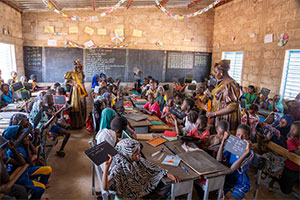 Two teachers work in a classroom in Forces Vives School in Dori, Burkina Faso. Credit: UNICEF/UNI978361
Safe and uninterrupted education is a fundamental right for all children. Education is paramount to global development, as it has been proven that investing in education – especially for girls and children – contributes significantly to economic growth and prosperity. Although more than 1 billion children go to school, many are subjected to conditions that are not conducive to a proper learning environment, including makeshift facilities, a lack of supplies, violence in classrooms, inadequate sanitation, untrained instructors, and widespread school closures. Since 2015, there have been immense gains in education with an increase of 109 million children in school. However, as of 2023, 272 million children are still out of school.
High poverty levels in developing countries also impede children’s access to a proper education. For example, from the early to mid 2000s, Sub-Saharan African nations witnessed a dramatic decline in trained teachers due to inadequate funding in the education sector. Furthermore, major cuts to United States international aid threaten an estimated 23 million additional children's access to education, as USAID‑funded school programmes across Africa and Asia face closure.
Various other factors contribute to the decline of education, notably hunger, which has increased as conflict and climate change interfere with global food production and dissemination. Meanwhile, certain social and cultural practices also impede children’s access to education, with gender inequality, discrimination, child labour, and child marriages preventing millions of children from attending school. Economic conditions such as the inaccessibility of higher education also affect disenfranchised communities across the world. In extreme situations, such as warfare where educational facilities are destroyed in their totality, notably in Gaza and Sudan, entire generations of children might grow up without access to education. Rebuilding educational infrastructure is a long and arduous process, especially when violence persists across generations, and this significantly stunts the development of societal prosperity and stability.
IPS is dedicated to telling the shocking truths about worldwide education through impassioned opinion pieces and comprehensive articles, highlighting global issues that impede worldwide education and the courses of action being taken by organizations such as UNICEF and Education Cannot Wait.

The Week with IPS

NEXT STOP - SDGs
Tracking global progress towards a sustainable world
Tracking global progress towards a sustainable world
