Languages
Sunday, November 8, 2026



News and Views from the Global South
Europe
BALKANS: Dial 9191 for Mladic
Serbia has offered a record one million euros reward each for information leading to the arrest of Ratko Mladic, former commander of the Bosnian Serb Army, and his associate Radovan Karadzic.RIGHTS: Poverty and Capital Punishment Go Hand In Hand
In rich and poor countries alike poverty and the death penalty are almost always inextricably bound together, according to a worldwide survey of experts and human rights activists carried out by journalists as part of the IPS Death Penalty Abolition Project.
Q&A: “Where Europe Has Failed These Europeans”
Thomas Hammerberg was elected Commissioner of Human Rights of the Council of Europe in October 2005. He plays a crucial role in promoting implementation of the recommendations of the human rights system of the Council.
ENVIRONMENT-ICELAND: Hay Restores Eroded Land
Icelandic farmers have found a successful way of repairing erosion escarpments: they blow cut-up hay at them.SLOVAKIA: Playing the Anti-Hungarian Card
Following months of strained ties with Hungary, Slovakia's government looks increasingly isolated after parliament approved a resolution hostile to the country's Hungarian minority.ENVIRONMENT-EUROPE: Education Ministers Step In
Representatives from 51 countries agreed at a three-day conference in Belgrade this week to undertake new environmental improvements to build sustainable development.BULGARIA: Luxury Hotels Coming Up in National Parks
Bulgarian Prime Minister Serghei Stanishev and former premier Simeon Saxe-Coburg attended a ceremony Tuesday marking the official start of a grandiose tourism project dubbed Super Borovits. An unusual show of political unity across party lines, it was meant to promote the tourism industry. But Super Borovits has been highly criticised for threatening nature.POLAND-RUSSIA: Once an Enemy, Always an Enemy
Poland remains Russia's most staunch enemy in the Central European region. But besides history, ideology and energy are playing a key role in the diplomatic impasse.HUNGARY: Debate on Fascist Danger Resurfaces
The ghost of fascism has resurfaced in Hungary following the set up of a paramilitary organisation promising to "protect the homeland". But the organisation's minuscule size made many critics wonder why so much attention was devoted to it.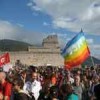
RIGHTS: Italians March for Peace
About 200,000 people marched from Perugia to Assisi Sunday calling for "all human rights for all" and the end of wars.RUSSIA: Putin Could Lead Another Way
If President Vladimir Putin does accept the post of prime minister offered him by the pro-Kremlin United Russia party, he would take a step down in the political hierarchy. For a while, anyhow.UKRAINE: ‘Just Start Governing, Please’
An exhausted public waits as Ukrainian political parties work out a coalition agreement following last week's parliamentary elections. The governing Party of the Regions won the greatest share of the vote, but most likely the pro-Western opposition will outplay it.ENVIRONMENT: EU Troubling Fishy Waters
European Union governments routinely ignore scientific advice when they establish catch limits for their fishermen, a leading environmental group has suggested.
ROMANIA: Villagers Resist a Corporation
"I never had money, I never wanted money, and I never will want money." "I fear no one but God." "I will not leave this place for as long as I live." Such statements, from a small yet determined core of inhabitants of Rosia Montana are indication that the Canadian corporation that wants to dig for gold here could get blocked by at least some people.POLAND: Populism Seen behind Death Penalty Talk
Warsaw's head-on clash with the European Union by vetoing a symbolic day against the death penalty is being interpreted here as a pre-electoral attempt to win domestic support for the so-called "Fourth Polish Republic" - a vision of a nation with a far wider sense of morality and democracy than existed under any past government.
Q&A: Communist Secret Files Threaten Politicians
Countries in Central and Eastern Europe are still struggling to find ways to deal with their past under communist regimes. Bulgaria is one of the last states in the region to decide in favour of opening files kept by the former secret services to the public.GERMANY: ‘War on Terror’ Divides Government
National policy on the 'war on terror' is dividing the German coalition government, with some right-wing Christian Democrat leaders urging radical measures such as the right to shoot down commercial aircraft hijacked by terrorists, and the Social Democrats vigorously rejecting such proposals.RUSSIA: U.S. Report on Rights Challenged
Russian authorities and analysts have hit back at the latest U.S. State Department report on religious freedom, non-profitable organisations and democracy. The report 'International Religious Freedom 2007' was released Sep. 14 by the Bureau of Democracy, Human Rights and Labour of the State Department.
ENVIRONMENT: Algae Against Climate Change?
Research into the use of algae to capture carbon dioxide from the air is changing the negative reputation of these organisms, often seen as a plague associated with agricultural fertiliser run-off.
Q&A: ‘I Hate Politics and Intellectuals’
Croatian writer and journalist Slavenka Drakulic is preparing to launch the German edition of her latest novel, Frida, in November, in Berlin. In the meantime, she attended last week the 20th meeting of Eurozine (European Meeting of Cultural Journals) in Sibiu, Romania, the European city of culture for 2007.BALKANS: Serbia Leans Towards a Russian Hug
Visitors to Montenegro are welcomed by billboards in Russian, because so many Russians have bought property in this tiny Adriatic country. Many Serbs think similar signs might now appear at Belgrade airport.« Previous Page — Next Page »





The Week with IPS

NEXT STOP - SDGs
Tracking global progress towards a sustainable world
Tracking global progress towards a sustainable world
