
Thursday, October 15, 2026



News and Views from the Global South
Q&A: ‘I Hate Politics and Intellectuals’
Interview with writer Slavenka Drakulic
- Croatian writer and journalist Slavenka Drakulic is preparing to launch the German edition of her latest novel, Frida, in November, in Berlin. In the meantime, she attended last week the 20th meeting of Eurozine (European Meeting of Cultural Journals) in Sibiu, Romania, the European city of culture for 2007.
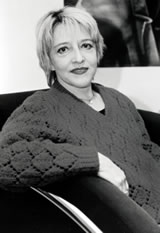
Slavenka Drakulic Credit: Michael Hermann
IPS correspondent Claudia Ciobanu caught up with Slavenka Drakulic for a conversation about some of the threads running through her books.
IPS: Your latest book is about Frida Kahlo. Why did you write about her? What is she like in your book?
Slavenka Drakulic: My book is a novel, not a biography. It means that I took a few events from the life of one of the icons of the 20th century and used them to create a fictional character. I was interested in the relationship between her bodily pain and the possibility of expressing it in art. As a writer, I believe that painters might have better means of expression. A writer is confined by a language, by words. The problem is that pain usually reduces us to a non-speaking state, when we can only scream. There is no place to articulate it, we can hardly communicate it.
IPS: Some of your books deal with crucial political issues. Do you think it is the responsibility of intellectuals to stay engaged with politics?
Drakulic: I hate politics because it has been polluting our lives completely. And this happened precisely because communism was such a system that one of its most important features was to control people, their private lives. There is no private space now either – it is occupied by media and consumerism. We are controlled again, only by other means.
And I have very a bad opinion about intellectuals too. Look only what they did to prepare the war in Yugoslavia! They are the ones who did all the propaganda work. Generally speaking, we, the citizens, should all be responsible and understand that politics is not only for Them, although it often is so in fact. We should also try to understand that we could make a difference – democracy is all about voting to make a difference. I do not like it that people are cynical and disappointed after only a decade of fake democracy. It is too easy to give up so soon.
IPS: You currently live in both Sweden and Croatia, but you travel often to Eastern Europe. What are the major changes you have noticed in this region over the past years?
Drakulic: Well, besides changes for better – like, for example, EU membership, more political freedom, and better chances and opportunities to work and make a decent living – I see the other side too. It doesn’t look so cheerful: unemployment, poverty and, above all, corruption.
It all gives people a feeling of anxiety, depression, passivity, and they end up feeling as victims of historical changes, of crooks in power, of globalisation, etc. That feeling is dangerous because there will always be political groups interested in manipulating such feelings. Populism is, so to say, a side-effect of big political and economic changes, and we see it in new EU member countries. As if they waited to get in, in order to finally show their disappointment.
IPS: How do you see the Western Balkans at the moment? Do you hope for a peaceful resolution of the status of Kosovo?
Drakulic: If you ask me about hope, of course I hope for a peaceful resolution. But reality is something else and I am afraid that it is very hard to predict what will happen there. However, I do see the whole situation with the war in ex-Yugoslavia as a kind of a Balkan paradox: namely, to separate and create sovereign states, only in order to later on unite them and delegate sovereignty to somebody else (the European Union). If this is not weird, I don’t know what is! Especially since so many human lives were lost in the process. Serbia-Kosovo problems fit perfectly into this paradox.
IPS: You are known as a writer and journalist. But you also assumed, episodically, the role of a teacher. Did you like being a teacher?
Drakulic: I love teaching because, in this way, I meet young people, learn about their interests and preoccupations and generally stay tuned in. Teaching is a very noble profession, although terribly undervalued, especially in our wild capitalist society, interested only in consumerism. Teaching from time to time is a great joy for me.
IPS: How much influence do young Europeans today have on decision-making?
Drakulic: I am afraid that the EU is a very bureaucratic structure, and that has to change. People need to have more influence over their lives. Perhaps a young generation will manage to change that.
 Print
|
Print
|




