Languages
Sunday, September 13, 2026



News and Views from the Global South
Middle East & North Africa

Biden ‘Moving the Goal Post’ With Threat to Withhold Bombs from Israel
While some Palestine defenders on Wednesday welcomed U.S. President Joe Biden's threat to withhold bombs and artillery shells from Israel if it launches a major invasion of Rafah, critics noted that an invasion is already underway and accused the American leader of walking back a previous "red line" warning against an Israeli assault on the southern Gaza city.
1.8 Million More Palestinians Doomed to Poverty if Gaza War Persists
Nearly seven months into the Gaza war, the UN warns that to rebuild and restore the buildings lost in this period, it would take several decades, and to revitalize Palestine’s economy, it would be a great undertaking. Meanwhile, the great losses in housing and public services and the economic stall only threaten to push even more Palestinians into poverty.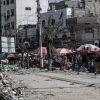
How Israel Has Used US Weapons to Commit War Crimes
The report from Amnesty International USA comes ahead of a May 8 deadline for the Biden administration to certify that Israel is complying with international and domestic laws.
Gaza Journalist Describes 33 Harrowing Days in Israeli Custody
Diaa Al-Kahlout, the veteran Gaza bureau chief for the Qatari-funded London-based newspaper Al-Araby Al-Jadeed, had been covering the Israel-Gaza war for two months when he became part of the news.
The Tragic Death of Palestinian Journalists
It is only fitting, against the backdrop of World Press Freedom Day, to recount the horror being inflicted on journalists and reporters around the world, which is increasing day by day. To tell the story of the mounting death of journalists in Gaza, it is essential to put into perspective the plight of journalists around the world.
The Deadliest Days for Journalists in War Zones
The seven- month-long war in Gaza is perhaps the only military conflict in contemporary history which has claimed the lives of over 100 journalists, including targeted killings.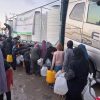
Gaza Teetering on the Brink of Mass Starvation
As we pass 200 days of war, the population of northern Gaza is teetering on the brink of mass starvation. Oxfam analysis found that the 300,000 people in northern Gaza had been forced to survive on an average of 245 calories per day from January to March—less than a single can of beans, and well below the recommended daily intake of 2,100 calories.
Seeking Justice for the Civilian Victims of the Syrian Civil War
When the Syrian Army launched its offensive against the stronghold of rebel FSA (Free Syrian Army) in Homs in February 2012, the safety of civilians was not a factor.
Fine, Sanctions, or Waiver: Iranian Gas Will Come at a Price for Pakistan
When Iranian President Ebrahim Raisi visits Pakistan this week (April 22, 2024), experts say the two issues topmost on his mind that he will want to discuss with his Pakistani counterpart, President Asif Ali Zardari, will be border security and the Iran-Pakistan gas pipeline.
A Hamas-Israel Cease-Fire, Perhaps?
While the international consensus and world public opinion are resoundingly clear in demanding an immediate cease-fire to the Hamas-Israel war, it remains uncertain whether a cease-fire will be observed.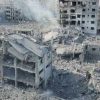
In the Shadows of the Wars in Ukraine & Gaza, Iran and Russia are Growing Ever Closer
Russia and Iran currently appear to be pulling firmly in the same direction in terms of foreign policy; ‘What has caused humanity’s suffering is unilateralism and an unjust global order, one manifestation of which can be seen in Gaza today.’ These were the words of Iranian President Ebrahim Raisi during a meeting with his Russian counterpart, Vladimir Putin, on 7 December.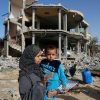
‘Scattered Measures’ in Humanitarian Aid for Gaza Are Not Enough – UN Secretary General
As the humanitarian crisis in Gaza drags into its sixth month on Sunday, April 7, the UN Secretary-General calls for a “true paradigm shift” in the delivery of humanitarian aid. On Friday April 5, 2024, Secretary-General António Guterres spoke before reporters to mark six months since the October 7 attacks, where 1,200 civilians in Israel were killed in a terrorist attack led by Hamas, which has since led to a military campaign by the Israel Defense Forces (IDF) into Gaza.
Israel’s De Facto Peace Plan
The de facto peace plan of Israel is Greater Israel (Eretz Yisrael Hashlema) with a dominant Jewish majority, which Israel expects America will accept and support.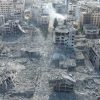
Biden Quietly OKs More 2,000-Pound Bombs & Warplanes for Israel
Despite growing worldwide calls for an arms embargo, the Biden administration in recent days has approved the transfer of billions of dollars worth of new weapons shipments to Israel, including warplanes and 2,000-pound bombs that have been dropped on densely populated areas of Gaza with devastating results.
The Kids of the Islamic State: A Childhood Stolen
Rozena, a 31-year-old woman from Guyana, says she travelled to Turkey in 2015 to join an NGO which helped Syrian refugees. That’s all she’ll reveal when asked how and why she ended up living in the so-called Islamic State for four years.
Abandoned Children Growing Problem in Northern Syria
Wael Al-Hassan was returning from work in the Syrian city of Harim when he heard the sound of a baby crying. He was returning from work on December 10, 2023. He stopped momentarily, turned on his mobile phone flashlight to investigate, and spotted a baby girl, around one month old, wrapped in a white blanket, lying by the roadside.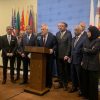
UN Security Council’s Ceasefire Resolution in Gaza Welcomed
After nearly six months of a devastating war in Gaza, the UN Security Council has at last adopted a resolution calling for an immediate humanitarian ceasefire. The resolution calls for the ceasefire to come into effect for the month of Ramadan, demands the unconditional release of all hostages and ensures humanitarian access.
Fueling Future: Dabaa Nuclear Project Offers Light in Egypt’s Economic Gloom
Egypt’s economy continues to face significant challenges, but amidst these, the Dabaa Nuclear Power Plant project emerges as a beacon of hope.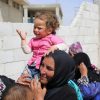
After 13 years in Conflict & Displacement, Syrian Women & Girls Must not be Forgotten
“I don’t think the world understands what it means to be a woman living in Syria today,” explains Shatha, a woman from Deir-ez-Zor, Syria, who is a survivor of gender-based violence. “It is a life filled with danger, grief, and daily struggle.”
Mortality and Misery in the Hamas-Israel War
Estimates of mortality in the Hamas-Israel war after five months of fighting indicate a Palestinian death rate 80 times greater than the Israeli death rate. In absolute terms, the number of Palestinian deaths is 18 times greater than the number of Israeli deaths.
International Women’s Day, 2024
Rural Tajik Woman’s Road to Empowering Women Living with HIV
Born and raised in a rural area in a traditional Tajik family, Takhmina Haidarova managed to finish high school with excellent grades and wanted to go to university.
“[But] it was compulsory for my family to give higher education to boys, and girls were trained to be housewives,” she says. Her dream of higher education was instead replaced by an arranged marriage to a cousin.
« Previous Page — Next Page »


The Week with IPS

NEXT STOP - SDGs
Tracking global progress towards a sustainable world
Tracking global progress towards a sustainable world
