Languages
Sunday, October 18, 2026



News and Views from the Global South
Arabs Rise for Rights
War Crimes Immunity for Ousted Leaders Under Fire
As ousted political and military leaders in the Middle East continue to seek immunity from war crimes prosecutions, the United Nations and international human rights groups are taking an increasingly tough stance against such legislation in Yemen, Egypt, and possibly in a post-conflict Syria.Cracks Widen in Syrian Economy
As the Syrian uprising enters its tenth month, the country’s economy is suffering. Since last March, the Syrian government has been cracking down on pro-democracy protests, and the once peaceful uprising has morphed into a full-blown armed rebellion in areas such as Homs, Hama and Jabal al-Zawiya.EGYPT: A Year On, Tiring of Demonstrations
Several revolutionary groups are calling for mass demonstrations against military rule on Wednesday to coincide with the first anniversary of the January 25 uprising that ultimately toppled the Mubarak regime. But many express doubt the event will succeed in replicating last year's revolutionary fervour on the part of the masses, most of whom express a desire for stability and a smooth transition to democratic governance above all else.EGYPT: Islamist Parties to Abide by Camp David – For Now
The Islamist landslide in recently concluded parliamentary polls has led to fears in some quarters of an impending paradigm shift in Egyptian foreign policy. Most local analysts, however, dismiss the likelihood of any sea changes, especially when it comes to the sensitive issues of Palestine and the Camp David peace agreement between Egypt and Israel.EGYPT: Lending to Repression, Again
For three decades Western governments and lending institutions bankrolled a corrupt regime in Egypt that trampled human rights and stifled democracy. Now they appear ready to do it again, say critics of the military council that has ruled since removing president Hosni Mubarak last February.Egypt Follows Israel, Eyeing U.S. Aid Without Pre-Conditions
The United States, the largest provider of military aid to Israel, has rarely, if ever, succeeded in using its leverage to get the Jewish state to abandon its continued repression of Palestinians or halt illegal settlements in occupied territories.A Second-Term U.N. Chief Says His Convictions Remain the Same
As Ban Ki-moon launched his second-five-year term as U.N. secretary-general last week, the international community remained focused on a rash of unresolved political problems: war crimes charges in Libya and Syria, human rights violations and civilian killings in Bahrain and Yemen, continued Israeli political repression in the occupied territories, and the threat of a new nuclear weapon state in the Middle East.Arab Observer Calls Syria Mission a “Farce”
A former Arab League observer in Syria has decried the organisation's monitoring mission to the country as a "farce", as the U.N. Security Council heard security forces had stepped up the killing of protesters after the observers' arrival.A Touch of Spring for LGBT Arabs
With a yearning for human rights playing a vital role in the Arab revolts; putting an end to discriminatory LGBT laws may determine how the future democratic process unfolds.EGYPT: Military Rulers Clamp Down on Civil Society
Raids on the Cairo offices of civil society organisations accused of receiving unauthorised foreign funds are part of a wider campaign by Egypt’s ruling military council to silence its critics, say rights groups.Syria Claims U.S. Aims to “Rekindle Violence”
Damascus has accused Washington of interfering in the work of the Arab League after a U.S. official travelled to Cairo for talks with the bloc about the protest crackdown in Syria.U.S.: “Arab Spring” Dominated TV Foreign News in 2011
The so-called "Arab Spring" led U.S. network television evening news coverage during 2011, comprising a total of about 10 percent of all the news coverage provided by the three major commercial networks during 2011, according to the latest annual review by the authoritative Tyndall Report.EGYPT: Islamist Parliament Inevitable ‘But Not Worrying’
Following another Islamist landslide in the second round of legislative polling, Egypt's first post-Mubarak parliament will likely see Islamist parties - especially the Muslim Brotherhood's Freedom and Justice Party (FJP) - calling the shots. While high-profile secular figures warn of looming "theocracy", many local analysts believe an Islamist-led parliament won't make any radical legislative changes.Arab Monitors in Syria Flashpoint Towns
Arab League observers are to visit three key protest hubs in Syria as world powers have urged Damascus to give full access to monitor if the country is implementing a plan to end a crackdown on protests.BOOKS: U.S., Iran Both Squandered Opportunities for Detente
Veteran observers of U.S.-Iran relations know better than to be optimistic about the chances for reconciliation between the two countries. It has long been the pattern - indeed the curse - that when one side was ready to engage, the other was not.SYRIA: Mass Protests in Homs as Arab Monitors Visit
Tens of thousands of Syrians have reportedly taken to the streets of Homs, as Arab League monitors finished their first day of observation in the city that has been the centre of the anti-government protest movement.OP-ED: This Spring Breeze Did Not Arise in the West
So here I am, an Arab journalist in Silicon Valley, where four out of every four people I meet believe Facebook invented the Arab Spring. Three more weeks here and I may start to hallucinate that Mark Zuckerberg was a Cairo-slums native named Hassouna El-Fatatri, who rotted in a Mubarak prison for advocating personal privacy rights.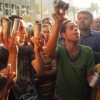
Deadly Gas Enters the Arab Spring
Activists across the Middle East are reporting a mysterious toxin, possibly a banned nerve agent, in the thick clouds of tear gas used by security forces to suppress anti-government protests in recent months.Syrian Troops ‘Ordered to Shoot to Kill’
More than 70 Syrian army commanders and officials have been named by former soldiers as having ordered attacks on unarmed protesters in that country, says the U.S.-based Human Rights Watch.
Iran Hedges Its Bets on Syria
Iran is courting the opposition to Syrian President Bashar al- Assad, seeking to maintain a crucial alliance in the event that Assad falls.
U.S.: Former Top Aide Offers Insight on Mideast and Iran
In his first public address since departing from the White House, Dennis Ross, former top Middle East aide to U.S. President Barack Obama, called for increased sanctions on Iran, a careful approach to new Arab regimes and a low-key approach to Israeli-Palestinian negotiations.« Previous Page





Middle East & North Africa


