Languages
Wednesday, October 14, 2026



News and Views from the Global South
Brazil

Deteriorating Urban Transport Sparked the Protests
A group of young people touched a nerve in Brazil’s large cities, triggering an outpouring of urban outrage at the deterioration of transportation conditions and of the quality of life.Rape in Brazil Still an Invisible Crime
Sexual violence against women is alarmingly under-reported and invisible in Brazil where, for example, there are no accurate, comparable data on rape in the country's 27 states.
Cancelling Fare Hike Fails to Quell Brazil Protests
Children of a generation that fought for basic rights like having enough to eat, learning to read and being treated in safer hospitals, the over 300,000 students protesting on the streets of Brazil want more from a democratic and economic system that no longer represents them and is beginning to show its limitations.
Straightening Out Accounts on Deforestation in the Brazilian Amazon
The bold strategy implemented by the Brazilian government has achieved an 84 percent reduction in deforestation in the Amazon rainforest in the last eight years. But when the natural resources and pesticides used in agricultural production are taken into account, the environmental progress made is not so impressive.
Highest Number of Refugees in Two Decades
Yves Norodom, a 21-year-old refugee from the Democratic Republic of Congo living in Brazil, is one of 45.2 million displaced people around the world – the largest number in 20 years.
Resurgence of Indigenous Identity in the Crossfire in Brazil
The powerful tractors and other farm machinery that landowners recently used to block roads at a dozen points from north to south in Brazil illustrated the economic clout of big agriculture, which rose up against the demarcation of indigenous reserves.
MDGs Fund Boosts Food Security
Since its founding in 2007 to help developing nations fight poverty, hunger, illiteracy, disease and gender discrimination, the Millennium Development Goals Achievement Fund (MDG-F) has financed about 130 joint programmes in 50 countries.
‘Happy Prostitutes’ AIDS Campaign Sparks Debate
Happiness, the subject of endless philosophical discussions, has now become the focus of controversy in an HIV/AIDS prevention campaign aimed at prostitutes in Brazil. The campaign chief has been booted out and a further question has been raised: What are the limits of popular participation in the definition of public policies?How to Close Latin America’s Rich-Poor Chasm
Latin American governments have increasingly been working to lessen inequality in the region, but new data suggests their efforts vary widely in quality and impact.
Tackle Malnutrition Now
Between 2010 and 2012, 868 million people worldwide were deemed hungry by a conservative definition. This figure represents only a small fraction of the world’s population whose health and lives are blighted by malnutrition.
Quantitative Easing: Impact on Emerging and Developing Economies
The global economy is awash with successive waves of liquidity generated over the past few years by the four most advanced economies, viz., the United States, the European Union, (EU), Japan and the United Kingdom, known as the G4. This liquidity has taken the form of “quantitative easing” (QE).
Healthcare for Native People in Brazil Is Ailing
Healthcare for Brazil’s indigenous minority is in poor health, according to U.N. experts, missionaries, social workers and native people themselves.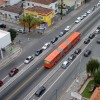
Brazil Floors Gas Pedal on Bus Rapid Transit
Brazil, and especially the city of Rio de Janeiro, is experiencing a boom in bus rapid transit (BRT), a public transport system that now has an internationally-recognised quality standard.
Where Law Enforcement Goes Bad
There is a “deficit of justice” in Brazil, where the police themselves sometimes join the ranks of organised crime, in the form of militias, according to Amnesty International.
Critics Slam California “Forest Offset” Plan
More than two dozen environmental organisations are urging California Governor Jerry Brown to disregard recommendations from a United Nations task force to include so-called forest “offsets” in the state’s new emissions-trading scheme.
Insecurity the “Achilles’ Heel of Development” in Latin America
Development experts here are warning that widespread, unchecked violence against citizens in Latin America is posing a threat to the development of the entire region.
The Brazilian State of Pará, Where Land is Power
Toiling beneath a blazing sun in the humid heat of the Amazon, Waldemar dos Santos, 60, tends the community garden he shares with other landless peasant farmers in the Brazilian state of Pará, as they wait for agrarian reform to provide them with the opportunity for a better life.
Q&A: Brazil’s School Meals Teach Good Eating Habits
Providing school meals for 45 million children is a remarkable achievement for Brazil. But the programme faces specific difficulties, as well as the generic problems plaguing any national plan in this vast country of more than 192 million people.
Dependent on Venezuela’s Oil Diplomacy
Venezuela’s economic challenges, more than the uncertainty over who will succeed late president Hugo Chávez, could threaten the oil diplomacy he practiced in the region.
Q&A: Rise of South “Unprecedented in Speed and Scale”
The world's 132 developing nations, largely part of the global South, are ascending at a pace “unprecedented in its speed and scale", according to the latest Human Development Report (HDR) released Thursday by the U.N. Development Programme (UNDP).
Brazilian-Made Plastic Solar Panels, a Clean Energy Breakthrough
As part of the country’s growing emphasis on green tech research, Brazilian scientists have developed plastic solar panels that could revolutionise power generation from this clean, renewable energy source.« Previous Page — Next Page »





The Week with IPS

NEXT STOP - SDGs
Tracking global progress towards a sustainable world
Tracking global progress towards a sustainable world
