Languages
Wednesday, September 23, 2026



News and Views from the Global South
Israel - Palestine
MIDEAST: September Knocks on Israeli Gates
"September 2011 is knocking on our gates," says an Israeli army officer who, under strict operation procedures, would not reveal his name. He was alluding to the United Nations General Assembly annual meeting expected to resoundingly endorse the Palestinian drive for recognition of statehood.
MIDEAST: Palestinian Spring Brings Nothing New
It is a scene replayed weekly in Palestine. In Gaza, groups of chanting demonstrators walk towards the border with Israel, singing, chanting, dancing. Ayat el Masari, 20, walks with the masses. An English major at Gaza's Aqsa University, the young woman is among many women who regularly attend Palestinian protests.MIDEAST: Settling Into Humiliation
For 61-year-old Abd al-Rahim Bisharat, life in the Bedouin community of al- Hadidiya in the northern Jordan Valley is anything but easy. "The problem is not only poverty, but the degree of how (the Israelis) treat us as humans, our rights as humans," Bisharat told IPS over the phone from his home, with the sound of roosters crowing in the background. "We have no transportation, no electricity, no water, no health, no education.
MIDEAST: Killer Butterfly Takes Wing
"Look, a swallowtail!" A 70-year old moustachioed man hops jubilantly between rocks and prickly flowers, chasing a butterfly. "And look here!" What looks like a dragonfly hovers around in a mechanical whirr of transparent wings.MIDEAST: Worse by the Day in Jerusalem
As thousands of right-wing Israeli settlers descended on Jerusalem to celebrate the so-called unification of the city this week, Palestinian residents of East Jerusalem were confronted by extreme provocations and the stark reality that their city remains very much divided.MIDEAST: Time Running Out for Two-State Solution
Time is of the essence if the implementation of a two-state solution to end the protracted Israeli-Palestinian conflict is to succeed. Changing demographics both within Israeli and Palestinian society could render this impossible, with a one-state solution the only feasible outcome.U.S. Veto Could Derail Palestine as New U.N. Member State
If the General Assembly is called upon to recognise Palestine as a new sovereign nation state, the resolution is expected to garner the required two-thirds majority among the 192 members in the world body, come September.EGYPT: Popular Opposition Mounts to Camp David Deal
Throughout ousted president Hosni Mubarak's 30-year rule, the 1979 Camp David agreement served to keep the peace between historical foes Egypt and Israel. But since Mubarak's February departure, popular calls for the treaty's abrogation have grown louder.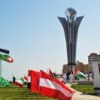
MIDEAST: Undefeated, Freedom Flotillas Expand
A gleaming new memorial towers in the centre of Gaza City's battered port. Flanked by flags of various nations whose citizens have sailed to the Gaza Strip to highlight the all-out siege on Gaza, the memorial's inscription bears the names of the Turkish solidarity activists who died one year ago when Israeli commandoes firing machine guns air-dropped onto the Freedom Flotilla, killing nine and injuring over 50 of the civilians on board.Peacemakers Swim Against the Tide
Although politicians seem to have put the peace process on ice, there are many different groups in Israel and the Palestinian territories that still believe in reconciliation. They call on the world not to believe in stereotypes. "The minute you choose sides, you become part of the conflict."MIDEAST: Settlers See New Support from Obama
The leader of Israel’s most right-wing government since the establishment of the Jewish state 63 years ago, has returned to Israel with his popularity surging since talks with U.S. President Barack Obama in Washington.New Iran Sanctions Could Push Petrol Prices Even Higher
U.S. lawmakers have introduced a new package of unilateral sanctions targeting Iran that would challenge U.S. President Obama's discretionary authority to enforce such sanctions and would impose comprehensive restrictions on foreign entities that ship, refine or provide any other related services to Iran's energy sector.EGYPT: Political Punch with a Religious Thrust
More than three months since the fall of the Mubarak regime, Egypt's Muslim Brotherhood movement is well on its way to forming its first official political party since its inception in 1928. But while the nascent party is to be based on "the principles of Islamic Law and respect for freedom of belief," some critics see this as a contradiction.Politics Could Dominate G8 Summit of World Leaders
When leaders of the Group of 8 (G8) industrialised nations meet in Deauville, France later this week, there is a strong possibility that politics will take precedence over traditional socioeconomic issues like food security and development aid, which are being overshadowed by the Arab revolution and Palestinian statehood.Syrians Running Out of Refuge in Lebanon
Syrians from the border town Tell Khalakh have been fleeing a wave of violence over recent weeks to cross into neighboring Lebanon. But those seeking refuge now face an uncertain fate.MIDEAST: Israel’s Cornered ‘Slaves’ Speak Out
A new Israeli law that would bind migrant workers in nursing or care-giving professions to their employers is raising alarm amidst human rights groups and legal experts, who say that the law infringes upon the workers’ right to dignity and freedom.
Netanyahu Conditions Denounced as “War” by Palestinians
Israeli Prime Minister Benjamin Netanyahu laid out what he called his vision for peace with the Palestinians Tuesday, but listed a set of conditions the Palestinians immediately called "a declaration of war".MIDEAST: ‘Open’ Borders Do Not Open Economy
Despite the Egyptian revolution, which ousted Israeli ally and former Egyptian president Hosni Mubarak, and despite Israel’s claim to have eased the blockade on Gaza following last year’s bloody clashes on the ill-fated Mavi Marmara flotilla, the coastal territory’s economy remains crippled thanks to both countries.MIDEAST: Obama Peace Vision Sparks New Disputes
"The borders of Israel and Palestine should be based on the 1967 lines with mutually agreed swaps, so that secure and recognised borders are established for both states." The seemingly neutral and quasi-consensual principle laid out by U.S. President Barack Obama in his May 19 policy address on the current state of affairs in the Middle East and North Africa (MENA) region was all the more harmless that it was buried in the last quarter of his speech.Netanyahu Rejects Obama Proposal on Pre-1967 Borders
U.S. President Barack Obama and Israeli Prime Minister Benjamin Netanyahu held an extended meeting Friday amid controversy over Obama's call for negotiations between Israel and the Palestinians based on the borders that existed before Israel's victory in the 1967 war which saw it occupy the West Bank, Gaza Strip and East Jerusalem.Few Surprises in Obama’s Mideast Speech
In a much-anticipated speech on the Middle East and North Africa on Thursday, U.S. President Barack Obama broadly outlined an ambitious set of U.S.-guided initiatives intended to reinforce economic and political prosperity, democratic reforms and, most emphatically, self-determination for the millions of protestors throughout the region who have taken to the streets over the past six months.« Previous Page — Next Page »


The Week with IPS

NEXT STOP - SDGs
Tracking global progress towards a sustainable world
Tracking global progress towards a sustainable world
