Languages
Tuesday, November 10, 2026



News and Views from the Global South
Southern Africa
TRADE: Africans Should Confront ''Blind Governments'' on EPAs
African governments came under fire for ‘‘blindly’’ negotiating the controversial economic partnership agreements (EPAs) and not making an effort to educate ‘‘ordinary people’’ on what they were negotiating.
DEVELOPMENT: Zimbabweans Worried About Aid With Strings Attached
Aid with strings attached frequently does not translate into the improvement of the lives of the people for whom that money was ostensibly sourced in the first place. Most of the capital received in aid is used to pay back debt owed to Western donors.POLITICS-SWAZILAND: Hide And Seek
Swazi gender activists are angry that King Mswati III and the newly elected Parliament have betrayed their hopes, and the Constitution, by not appointing more women to the House of Assembly and the Senate.
Q&A: Trade Liberalisation No Silver Bullet Against Poverty
Countries around the world aim to eradicate poverty and hunger by 2015 as one of the Millennium Development Goals (MDGs).
POLITICS-MOZAMBIQUE: Still A Man's Thing?
Only a handful of women are running in Mozambique's municipal elections scheduled for Nov. 19. Among the 111 candidates vying to become president in 43 municipal councils, only eight are women.PORTUGAL: "Angolagate" Bribes in Local Banks
Portuguese banks that received transfers of money to Angolan politicians implicated in illegal arms sales have kept mum after the Lisbon paper Público reported their involvement.
POLITICS-MOZAMBIQUE: Ready To Roll
The posters and flyers are ready, and so is Marta Simango. Ready for Nov. 4, when the municipal elections campaign officially kicks off in Mozambique.
TRADE-EAST AFRICA: Tanzania Still Torn Between Two Blocs
There were six of them – esteemed Kenyan nationals working at east and central Africa’s largest media house, the Nation Media Group. They were supposed to demonstrate the value of the East African Community (EAC) by being allowed to ply their profession in neighbouring Tanzania. The year was 2005.
DEVELOPMENT-AFRICA: Water and Improved Livelihoods
"Sanitation may hold the key to success or failure of the MDGs. It is really a time bomb in terms of health and the environment, waiting to be detonated," Professor Damas Mashauri told participants at a seminar on water and sustainable development taking place in Johannesburg, South Africa.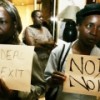
POLITICS-ZIMBABWE: Women Demand Movement On Talks
Over 300 women gathered outside the Rainbow Towers Hotel in Harare on the morning of Oct. 27, dressed mostly in black and white. They were there to protest the prolonged impasse over the allocation of Cabinet ministries among Zimbabwe’s rival parties.
AFRICA: Financial Crisis May Increase Pressure for Debt Repayment
The collapse of the financial markets may force the World Bank, the International Monetary Fund (IMF) and the United Nations Development Programme (UNDP) to come down hard on African countries to repay their debts because the huge rescue packages for collapsing banks will need to be recuperated.
SOUTHERN AFRICA: More Debt But Still No Development
Shupikai Machinya, a Zimbabwean cross-border trader who attended the recent Southern Africa Social Forum in Manzini, Swaziland, is one of the many delegates who wanted to understand just how a country ends up in debt.
POLITICS-SWAZILAND: A Woman With Swagger
The writing is on the wall. "WANTED - Men who Believe that Wives are not for Beating," reads a poster on Nonhlanhla Dlamini's office wall.HEALTH: Swaziland About To Eliminate Malaria
Hot on the heels of Mauritius, health experts predict Swaziland will be the second country in the Southern African Development Community (SADC) to eliminate malaria.
Q&A: Fistula Turns Women Into Outcasts
Women suffering from obstetric fistula in Malawi received free medical care to reverse their condition during the country’s Fistula Week.ECONOMY: Usual Suspects Eyeing Zimbabwe for Massive Deregulation
As the global financial crisis unfolds and more questions are asked about excessive deregulation, the World Bank and others are preparing economic policy prescriptions that will throw open Zimbabwe’s economy to the whims of the world markets.
POLITICS-MALAWI: The Bold and the Beautiful
The reigning Miss Malawi, Peth Msiska, has hit the campaign trail, not seeking another crown but to be voted into Parliament in her country’s general elections in May 2009.
TRADE-AFRICA: Customs Union to Be Launched at COMESA Summit
Following the signing of a power-sharing agreement in Zimbabwe on September 15, the country seems to be growing in confidence. Harare has announced that it will now host the 13th Common Market for Eastern and Southern Africa (COMESA) summit in the resort town of Victoria Falls.ZIMBABWE: Time To Do The Right Thing
At least 5,000 people are expected to gather in Chitungwiza today to demand improved access to water, sanitation and health services as part of the Stand Up, Take Action Against Poverty campaign.POVERTY: Water Wars Hit Rural Zimbabwe
When water experts warned at the turn of the millennium that soon wars will be fought not over oil anymore but over water, little did Zimbabweans know that they would be some of the first people affected by this dire prediction.ZIMBABWE: Food Crisis Worsens
Zimbabwe's agricultural production has been hit by a long list of difficulties - several rounds of severe drought, a collapsed currency that has made fertiliser and other farm inputs very expensive, ill-considered land redistribution, and brutal pre- and post- election violence by the ruling ZANU-PF that has hurt rural populations most.« Previous Page — Next Page »





The Week with IPS

NEXT STOP - SDGs
Tracking global progress towards a sustainable world
Tracking global progress towards a sustainable world
