
Wednesday, November 4, 2026



News and Views from the Global South
DEVELOPMENT-INDIA: Sanitation Is About Mobilising Communities
Soma Basu
- Off the dusty highway that connects the temple town of Madurai to the provincial capital of Chennai, this village strikes the stray visitor with its cleanliness.
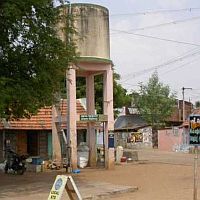
An overhead water tank and public fountain in Thumbaipatti village Credit: Soma Basu/IPS
"Each of our 563 households here has a new flush latrine… just like the homes in the cities," Chandra gushes. "It means no more odd-hour walks to answer nature’s call. The status and safety of Thumbaipatti women is now elevated," she says with pride.
Five months ago Chandra went all the way to the national capital of New Delhi to receive an award from the President of India on behalf of the panchayat of Thumbaipatti, which had bagged an annual award for attaining 100 percent sanitation coverage in its households and schools.
It is hard to think that just a little over four years ago the villagers suffered severe water shortages, defecated in the open and were prone to hygiene-related epidemic outbreaks. Today, there is a complete turnaround, so much so that it has prompted the state government to declare Thumbaipatti a model village to be emulated by 150 other villages in 29 districts.
As often happens in these parts, the drive behind the transformation of Thumbaipatti into a ‘zero-pollution’ zone depended on the zeal and ability of one man, A. Mariappan, to mobilise people. This self-effacing engineer serves with the Tamil Nadu Water and Drainage Department (TWAD) that supplies water to the residents of Thumbaipatti through 346 house service connections and over two dozen hand pumps (public fountains).
Posted in Madurai district five years ago, Mariappan set about sensitising people to the importance of cleanliness and personal hygiene, following a new work ethic, slowly being adopted by engineers and other public officials, that calls for transparency, accountability and responsibility and a willingness to take risks that go beyond the call of duty.
Thumbaipatti proved that when public officials and citizens work as partners their achievements can be remarkable. Mariappan attributes his success to the cooperation he received from the village women. "I started with a self help group (SHG) of 27 women, explaining to each of them the necessity of sanitation. They were willing to cooperate and their enthusiasm had a ripple effect on the entire Kottampatti block of Madurai district. "
Thus clean lanes are now a feature not only of Thumbaipatti but also of some 2,300 households in the surrounding 10 villages of the Kottampatti block (administrative unit within a district) that includes six primary and one high school. There are 52 hand pumps and three water storage tanks built and maintained by villagers who contributed 10 percent of capital cost and labour.
Thumbaipatti is now gearing up to celebrate the International Year for Sanitation as declared by the United Nations Children’s Fund (UNICEF) which supports Tamil Nadu and other state governments development and implement a range of sanitation models. The current priority for UNICEF is to maintain water systems, monitor and regulate water quality and ensure sustainability.
‘’Improved sanitation facilities have reduced diarrhoea-related morbidity and other diseases related to unsafe drinking water in our young children. Students, especially girls when they reach puberty, no longer miss out schooling due to lack of clean and safe toilets in schools," beams Chandra’s husband N.Palaniappan.
Palaniappan points to the role of school children in community management of the village's water and sanitation needs. "We collect water from different parts of the village and test its quality with the help of field kits provided by TWAD," says Abida Bano, a class XI student.
The children conduct tests to check for leakage as also against pilferage through illegal connections. Most importantly, all of them are collectively spreading awareness about water conservation and sanitation in the community.
Putting a stop to open defecation called for a total behavioural change, and it is the children who are shaming the adults out of the habit. ‘’If I see people defecating in the open, I sternly tell them to make use of a toilet. If somebody leaves a tap open, I close it but not without pointing out the negligence. We also keep stressing on the need for proper hand washing," says Khursheed, a student.
Hemlata, the village sanitation committee chief, says: ‘’ The master plan started by TWAD has now become an ongoing and voluntary process which looks into groundwater recharge, de-silting water resources and maintaining water quality, environmental protection and preventing contamination.’’
‘’All decisions related to water and sanitation are taken by the community members who help TWAD officials maintain water supply, ensure quality and collect water charges from the users,’’ explains Palaniappan.
‘’Protecting drinking water from faecal contamination is a major challenge given the widespread lack of sanitation. One strategy is to maintain platforms and drainage around hand-pumps. But the most effective solution is to focus on home hygiene practices, including safe sue of toilets,’’ says Mariappan.
"Many challenges still loom large, threatening the success of the water management exercise. Continuing and sustaining the change process is a critical issue that now confronts TWAD," Mariappan admits.
But officials and villagers are sure of one thing – the abomination of open defecation in these parts is now a thing of the past.
 Print
|




