
Sunday, October 18, 2026



News and Views from the Global South
BIODIVERSITY: How Many Species Are "Enough"?
Stephen Leahy
- Plants are the only source of oxygen on Earth – the only source. And studies around the world show that as plant species become extinct, natural habitats can lose up to half of their living plant biomass.
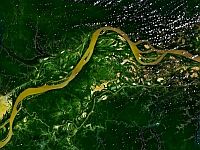
The Amazon River and rainforest viewed from space. Credit: NASA
If a forest loses too many unique species, it can reduce the total number of plants in that forest by half, says Bradley Cardinale, lead author of the meta-analysis published this week in the Proceedings of the National Academy of Sciences (PNAS).
"Those unique species are not replaceable. Nothing takes their place. It was a really shocking finding for me," Cardinale, a biologist at the University of California, Santa Barbara, told IPS. "That's how much biodiversity matters."
An ecosystem is like a soccer team needing both star athletes and supporting players that act as defence and make passes to be successful. Highly productive and important "star" species in an ecosystem, such as trees, need many unique and complementary "supporting" species for the forest to remain healthy, he said.
Currently, one species goes extinct every three hours. And the rate is accelerating.
The PNAS study summarised the results of 44 experiments from around the world that simulated plant species extinction and showed that ecosystems with fewer species produce up to 50 percent less plant biomass than those with more "natural" levels of diversity.
"Our analyses provide the most comprehensive evidence yet that natural habitats with a greater variety of plant species are more productive," said co-author Michel Loreau of McGill University in Montreal.
The importance of biodiversity is not well appreciated by policy-makers or the public, says Ahmed Djoghlaf, executive secretary of the Convention on Biological Diversity (CBD).
"They are unaware of the consequences nor the urgency of the biodiversity crisis," Djoghlaf told IPS last September.
Many people have lost their connection to nature and think there are infinite resources. That relationship has to change, he said.
And that change could be upon us since environmental issues have never been more at the forefront of people's minds.
"It is crucial to seize the moment to engage people in the preservation of species that are the foundation of life on Earth," Djoghlaf said.
The CBD has a Biodiversity Target – to achieve by 2010 a significant reduction of the current rate of biodiversity loss at the global, regional and national level.
Biodiversity science is relatively new and cannot answer the crucial question of how much diversity, i.e. how many species, a particular ecosystem needs to remain healthy, says Cardinale.
"I think we're going to need at least another 10 years to be able to answer how many species are needed," he said.
The answer will be difficult to tease out, not only because of the complex interrelationships of living things, but because we are living in a rapidly changing world where species vanish before being discovered and climate change alters the conditions for life.
Climate change is pushing species south and north as temperatures rise, and that has the potential to drive extinction rates higher, Cardinale says. About 40 percent of all human emissions of carbon dioxide (CO2) are absorbed by plants on land and phytoplankton – tiny plants – in the oceans. The balance remains in the atmosphere, warming the planet.
As species go extinct, and the productivity of forests and grasslands and phytoplankton blooms decline, much less CO2 will be removed from the atmosphere, in turn ratcheting up levels in the atmosphere in a destructive, positive feedback loop.
All the more reason to dramatically slow the rate of extinctions, says Cardinale. And the biggest single threat is loss of habitat due to deforestation, followed by expansion of agricultural areas and cities.
Up to 30 percent of all species on Earth could vanish by 2050 due to unsustainable human activities, according to the 2006 Millennium Ecosystem Assessment, an unprecedented international four-year research effort.
Without knowing how many species are "enough", it is impossible to know how many ecosystems will experience massive declines in the total mass of living plants.
"I have no idea how this will affect oxygen levels but it is something we should be thinking about," Cardinale said.
 Print
|
Print
|




