Sunday, October 11, 2026



News and Views from the Global South
Q&A: 'Brutalisation of State, Society Behind Spurt in Executions'
Interview with I. A. Rehman, Human Rights Commission of Pakistan
- In 2007, Pakistan executed someone, somewhere on an average, every three days. And every single day 7,000 others died – ''figuratively speaking" – waiting in dread for the black warrant announcing their own date with the gallows, says I.A. Rehman, director of the independent Human Rights Commission of Pakistan (HRCP).
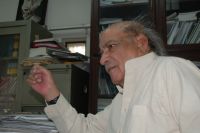
I.A. Rehman, director of the Human Rights Commission of Pakistan Credit: Alefia Hussein/IPS
IPS: The Human Rights Commission of Pakistan has just released its annual report. Can you explain the enormous increase in executions last year?
I.A. REHMAN (IAR): There were 134 executions in 2007, compared to 83 in 2006. That’s a 61 percent increase. Executions have been rising year by year – 18 in 2003, 21 in 2004, 52 in 2005 and 83 in 2006. The spurt in executions is due to a number of reasons, but mainly the brutalisation of state and society. Also responsible has been the bar to pardons and remissions caused by the 1990 Qisas and Diyat Ordinance (on retribution and blood money), the government’s increasing despair at the burgeoning death row population and its cost, and lastly, the high number of offences for which death penalty is prescribed.
IPS: Amnesty International in its annual report now ranks Pakistan second in the world for the numbers of those sentenced to death. What are you reporting on this?
IAR: Pakistan does have a fairly high rate of death penalty convictions. For example, there were 455 in 2004, 362 in 2005, 445 in 2006 and 319 in 2007. The pattern is clear. Every year the death row population is increasing by a good margin. Obviously, the state has decided not to wait long enough for "compromises" that would enable convicts to escape the gallows.
IPS: Can you generalise about the crimes, background and ages of the people sentenced to death?
IAR: The largest group comprises of men convicted of murder, some 147 in 2007. There were also two women sentenced to death for murder in 2007. Other crimes for which death penalty can be awarded are drug smuggling, kidnapping for ransom, rape, robbery, terrorism. As for the age and background of those sentenced to death, I am unable to give you details.
IPS: How can you stop the execution numbers rising even more this year?
IAR. The only way is to reduce the number of offences liable to the death sentence and by reviving the practice of commutation. For the last two years, HRCP has been demanding a moratorium on executions, pending the abolition of death penalty.
IPS: The HRCP reports that Pakistan has more than 7,000 on death row. Can you explain how 134 of these were selected for the gallows last year?
IAR: There is no logical way of selecting candidates for execution. Those who complete the process of trial, review and mercy application can be hanged. It goes something like this: first a trial – taking up to 3 years; the High Court’s confirmation of the sentence – another 2 to 3 years; the appeal to Supreme Court – many years; and, finally, a period allowed for compromise and mercy petitions – possibly indefinite. In some cases, such as terrorism and if the target is the president of Pakistan or an army general, the sentence may be carried out quite soon – even within a year of the crime.
IPS: Can you describe conditions for those held in prison awaiting execution?
IAR: Conditions on death row are horrendous. In the distant past those awarded the death sentence used to be kept in solitary confinement – one person per cell. Often they were kept in chains, with an iron ball in their mouths. Now there are three or four prisoners to a cell. This is an improvement. There are better class convicts on death row also.
IPS: Are these conditions better or worse than in the general, overcrowded sections of the prisons?
IAR: My impression is that conditions in death cells are no worse than elsewhere in the prisons.
IPS: What prevents Pakistan the most from simply abolishing the death penalty – religion or politics?
IAR: Religion more than politics, but I’d say, inertia above all. The state is a victim of the belief that Islam provides for mandatory death penalty and thus this cruel practice cannot be done away with.
IPS: But doesn’t Islam, indeed, teach "an eye for an eye"?
IAR: Eye for an eye is the classical interpretation of the Quranic verse. But there is room for debate whether the trial system prevailing here accords with the incorruptible system considered necessary for application of the Quranic rules. I also accuse the Pakistani clerics of selective obedience to Islam holding to this tit-for-tat rule. They also condone, for example, the marrying of minor girls and even more fundamental Islamic principles rather than fight exploitation and support living by honest labour.
IPS: Are you planning any new initiatives to bring an end to capital punishment in Pakistan?
IAR: We are planning quite a few activities this year to persuade people to support death penalty abolition.
IPS: Will you give more details of these?
IAR: After our annual meeting last month, we sent a 16-point priority list in response to the prime minister’s 100-day agenda for the newly-formed government. Point number eight strongly suggests a moratorium on executions and the setting up of a parliamentary review committee on this form of punishment. We also plan to publish brochures and hold meetings across the country to mobilise public opinion in support of our views.
IPS: Will you be targeting lawmakers on the argument that the capital punishment is not a deterrent?
IAR: We have done a study on the death penalty with the Paris-based International Federation of Human Rights (FIDH) and published it in both Urdu and English. The idea behind this is to try to sensitise parliamentarians on such issues.
IPS: Is a one-time study with the FDIH going to be sufficient to achieve your aims of raising awareness of the lawmakers and bring about a review of the laws?
IAR: No one-time, two-time, 10-time study will ever bear fruit. It is going to be a long haul. We have to go on slogging at the bad practice.
IPS: With a democratic set-up now in place, are you optimistic that the new government will be more amenable to your pressure to halt executions?
IAR: We will push for a moratorium. We had higher hopes while Benazir Bhutto was alive, because she understood our point of view. She pardoned many convicts in 1988 – the first thing after becoming the prime minister. And executions during her two terms were rare. Maybe something can be done even now, though coalitions are not good or fast vehicles.
IPS: You say you will be pushing hard for a moratorium. Have you started building momentum towards this and already held meetings with the new government?
IAR: It is too early to meet the new government leaders. But we have sent a statement to all ministers. All offices of HRCP are approaching the government and political parties on the subject.
IPS: Do you feel the new government is ready to listen to you on this sensitive issue?
IAR: There is no harm in hoping.
 Print
|
Print
|



Pictures for this story
This story includes downloadable print-quality images -- Copyright IPS, to be used exclusively with this story.