
Friday, October 9, 2026



News and Views from the Global South
ASIA: Shoring Up Against Climate Change
Marwaan Macan-Markar
- Three years after a devastating tsunami flattened Banda Aceh, the mayor of that coastal town on Indonesia’s northern tip reckons that restoration work is far from over. He now needs to adapt to threats posed by climate change.
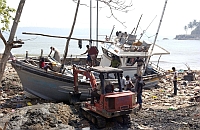
Asian Tsunami aftermath in Galle, Sri Lanka. Credit: UN Photo/Evan Schneider
But in other areas, the local government has pushed ahead with planting mangroves and introducing a tree-planting campaign with local community support, he told IPS. ‘’Each household has been given trees to plant and schools have also got involved. The students have planted 17,000 trees like mango and other varieties.’’
What brought the mayor to this resort city south of Bangkok was to pick up more programme ideas and policy tips during a three-day meeting for local government officials from East Asia to deal with the new challenges posed by climate change.
Such a quest is shared by other officials shaping local government policies across East Asia.
In Vietnam some 13 million people, living in the country’s southern delta region, are threatened with untold hardship if there is a rise in sea level. ‘’It is a big area and we have already begun preparing people for floods like we had last year, where five million people were affected,’’ says Che Trung Hieu, head of the architecture and planning department at the Urban Planning Institute of Haiphong.
Among plans are dikes to protect urban centres that could be hit, Che revealed in an interview. Ho Chi Minh City, or Saigon as it was previously known, tops the list of the large urban centres that could be swamped by river and sea water. ‘’The estimate cost for these parts of Vietnam to adapt and prepare for the impact from climate change is very high. It could be about five billion (US) dollars,’’ Che added.
This week’s meeting in Pattaya points to an emerging trend for local governments to take the lead in preparing their communities to adapt to the dramatic change in the weather caused by greenhouse gas (GhG) emissions. ‘’The climate change negotiation has so far focused 90 to 95 percent on mitigation to reduce greenhouse gases. That can only be done through the central governments,’’ says Jerry Velasquez, senior regional coordinator of the International Strategy for Disaster Reduction, a U.N. body.
‘’But since last year there has been a shift towards adaptation. Because of this, we are seeing an important role that local governments have to play,’’ he explained to IPS. ‘’Ultimately, the activities that need to be done to combat and adapt to climate change have to be done locally.’’
The lead taken by some local governments confirm that a ‘’bottom-up approach’’ is being gradually embraced, rather than waiting for national governments to point the way, Velasquez added. ‘’More of this will be evident during the first international conference focusing on cities in Asia to be held in Manila in November. The mayors will be engaging with ministers and climate change negotiators.’’
To guide local government officials from the region, the World Bank released a blueprint for action at this week’s ‘Green Cities Workshop’. The 149-page ‘Climate Resilient Cities – 2008 Primer’ was aimed at ‘’initiating a dialogue’’ for city governments in East Asia to ‘’better understand and how to plan for climate change impacts and impending natural disasters’’ to reduce vulnerabilities.
The need to insulate East Asian cities from climate change stem from how exposed they are to the ravages of nature as the planet gets hotter, states the Bank, since this region has more than 30 mega cities, with populations over five million, that are in coastal areas. They include Jakarta, Bangkok, Ho Chi Minh City and Manila.
According to the Bank, China leads the East Asian countries with coastal populations ‘’most highly vulnerable to sea-level rise.’’ The regional giant has close to 80 million people who stand exposed, followed by Japan, with some 30 million, Indonesia, with 25 million, Vietnam, with 13 million, Thailand, with 13 million, the Philippines, with seven million, and Burma, with three million.
‘’City planners should know what a city by the sea will have to deal with if there is a rise in sea level due to global warming. They need to put together data and look at the historical trends. The ‘Primer’ offers a tool,’’ says Neeraj Prasad, lead environmental specialist in the operations and policy unit for sustainable development at the Bank.
‘’The economic analysis also points to the fact that there are huge untapped opportunities in building codes, building designs, insulation and energy efficient gains from the urban sector,’’ he told IPS. ‘’So not only will it be a better way of living, but a sincerely better way of addressing climate change while getting financial returns.’’
‘’The mega cities of the world are here, in East Asia. This is where the impacts of climate change are going to be felt the most,’’ he added.
 Print
|
Print
|




