
Monday, October 12, 2026



News and Views from the Global South
ENVIRONMENT-AUSTRALIA: Top Expert’s Emissions Target Slammed
Stephen de Tarczynski
- The Rudd government’s hand-picked climate change advisor’s recommended targets for reducing Australia’s greenhouse gas (GhG) emissions have been widely denounced by environmentalists and leading scientists.
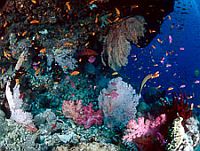
Great Barrier Reef Credit: WWF/Jurgen Freund
Released on Sep.5, Garnaut’s supplementary draft report -titled ‘Targets and Trajectories – calls for Australia to do its utmost to secure a global agreement on targets for reducing GhG emissions.
The supplementary draft represents the economist’s penultimate report, with his final account due by the end of September.
Garnaut – who was commissioned by federal, state and territory governments in 2007 to examine the impact of climate change on Australia’s economy and to recommend strategies to retain the nation’s prosperity – argues that a comprehensive agreement should be based on a global per capita allocation of emissions rights, which he says is the fairest framework.
“Per capita allocations provide the only possible basis for an international agreement that includes developing countries,” he says.
Nations such as China and India, despite being large overall emitters of carbon dioxide, are relatively low emitters on a per capita basis.
Campbell told IPS that while an agreement based on per capita emissions rights “might be a good idea”, he says that he has reservations about the proposal.
“That isn’t the current architecture of the international framework and it’s a new idea that would have to go into the Kyoto process. Potentially, you’d be spending years getting 200 nations to agree to it,” argues the Greenpeace campaigner.
While Garnaut says that a global deal whereby carbon emissions are limited to 450 parts per million would be in Australia’s best interests, a limit of 550 ppm is more feasible “given that emissions are currently around 455 ppm CO2 and rising rapidly due to fast global economic growth.”
He argues that such a trajectory should be regarded as a starting point and that the world should adopt a 450ppm trajectory or lower as soon as practicable.
Under a 550 ppm-limit scenario, Garnaut says that Australia would need to reduce carbon emissions by 10 percent on 2000 levels by 2020, equating to 30 percent in per capita terms. By 2050, the country would be required to reduce emissions by 80 percent on 2000 levels, or 90 percent on a per capita basis.
The government has a stated goal of a 60 percent cut in emissions by 2050 based on 2000 levels and is awaiting Garnaut’s final report before announcing a medium-term commitment.
But despite stating that “there would be no point in global action which was not geared at avoiding the substantial climate change impacts” Garnaut’s recommendations have come under fire from opponents who argue that devastating consequences will be the end result.
Campbell argues that Garnaut’s recommendation to limit emissions at 550 ppm would be disastrous if governments were to adopt such a target. “All of the scientists tell us that that is enough to push the world into catastrophic climate change,” he says.
And the scientists are speaking out. Three Australian climate scientists, Dr Bill Hare, Prof. David Karoly and Prof. Amanda Lynch – all authors with the Nobel Peace Prize-winning Intergovernmental Panel on Climate Change – have attacked the 10 percent reduction target by 2020 in local media reports. They argue that Australia should be cutting emissions by 25 to 40 percent by 2020.
Tony Mohr, climate change programme manager with the Australian Conservation Foundation (ACF), agrees.
A 25 percent cut by 2020 “is really the minimum, in our view, that Australia could do as part of our global effort to avoid dangerous climate change,” Mohr told IPS.
According to the ACF, committing to Garnaut’s advice would result in the doubling of temperature-related deaths in Australia and a massive increase in what it calls “bushfire weather.”
The group also says that the Great Barrier Reef – the world’s largest coral reef system, located off the coast of Queensland in northeast Australia – would disappear.
Garnaut reports that under the 550 ppm scenario, the Great Barrier Reef and other coral reefs would indeed be destroyed while 8 to 39 percent of species worldwide would face extinction.
The outcome for fauna and flora under a 450 ppm-limit scenario, while less ruinous, is still alarming. Garnaut expects that the reefs would be damaged and that between 5 and 23 percent of species would be wiped out.
But Garnaut also recommends that Australia should aim for a five percent reduction in emissions by 2020 in the absence of an international agreement between developed nations and, in particular, China.
He argues that although his conclusions do not indicate a best-case scenario, “they are the best available to us now.”
John Connor, chief executive officer of the Climate Institute – an independent research organisation – is also highly critical of the proposals by the government’s climate change advisor. “Accepting the recommended 2020 targets of five or ten percent reductions would strip Australia of international credibility in global climate talks and, if followed by other major polluters, would lock us into a highly dangerous world of climate change,” he says.
Conner opines that the government should adopt a target for 2020 of at least a 25 percent reduction in emissions on 1990 levels. He argues that Garnaut’s targets “overlook the fact that Australia can be a very influential player in global negotiations.”
Campbell also wants Australia to take on a leadership role. “Australia has got so much to lose from climate change,” he says.
Campbell told IPS that Australia needs to go much further than the recommendations contained in the supplementary draft report.
“If we’re going to save our own environment and show leadership we’re going to have to take harder cuts and the government is going to have to get on the front foot and start playing this game to win,” he says, invoking a cricketing metaphor.
 Print
|
Print
|




