
Wednesday, September 30, 2026



News and Views from the Global South
RIGHTS-COLOMBIA: Government Apologises for Senator’s Murder
Constanza Vieira
- “I accept this apology as a sign of a new time in Colombia, when democratic participation by all political forces will be possible,” leftwing legislator Iván Cepeda said – and a ripple ran through the crowd in the packed gallery in Congress.
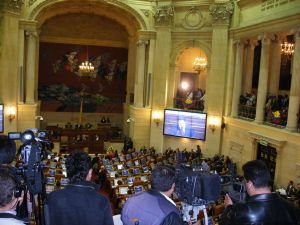
View from the gallery as Minister Vargas apologised in Congress for Manuel Cepeda's murder. Credit: Constanza Vieira/IPS
Addressing a joint session of the two houses of Congress that was broadcast live Tuesday afternoon, Interior Minister Germán Vargas acknowledged the state’s responsibility for Cepeda’s murder.
Vargas read out parts of the Inter-American Court ruling handed down in May 2010, with which the previous government, of rightwing President Álvaro Uribe (2002-2010), refused to comply.
Cepeda was killed by agents of the state – in other words, by the state itself, Vargas admitted, adding that such incidents must “never happen again.”
"My feelings are impossible to describe. It's an unfamiliar sensation: this is the first time we have heard a public acknowledgement of the state's responsibility, and that is quite encouraging, in terms of the respect merited by the issue of the victims and all of the legislation addressing the question.
"From that point of view, it seems to me a very significant development. But it is also a recognition for Iván Cepeda, for his persistence, his tenacity and his fight to uncover the truth about his father's death."
Lawyer María Eugenia Guzmán, the widow of UP leader José Antequera, killed Mar. 3, 1989
….
"I think if a ceremony like this was held for all the victims of the state, there wouldn't be enough time – it would take decades, not years.
"The Organisation of American States recently gave a figure of 180,000 violent deaths confessed by the paramilitaries who have confessed so far (as part of the demobilisation agreement). In the data bank, we have managed to document around 100,000 killings committed since 1988, and we estimate that in the current wave of violence, 110,000 people have already been killed."
Catholic priest Javier Giraldo, director of the data bank of the Jesuit Centre for Popular Research and Education (CINEP), which tracks human rights violations in this civil war-torn country
The UP was founded in 1985 as the result of peace talks between the government of Belisario Betancur (1982-1986) and the Revolutionary Armed Forces of Colombia (FARC), which emerged in 1964 from the embers of the first phase of this country’s civil war, that began in 1946.
Under the peace deal, the guerrillas were to participate in political life through the UP, seeking political and institutional reforms through peaceful channels.
But the systematic elimination of members of the new legal party began immediately, all across the country. The main political force in the UP was the Communist Party, and Cepeda, a journalist, headed the party’s newspaper Voz for 18 years.
"This ceremony is painful to me, distressing. I saw so many people waging war in uniforms, who we managed to persuade to get involved in politics instead, and who were killed. Uniforms were even put on their bodies after they were murdered. That for me was very painful.
"But I have the satisfaction of hearing the government's apology and Iván's acceptance of the apology. That is what we need in this country: to allow everyone to think the way they want, and to make a great country among all of us."
Jorge Lara Bonilla, a member of the peace commission set up by Belisario Betancur to negotiate with the guerrillas. His brother, then minister of justice Rodrigo Lara, a leader of the New Liberalism party, was killed Apr. 30, 1984
....
"This ceremony gives me 'a second hope'…A more serene, and more grounded, hope. That's where I'm standing, in the place where hope resides. I think this heals personal, political, historical wounds in Colombia."
Ángela María Robledo, representative of the Green Party in the lower house of Congress
Tuesday’s was the most solemn of the ceremonies held so far, at the instructions of the Inter-American Court, for the Colombian state to publicly apologise to the victims of state agents and the far-right paramilitary units – now partially demobilised – who worked in tandem with members of the security forces.
Many people attending the ceremony had mixed feelings. In the gallery, two men silently held up signs that said “no apology has yet been given for 3,999 UP victims”.
The collective case of the UP is still making its way through the Inter-American human rights justice system.
“Like any long march, it starts with one step,” Iván Cepeda, the son of the UP leader who was killed in 1994, told IPS.
“After this ceremony, it’s going to be very difficult for them to continue arguing that the UP killings were the work of drug traffickers,” he asserted.
“The state has recognised that it killed Manuel Cepeda, that it left the crime unsolved and unpunished, and that it did everything possible to avoid making an acknowledgment like today’s,” he said.
“I feel happy, after so many years of difficulties. Because the damage that was done has been at least partially compensated. And because this can help thousands of other people who weren’t in this hall today, to see a glimpse of hope in the midst of it all,” he said.
For retired teacher Ruth Cepeda, Manuel’s twin sister, Tuesday was “a very rough day.”
“This morning we visited him at the cemetery,” she said. The two were so close that there was a period in their lives when they would get sick at the same time.
Has this brought her consolation? “No. It’s like hope. It’s a mixture of light and shadow at the same time…what hits me at times it that everything that was achieved today, which people have welcomed with so much respect, might not be fulfilled or enforced. That’s the only shadow over this,” she told IPS.
 Print
|
Print
|


Pictures for this story
This story includes downloadable print-quality images -- Copyright IPS, to be used exclusively with this story.


