
Tuesday, September 29, 2026



News and Views from the Global South

Environmental Thumbs-Down for Mexico's Presidential Candidates
- Vague and contradictory — that's how activists describe the environmental proposals of the presidential candidates for Mexico's July 2 elections. If natural gas and gasoline prices are cut, consumption and air pollution will skyrocket, they warn.
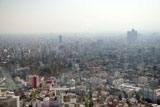
Mexico City's air pollution is an ongoing environmental headache. - Proceso
They had hoped that the candidates running in the July 2 election would present viable and verifiable proposals for confronting the environmental emergency they believe the country faces. But the activists and experts have been disappointed.
“The concern is no longer who is going to win, but rather in the coming six years (the term of the new president) that we will have a completely retrograde environmental agenda,” José Juan González Márquez, coordinator of environmental law at Mexico's Metropolitan Autonomous University, told Tierramérica.
According to official figures, the current destruction and degradation of ecosystems is equivalent to an annual 10 percent loss of Mexico's gross domestic product (GDP).
Mexico is ranked fifth in the world as a destroyer of forests, with some 600,000 hectares lost each year. Furthermore, most of the country's farmland suffers some degree of erosion, and one-third of the population lives in areas where air pollution is a problem.
The polls of voter preference indicate that the candidates with the greatest chances of winning the July 2 elections — and being sworn in as president in December — are Felipe Calderón, of the ruling, conservative National Action Party (PAN), and Andrés López Obrador, of the left-leaning Democratic Revolutionary Party (PRD).
In a distant third place is Roberto Madrazo, of the Institutional Revolutionary Party (PRI), which governed Mexico from 1920 to 2000, and even farther behind are Patricia Mercado, of the Alternative party, and Roberto Campa, of the New Alliance.
The Espinosa Yglesias Research Center, which subjected the platforms of the aspiring successors to President Vicente Fox to a rigorous analysis of design, viability and implementation, resulted in failing grades for the environmental proposals.
Of the three leading candidates, López Obrador's environmental plans were the worst, with an average grade of 1.1 out of a maximum of 4 (0 being “very poor” and 4 being “very good”). Calderón's plans received an average of 1.8 and Madrazo's, 1.9.
As usually occurs in other countries during election season, environmental issues have not carried much importance in the Mexican campaign. Nevertheless, in April, during the first of two televised debates, the candidates discussed water, forests and sustainable development.
Expert González Márquez criticized Calderón, López Obrador and Madrazo for having offered “in a totally irresponsible way and with political malice” to cut prices for natural gas and gasoline. In his opinion, “that will only stimulate consumption and lead to higher emissions of gases” that contribute to the greenhouse effect and climate change.
“It's an environmentally destructive proposal,” said the academic, who is also president of the non-governmental Mexican Institute of Environmental Law Research.
The director of the Mexican branch of the environmental watchdog Greenpeace, Alejandro Calvillo, said he, too, was disappointed by the candidates' proposals. “They don't go very deep, they are very general and some are frankly worrisome,” he said in a conversation with Tierramérica.
He said he was surprised that none of the candidates have a clear proposal for confronting impunity in environmental crimes. None has committed himself to giving independent power to the Federal Procurator's Office for Environmental Protection, an ongoing demand of communities and environmental groups.
Calvillo also is concerned that neither Calderón nor Madrazo link agricultural policy with environmental policy, and that none of the candidates has talked about genetically modified crops or biopiracy.
Two of López Obrador's proposals in particular sound an alarm with Greenpeace: promoting nuclear energy and burning low-cost petroleum derivatives instead of gas to generate electricity, which, says the activist, “would represent an aggression against the health of the Mexican people,” due to the toxins produced by those fuels.
Activists also denounce the “absolute closemindedness” of the PRD candidate about allowing foreign investment in developing renewable energy sources, like wind, solar and others. López Obrador has said that power generation must remain in the hands of the Mexican government.
According to Calvillo, PRI candidate Madrazo has no notable environmental proposals, but PAN candidate Calderón does — “although many of them are too general, and even contradictory.” But his credibility is questionable, because his party, the PAN, “has been a failure in environmental terms, and did not comply with expectations,” said the Greenpeace chief.
Very few activists have any applause for the Fox administration when it comes to its record for protecting the environment.
During the Fox's term in office, which began in December 2000, there have been three secretaries (ministers) of Environment, who most observers agree did not meet their objectives.
Spokeswoman Claudia Suárez, of the Mexican Environmental Law Center, says the environmental proposals of the candidates “have very little content.” They talked about water, forests and energy, but did not lay out any concrete plans, she said.
“They lacked substance, and that disappointed us,” Suárez told Tierramérica.
Suárez, Calvillo and González Márquez all agreed that Mexico's environmental future will enter unknown territory after the elections, because the country's environmental agencies are still weak and will be at the mercy of the will and the abilities of the new government.
 Print
|
Print
|




