
Monday, September 28, 2026



News and Views from the Global South

Environmental Crime Doesn't Pay in Peru
- The Peruvian Environment Ministry's public prosecutor will present an initiative in February to channel fines to pay for the damaging effects of mining, logging and oil drilling.
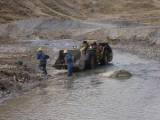
Caudalosa workers clean up mining tailings in the Opamayo River - Milagros Salazar/IPS
“The money would have to go to the area where the offense occurred. That's common sense,” environmental prosecutor Julio Guzmán told Tierramérica. He is the author of the bill that aims “to resolve one aspect of the environmental problem.”
The draft law proposes that the funds obtained through economic reparations go to an account of the Ministry of Environment. From there, the money would be distributed to the institutions entrusted with protecting the country's environment.
“What happens now is that the money goes to the Treasury, and in the following national budget is distributed indifferently,” he said.
Guzmán will present the bill in February to the Ministry of Environment as part of the tools it is seeking to implement to better manage Peru's environmental issues.
The General Law on Environment No. 28611 states in Article 147 that the fines paid for environmental damage “will be designated for carrying out actions that compensate the interests of those affected or contribute to achieving the constitutional objectives with respect to the environment and natural resources.” However, Guzmán pointed out, “it doesn't have the power of a mandate.”
“The problem is that this norm is a dead letter and is not applied,” said attorney José Luis Capella, of the non-governmental Peruvian Society for Environmental Law. “The Public Prosecutor is right to define the mechanisms so that it can be executed,” he told Tierramérica.
The Ministry's Public Prosecutor Specialized in Environmental Crimes has existed since June 2010 to defend the government's interests.
Prior to that, prosecutors from different institutions of the Executive branch were responsible for such cases, but often were unable to provide adequate follow up in cases requiring specialized knowledge of technical aspects.
Currently, the Ministry of Environment's prosecutor's office has taken on more than 2,140 cases against companies and individuals for serious environmental crimes.
Around 60 percent of the claims presented so far involve forested areas, followed by industrial contamination, and mining and oil drilling activity.
The lawsuits involve representatives from more than 100 companies. But undoubtedly the majority of the claims fall on the local residents — with more than 2,000 cases. There are 450 investigations into cases against informal miners and nine against major mining firms, including Antamina, Shougang and Caudalosa.
Antamina, a partnership involving the British-Swiss mining company Xstrata, the Australian-Dutch BHP Billiton, Canada's Teck and Japan's Mitsubishi Corporation, is under investigation for lead contamination found in the blood of residents of Juprog and Ayash, in the Andean region of Ancash. The company allegedly failed to appropriately manage its tailing basins.
The Ancash case had been shelved, but the Public Prosecutor filed an appeal, based on the fact that crimes against health cannot be left unpunished.
Meanwhile, the Chinese company Shougang is being investigated on charges of surpassing the permissible limits of toxic agents in its operations. The Peruvian firm Caudalosa must answer for the 25,000 cubic-meter spill of wastewater that affected several rivers in the Andean region of Huancavelica — among the poorest in Peru.
“The idea is to improve the identification of those responsible for environmental crimes, which historically have not been penalized,” said Guzmán.
But there are obstacles. Twenty percent of the more than 2,000 lawsuits remain in the preliminary investigation phase in the prosecutors' offices.
So far, just 2,000 soles (less than 800 dollars) has been collected in fines, with another 13,000 soles (4,650 dollars) in fines to be executed in January, and a goal to collect 30,000 soles (10,750 dollars) this year, according to Guzmán.
“The problem is that the courts often do not consider environmental crimes as serious issues that directly affect people, and opt not to penalize those responsible, or do not adequately review the evidence,” he said.
In the cases that have been resolved, several judges have decided to suspend the penalties, as occurred in a lawsuit against a resident for misappropriation of land in the Pómac Forest Historic Sanctuary, in the northern region of Lambayeque.
“Many judges consider these crimes as misdemeanors, so they set punishment of one or two years, without prison time. The problem is the weak interpretation of the laws that penalize these crimes,” said attorney Capella.
Public prosecutor Guzmán stressed the need to educate investigators and judges about the environmental issues, and increase awareness that these crimes do not just affect the landscape, but also violate people's rights and harm human health.
One important step was the creation of 29 prosecutor's offices specializing in environmental issues.
Meanwhile, there are many residents of areas affected by environmental crimes who are demanding that the government also set aside a portion of the fines collected for individual compensation.
Guzmán said the residents should work with attorneys of the Justice Ministry to demand their rights, and noted that one way the local population benefits from the reparations is the clean-up of water sources and soil that are vital for their communities.
 Print
|
Print
|




