Wednesday, September 9, 2026



News and Views from the Global South
POLITICS-SOUTH AFRICA: A Case of "Not Over Until It’s Over" for Zuma?
Moyiga Nduru
- The long-running scandal over corruption in South Africa’s five-billion-dollar arms deal passed a milestone Tuesday with the sacking of Deputy President Jacob Zuma. However, it remains uncertain whether this dismissal has sounded the death knell for the official’s future in politics.
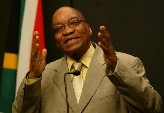
Jacob Zuma addresses a press conference, after his dismissal. (Photo: Obed Zilwa) Credit: PictureNET Africa
These included soliciting a bribe on behalf of Zuma from French arms company Thomson CSF – now named Thales – in return for supporting it during the weapons procurement process, and for insulating the firm during a subsequent probe into its conduct.
Nonetheless, “I don’t think this is the end of his political career. Zuma enjoys wide support within the ANC (the ruling African National Congress),” Ibrahim Fakir of the Johannesburg-based Centre for Policy Studies told IPS. “He is also very popular in KwaZulu-Natal where he ended the violence between the ANC and Inkatha supporters in the 1990s.”
The south-eastern KwaZulu-Natal province is the stronghold of the opposition Inkatha Freedom Party (IFP), a predominantly Zulu grouping. Conflict between ANC and IPF militants claimed thousands of lives during South Africa’s transition to democracy in the early 1990s – only easing after the demise of apartheid in 1994.
Zuma, himself a Zulu, was viewed as someone who could bridge the divide between ANC and IFP.
“He remains deputy president of the ANC. This is a very influential post,” Fakir added. “If due process of law takes its course and Zuma is not found guilty, he may bounce back.”
Zuma has not been tried in connection with the bribe solicited from Thales/Thomson CSF or any other matter. In 2003, the National Prosecuting Authority concluded that while there was a certain amount of evidence against the former deputy president concerning the arms deal, it was not sufficiently compelling to convict him.
During his address to parliament yesterday, Mbeki was at pains to emphasise that his former deputy had not yet had his day in court. However, persistent claims that Zuma was implicated in corruption surrounding weapons procurement (news that he was under investigation first emerged in 2002) eventually transformed Zuma into a political liability.
“Circumstances dictate that in the interest of the honorable deputy president, the government, our young democratic system and our country, it would be best to release the honorable Jacob Zuma from his responsibilities as deputy president of the republic and member of the cabinet,” Mbeki told attentive legislators.
In reaction to his sacking, Zuma blamed everybody except himself.
“My conscience is clear. I have not committed any crime against the state or the people of South Africa. I however still maintain that I have been treated extremely unfairly throughout the entire debacle for about half a decade,” he told reporters in Cape Town, shortly after the parliamentary session.
“I have been tried by the media and in effect found guilty by a court in absentia. I have not been given an opportunity in an appropriate forum to defend myself against the allegations made. Yet our constitution states that everyone is innocent until proven guilty.”
Zuma went on to say that he looked forward to further collaboration with Mbeki in his capacity as deputy president of the ANC.
Concerns have been expressed over whether Zuma can reasonably continue in this post, which gives him considerable say in the political arena from which he just been excluded. However, the Congress of South African Trade Unions and the South African Communist Party – which are in alliance with the ANC – have been unstinting in their support of Zuma.
The ruling party’s youth league and women’s league have also thrown their weight behind the former deputy president. Zuma is typically described as the genial antithesis of the more severe Mbeki, capable of sustaining support for the ANC at times when its free market policies have strained the alliance.
While opinions vary on the warmth of relations between the two men, few doubt that the president’s decision to fire Zuma was reached without a few sleepless nights.
“It has been an extremely difficult decision for Mbeki to take. This is a man he had known for 30 years,” David Monyae, a lecturer in international relations at the Johannesburg-based University of the Witwatersrand, told IPS. Mbeki and Zuma first met during the struggle against apartheid, when they worked together in the ANC, abroad.
Zuma’s dismissal comes at a time when South Africa is spearheading a campaign to clean up Africa’s image by mediating in various conflicts across the continent, and promoting the New Partnership for Africa’s Development (NEPAD). This initiative seeks to attract foreign investment to the continent through improving standards of governance in African countries. The former deputy president was himself one of the chief mediators in talks to end Burundi’s civil war.
Mbeki said Tuesday that he would soon announce a replacement for Zuma. Names being tossed around include those of Foreign Affairs Minister Nkosazana Dlamini Zuma, minerals and energy minister Phumzile Mlambo-Ngcuka and ANC Secretary-General Kgalema Motlanthe.
As debate on this matter proceeds, the National Prosecuting Authority is reported to be once again considering whether to press charges against Zuma.
For his part, Schabir Shaik is appealing the verdict in his case, which has seen him sentenced to 15 years in jail. Shaik was also found guilty of paying Zuma upwards of 180,000 dollars in return for help from the former deputy president in furthering his business empire.
The judge in the case, Hillary Squires, found the two men had cultivated a “generally corrupt relationship”.
 Print
|
Print
|