
Saturday, October 24, 2026



News and Views from the Global South
Opinion
Africa’s Youth are Shaping the Continent’s Climate Future
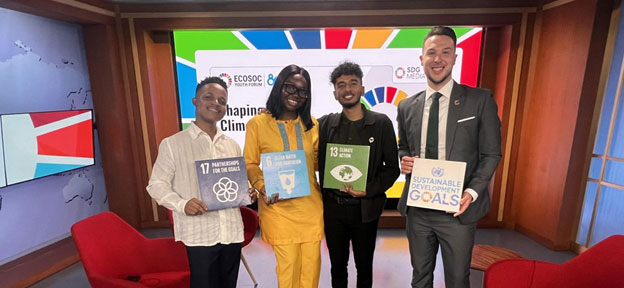
On the sidelines of the UN Youth Forum, four climate leaders from across the continent and diaspora unite to call for stronger protection of Africa’s environment and vital resources.
Sibusiso Mazomba (far left), member of the UN Secretary-General’s Youth Advisory Group on Climate Change; Eugenia Boateng (second from left), Founder and Executive Director of the African Diaspora Youth Hub, FABA Institute; Jabri Ibrahim, also of the UN Secretary-General’s Youth Advisory Group on Climate Change; and Damon Hamman, Graduate Student, New York University, Centre for Global Affairs. Credit: UN Photo
- Africa is on the frontlines of the climate crisis, warming faster than the global average and facing disproportionate climate impacts, despite contributing the least to global greenhouse gas emissions.
This is particularly evident in the growing pressures that climate change is placing on water resources and systems across the continent. As water underpins agriculture, livelihoods, ecosystems, and energy production, water-related climate impacts are deepening inequalities and threatening sustainable development across Africa.
At the forefront of this year’s ECOSOC Youth Forum – the largest annual UN gathering of young people – four African climate youth leaders led a dynamic discussion spotlighting the key role that African youth play in driving climate solutions across the continent, building community resilience, strengthening water security, and advancing locally led adaptation efforts.
Their insights highlighted how young people are not only responding to the climate crisis but reshaping the development agenda through innovation, advocacy, and community rooted action.
African youth are charting bold new pathways for climate leadership and proving that the future of climate action is being shaped by their vision and determination.
Learn more about the speakers:
Eugenia Boateng is an African diaspora strategist and founder of the African Diaspora Youth Hub (ADYH) and FABA, a production strategy lab building systems to make African economies more visible, structured, and investable.
Her work focuses on translating informal economies into institutional intelligence, connecting diaspora resources to African production, and designing systems that enable value retention on the continent.
Jabri Ibrahim is a climate and energy policy expert with an extensive network across Africa, connecting youth movements, policymakers, and private sector leaders. Jabri has played a central role in mobilizing African youth for climate action, particularly through the African Youth Initiative on Climate Change (AYICC).
Sibusiso Mazomba is a climate justice activist, advocate, and researcher. He leads youth advocacy at the African Climate Alliance, driving initiatives to ensure meaningful youth participation in decision-making.
A junior negotiator for South Africa’s UNFCCC delegation since COP26, he has contributed to negotiations on adaptation, oceans, and loss and damage, representing youth and national interests on the global stage.
Damon Hamman is a Master of Science candidate in Global Affairs at New York University, concentrating in transnational security, intelligence, and conflict analysis. His work centers on the intersection of human security, diplomacy, and data-driven policy research.
He has served with the United Nations Office of the Special Adviser on Africa, where he built an AI-assisted thematic analysis pipeline for Voluntary National Reviews, contributed to policy briefs aligned with Agenda 2030 and AU Agenda 2063, and supported diplomatic engagement with African missions.
Source: Africa Renewal, United Nations
IPS UN Bureau


 Print
|
Print
|




