
Thursday, September 24, 2026



News and Views from the Global South
Women & Economy
Breaking Cultural Barriers to Equip Marginalised Kenyan Girls With Entrepreneurial Skills
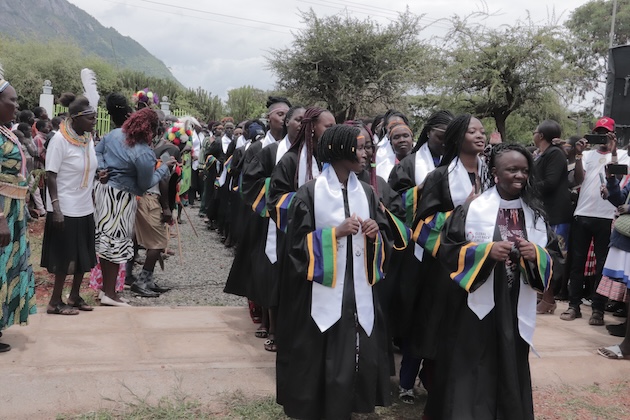
A group of young women graduate from an entrepreneur skills programme taking place in Kenya's arid and semi-arid regions. Credit: Isaiah Esipisu/IPS
- For generations, communities in Kenya’s arid and semi-arid lands (ASAL) have viewed girls through the lens of marriage, with some being married at 11 in exchange for livestock or soon after secondary school, denying them opportunity for further education and skills training.
However, in West Pokot, a community deeply rooted in traditions, something extraordinary is happening. On April 15, at the Perur Rays of Hope, a local community-based organisation in Morpus village, 156 girls from different ASAL regions, some of whom were holding their babies, paraded in colourful gowns during a graduation ceremony after completing a one-year entrepreneurial skills training through a programme known as HER Lab.
“In this community, the gender of a child defines their path in life,” said Shujaa Caroline Menach, the Executive Director of Perur Rays of Hope. “Boys are trained how to navigate harsh terrains as they herd and protect livestock, while girls remain at home learning household chores. At the age of ten or eleven, many of them undergo rites of passage such as Female Genital Mutilation (FGM), marking their transition into womanhood,” she said.
Some of these cultural practices directly link to the looming tough and ever-changing climatic conditions. Between the years 2021–2022 for example, the ASAL regions endured scorching drought, during which five consecutive rainy seasons failed, leading to the loss of over 2.5 million livestock, the main source of livelihoods in such regions.
“When families lose livestock due to such droughts, they turn to their circumcised girls as the currency to replenish the stock,” said Lillian Chepkemei, a gender activist from the Pokot community.
“Often, the girls are married off in exchange for livestock, sometimes long before their bodies fully develop, so that they are nurtured in their husbands’ place until their bodies start showing signs of maturity,” she said.
Such practices have resulted in early pregnancies, with married girls under the age of 15 being forced into early parenthood.
Those who are lucky to go to school are often subjected to social pressure to get married once they complete their primary or secondary education.
The reasoning is that there is no need to educate a girl-child beyond secondary school, because by the end of the day she will get married and take all the benefits to her husband’s family,” said Chepkemei.
It was based on such challenges that HER Lab was established to support girls who have gone to school beyond primary education, whether married or not, to acquire professional, entrepreneurial, life-changing skills.
The programme (HER lab) is a skilling and entrepreneurship curriculum, largely supported by the Mastercard Foundation and implemented by the Global Give Back Circle through organisations such as the Perur Rays of Hope. It targets young women from hard-to-reach counties, offering support services like mentorship, reproductive and mental health care, and confidence building, among others, with a goal of improving the social and economic status of marginalised adolescent girls and rural young women and their communities, promoting better, equitable opportunities for all.
Dr Mwende Munuve, the Chief of Programmes at the Global Give Back Circle, notes that the programme works closely with the government at both the county and national levels.
“Without involving the government, then we will go nowhere,” she said.
Menach says that some of the girls recruited in the first cohort were picked from their matrimonial homes as long as they had basic education to enable them to train for basic entrepreneurial and leadership skills such as plumbing, electrical installation, food production, cosmetology, fashion and design, agriculture, ICT operations and beadwork.
“This is a dream come true,” said Sharlyne Jerop, who comes from Baringo County. “I never imagined that I would acquire such skills in electrical installation, which is proof that girls can thrive in fields traditionally seen as reserved for men,” she said, adding that she intends to further her studies to a diploma level.
Stephanie Cheyech, who graduated with a certificate in ICT operations, said that the programme had given her a new perspective. “Before this programme, I had very little exposure to technology; I had never even touched a computer,” she said. “Through this training, I have just been exposed to the world of possibilities.”
So far, the selection of the second cohort for the next 12 months is underway, and according to the Director – Perur Rays of Hope, the demand is overwhelming.
“We are recruiting for the second cohort and so far, we have already received over 700 applications, which is a clear indication that girls in ASALs are eager to grab entrepreneurial opportunities,” said Menach.
During the 12-month training period, some of the learners live at the training centre, while others, especially those with demanding marital duties, are allowed to report daily for half-day training to balance their household chores with the training.
“We have dedicated one room for kids who cannot be separated from their mothers, and carers are available to attend to the children while their mothers attend class,” said Menach.
The current graduates will now proceed to a three-month internship, after which some will start small businesses, others will seek employment, or they will advance their skills further.
But importantly, the girls have been tasked to mentor at least one or two other girls from marginalised communities to further break the intergenerational cycle of abuse of girl children and human rights as a way of giving back to society.
IPS UN Bureau Report


 Print
|
Print
|



Pictures for this story
This story includes downloadable print-quality images -- Copyright IPS, to be used exclusively with this story.


