
Monday, September 21, 2026



News and Views from the Global South
Environment
Make Last Sprint Towards 2030 a ‘Turning Point’ for Nature Finance, Eighth GEF Assembly Told
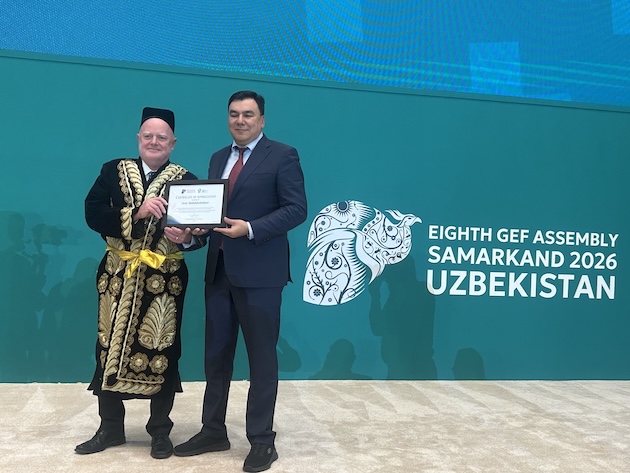
Claude Gascon, interim CEO of the GEF and Aziz Abduhakimov, Minister of Environment of the Republic of Uzbekistan, at the closing ceremony of the Eighth GEF Assembly in Samarkand, Uzbekistan. Gascon was presented with a traditional Uzbek outfit. Credit: Stella Paul/IPS
- “While pressures on public budgets are growing and geopolitical tensions rising, it can be tempting to see environmental finance as optional. It is not,” GEF Interim CEO and Chair Claude Gascon told the closing plenary of the Eighth GEF Assembly in Samarkand, Uzbekistan, today.
For developing countries, least developed countries, small island developing states and fragile and vulnerable countries, overseas development aid is the cornerstone.
“Because what is at stake is not only a set of international targets. What is at stake is the future quality of life on this planet. What is at stake is whether children inherit rivers that still run clean, forests that still stand tall, coastlines that still protect communities, and economies that can thrive without destroying the natural systems on which all prosperity depends.”
Assembly chair Aziz Abdukhakimov, Advisor to the President of Uzbekistan on Environment and Chairman, the National Committee on Ecology and Climate Change, noted the event had been highly productive with over 50 side events, bilateral meetings, and informal exchanges.
“The GEF council reviewed and improved key decisions, including the GEF-9 programming directions and (the last) GEF-8 work program,” he said, while welcoming a strong focus on integrated programming, innovative financing, and inclusive participation, including the aim to direct at least 20 percent of GEF-9 resources to Indigenous peoples and local communities.
He said that Uzbekistan’s President Shavkat Mirziyoyev’s message that Uzbekistan would become a donor country reflected the country’s “commitment to environmental sustainability.
“This shows our readiness not only to benefit from cooperation but also to contribute to global environmental relations,” Abdukhakimov said.
Earlier in a high-level panel discussion, Dr Rosina Bierbaum, Chair of the Scientific and Technical Advisory Panel (STAP) of the GEF, reminded the Assembly that while half of the global GDP depends on nature, there is a “USD 700 billion annual biodiversity financing gap”.
However, she said, an analysis by management consulting firm McKinsey confirms that implementing the 30 by 30 biodiversity goals, aimed at effectively conserving at least 30% of the Earth’s land and oceans by 2030, will generate significant conservation and socioeconomic goals and lift people out of poverty.
While the discussion about funding was coming at a difficult time, Kenneth Lay, Senior Managing Director at RockCreek and former Treasurer of the World Bank, said the good news was that the private sector could help tackle the problems.
Detailing how the global savings pool has grown dramatically “driven by 15 years of exceptional markets”, he said there were trillions of dollars available in pension and sovereign wealth funds, insurance sector reserves, and others, and these funds could become available to invest in nature, but “asset owners were not in the room”.
Lay suggested that the GEF convene the players who run central banks, the International Monetary Fund, the World Bank and securities regulators among others and ensure that “investing in nature is as natural as investing in infrastructure.”
Valerie Hickey, Director, Environment, World Bank Group, said the GEF had a role to play in building enabling regulations and policy predictability to help the private sector manage risk – with a focus on what she called the ‘Goldilocks’ blend of concessional and commercial finance to cushion investment failures while ensuring the investment has commercial returns and is financially solid enough to unlock private capital that has “measurable environmental outcomes.”
There were warnings too.
Rachel Kyte, Special Representative for Climate, United Kingdom, warned that a study showed her country was “highly vulnerable to ecosystem collapse.
“What does that mean? It means that for a British family, their ability to fill their supermarket trolley with the things they need to keep their children healthy is entirely linked to the integrity of the Congo Basin. And that if anything were to further threaten it, there would be security and defence implications.”
Getting local communities and Indigenous people involved through people-centred, inclusive, and economically viable solutions was key, Joyelle Clarke, Minister of Sustainable Development and Environment, Climate Action and Constituency Empowerment, Saint Kitts and Nevis, said. She explained how the blue carbon market was underappreciated and often hard to grasp.
Clarke gave an example of a UNESCO world heritage site that conserves turtles – in an area where the fishing community’s diet included turtles. By offering alternative job opportunities in the tourist industry, they were able to garner the community’s support for the site.
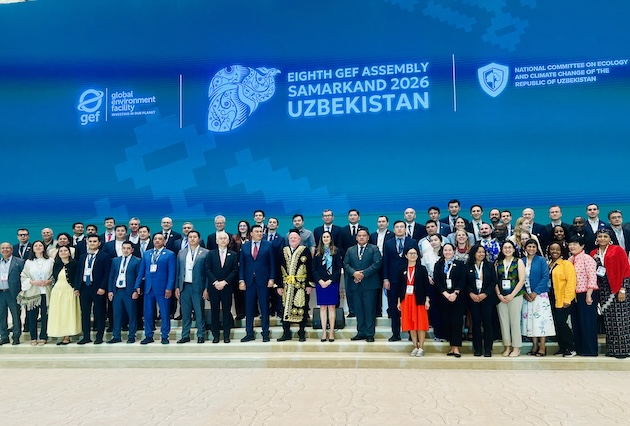
Leaders and delegates from the Uzbek government and the GEF pose for a group photo at the conclusion of the Eighth GEF Assembly in Samarkand, Uzbekistan. Credit: Stella Paul/IPS
Gascon reminded the plenary that the environment was not a “side issue”.
“First, we must defend and strengthen continued public development assistance for countries… Continued public ODA is therefore not only a moral commitment. It is an investment in global stability, in human security, and in the shared future of all nations.”
Then, he said “countries need to align national policies with the environmental outcomes they seek. We cannot say we are committed to sustainability while still rewarding the destruction of ecosystems, the overuse of natural resources, or the pollution of air, land, and water.”
Third, the GEF should unlock the full power of private capital and ensure that the private sector becomes “not just a source of finance but a true partner in governance and delivery of global environmental outcomes”.
And finally, “cabinet-wide commitment and society-wide participation” were needed for the environment goals to be achieved.
“We need national leadership, but we also need local ownership. That means listening to and working with communities, Indigenous Peoples, women, youth, civil society, scientists, local authorities, farmers, workers, and entrepreneurs. It means recognising that durable solutions are not imposed – they are built together.”
Finally, Gascon said the final push to 2030 “must be more than a countdown. It must be a turning point.”
Note: The Eighth Global Environment Facility Assembly held its final plenary today, June 6, 2026, in Samarkand, Uzbekistan.
This feature is published with the support of the GEF. IPS is solely responsible for the editorial content, and it does not necessarily reflect the views of the GEF.
IPS UN Bureau Report


 Print
|
Print
|



Pictures for this story
This story includes downloadable print-quality images -- Copyright IPS, to be used exclusively with this story.
- Claude Gascon, interim CEO of the GEF and Aziz Abduhakimov, Minister of Environment of the Republic of Uzbekistan, at the closing ceremony of the Eighth GEF Assembly in Samarkand, Uzbekistan. Gascon was presented with a traditional Uzbek outfit. Credit: Stella Paul/IPS
- Leaders and delegates from the Uzbek government and the GEF pose for a group photo at the conclusion of the Eighth GEF Assembly in Samarkand, Uzbekistan. Credit: Stella Paul/IPS


