Saturday, June 20, 2026



News and Views from the Global South
POLITICS-PAKISTAN: Intelligentsia Finds Ways to Beat Emergency Rule
Beena Sarwar
- Faced with a continuing news blackout and with street protests being met with police beatings and imprisonment, members of Pakistan’s civil society who oppose the ‘emergency’, imposed by President Gen. Pervez Musharraf a week ago, are finding alternative ways to express dissent.
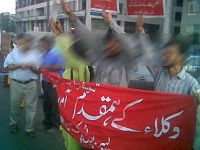
A 'flash protest' by citizens in support of arrested lawyers -- their faces blurred for anonymity Credit: SOS
Pakistan’s intellectuals and civil society activists were the first to react against the emergency imposed on Saturday. Activists in Lahore who met at the independent Human Rights Commission of Pakistan (HRCP) to discuss the situation were arrested and detained before finally being released on Tuesday evening. HRCP chairperson Asma Jahangir is still under house arrest, served with a 90-day detention order.
Families and friends expected the detainees to be released sooner. Many belong to the intellectual and social cream of society – professors, lawyers, journalists, artists, economists, former ministers and retired army officials. But their powerful connections were useless this time. The relative of one detained activist who managed to get through to a ‘very high level official’ was told that the local and provincial administration was helpless. "The orders came from the very top, to teach these people a lesson," the official reportedly said.
The regime has been particularly brutal on the legal community for refusing to accept new judges sworn in under emergency orders. The judges of the superior courts who refused to take oath under these orders were placed under house arrest and thousands of lawyers imprisoned around the country. Many were brutally beaten before being hauled off. Hundreds have been charged under the anti-terrorism laws.
In a statement on Nov. 8, Jahangir drew attention to two former presidents of the Supreme Court Bar Association (SCBA)- Muneer A. Malik and Tariq Mahmood. Malik – shifted, she alleged, to the notorious Attack Fort "under the custody of the military intelligence and tortured". No one has been allowed to see Mahmood or Aitzaz Ahsan, recently elected SCBA president. Mahmood has been shifted "to an unknown place". The whereabouts of Ali Ahmed Kurd, former vice chair of the Pakistan Bar Council, are also unknown. He is believed to be in the custody of military intelligence, said Jahangir.
Police have also targeted journalists in what the Pakistan Federal Union of Journalists (PFUJ) terms as the worst repression of the media since the days of the military dictator, Gen. Ziaul Haq who held power from 1977-88. Police beat journalists who emerged from the Karachi Press Club following a protest meeting on Monday, and arrested six. The journalists, nominated in the police report as ‘hardened criminals’, were produced before a magistrate in handcuffs. The PFUJ has released a poster based on this image headlined ‘Press in Chains’ – the title of a famous book by the late chronicler of media freedoms, Zamir Niazi.
After an inconclusive 45-minute meeting with the government over the withdrawal of anti-press ordinances, resumption of television channels and FM radio on Thursday, the journalist union announced a countrywide "Black Day" on Friday. The protest will include a boycott of official functions, protest camps from Nov. 14 -17, a Global Action Day on Nov. 15 and countrywide protest rallies and demonstrations on Nov. 20, said Mazhar Abbas, PFUJ’s secretary general.
The detention of civil society activists, lawyers and journalists have prompted criticism that Musharraf is diverting attention from the ‘war on terror’ that has reached worrying proportions, particularly on Pakistan’s north-west frontier that borders Afghanistan. "While the terrorists remain on the loose and continue to occupy more space in Pakistan, senior lawyers are being tortured," said Jahangir.
Mainstream political parties have been relatively slow to respond but since twice elected former prime minister Benazir Bhutto on Tuesday announced an agitation starting with a protest on Friday, Nov. 9, and a ‘long march’ from Nov. 13, workers of her Pakistan People’s Party (PPP) have been demonstrating in various cities. The government has banned both events.
On Wednesday, police in Islamabad thrashed workers attempting to break through a barricade near the National Assembly. Hundreds of PPP activists have been detained around the country.
The blackout on television news has made it hard for people to know what is happening. "There’s nothing going on," said Nausheen, an economics teacher who gave only her first name, talking to IPS.
By Wednesday evening, two business channels (Business Plus and CNBC-Pakistan) had been restored. On Thursday, BBC and CNN were also back on air. However, these channels are in English, a language few people in Pakistan understand. (A business channel holding discussions in Urdu also resumed broadcast on Thursday)
The newspapers are publishing critical comments, reports and photographs, but Nausheen does not read any. So like most Pakistanis, she remains unaware of current happenings. The surface normalcy that is visible intersects frequently with the pockets of protest catalysed by the emergency, found Saskia Sassen, a professor of urban sociology at Columbia University, recently in Pakistan to deliver a lecture in Lahore. Writing in the British newspaper ‘The Guardian’ (‘Pakistan’s Two Worlds’, Nov 8), she observed, that "through it all, the streets continued to bustle, the traffic remained heavy and the airlines continued to fly according to schedule, as if nothing is happening".
Shops, businesses and banks are open.In Quetta, capital of the western province of Balochistan, it was shutters down on Monday after a small nationalist party gave a strike call.
Urban markets continue to do booming business. One item that was selling fast, after the news channels were blocked over cable, was satellite dishes. But on Wednesday, shopkeepers were told they could not sell satellite dishes. "I wish I had kept my satellite dish," said a visual artist, meeting friends at a lively coffee shop in uptown Karachi. "Now it’s just the internet."
This is in fact a tool that the younger generation in particular is using effectively. Information exchanged over the internet and via cell phone text messages has enabled young people to organise quickly and effectively. This includes the normally de-politicised students of private institutions who have been mobilised for the first since the ban on student unions two decades ago, say observers.
Students of a premier business school, the Lahore University of Management Sciences (LUMS), have loudly opposed the emergency and suspension of the constitution. Several LUMS professors were among those arrested from the HRCP meeting on Sunday. The ranks of the 400 (four hundred) students who participated in the first protest on Tuesday swelled to 1,500 the next day. Islamabad’s prestigious Quaid-e-Azam University (QAU) has seen similar activism, with students holding ‘flash’ protests called at short notice, chanting slogans, then dispersing before police arrive.
For their part, civil society activists are engaging in creative ways of protest focusing on symbolism, like taking flowers to the dissenting judges and spray-painting graffiti symbols like ‘eject’ and ‘repeat’ signs. On Wednesday, a small group of activists took several bouquets to Sabihuddin Ahmed, Chief Justice of the Sindh High Court (SHC), who is also under house arrest. Police vehicles blocked both ends of Ahmed’s residential street.
Salahuddin, the judge’s son, was among the lawyers arrested from the SHC on Monday. He was also among the few lawyers to be released early Tuesday morning. He was unharmed, but Haider Waheed, another young lawyer released around then, had bruises on his neck and upper back caused by blows from police fists when he tried to resist arrest.
"These youngsters should not be aggressive," said Waheed’s grandmother Sadiqa Waheeduddin, 88, who cut her teeth on the resistance against British rule before Pakistan and India’s simultaneous independence and partition in 1947. "This is all about politics. If the police is arresting them, they should go quietly and not resist. After all, what did they go there for? If they hit back, what is the difference between intellectuals and the illiterate? When the police beat (Mahatma) Gandhi or Maulana Hasrat Mohani, did they retaliate? It is because of their patience that their ideas caught on around the world."
A popular method of showing dissent called 'flash protest' involves unannounced gatherings by small groups who unfurl banners, shout slogans and then disappear before the police arrive on the scene.
The Internet and cell phones have helped sustain the protests and connect activists in Pakistan with sympathisers abroad. Judging by the e-mails, blogs and messages of support whizzing about, the expatriate community is in an uproar. They include ‘techies’ like Sabahat Ashraf (iFaqeer), a blogger, technical writer and activist in Silicon Valley, who created a ‘wiki page’ on the emergency.
"While the business world obsesses about what this means for enterprise and the all-important bottom line, activists are using the tools of the Web 2.0 world – blogs, wikis, user-created multimedia sites like YouTube and its clones – to vault the barricades and get around censorship and the other tools of police states," he commented in an e-mail to IPS from San Francisco.
Ashraf says that it was initially natural disasters like the tsunami in South-east Asia and the earthquake in Pakistan that inspired activists like him to use Wikis to great effect – rapid, collaborative information-collecting and organising, fundraising, and so on.
"All these factors are coming together with the emergency in Pakistan. A list of detainees and their status is evolving; protests are being planned; information on where to see live feeds of Pakistani news channels is being exchanged,’’ he said. ‘’A new factor is Facebook, fast emerging as a social networking platform on which vigils and protests are being coordinated, photos and websites exchanged…"
Such information exchanges have had a ripple effect within Pakistan too. A chartered accountant recently e-mailed activists, saying "a large number of chartered accountants intend to join the struggle for the retoration of democracy, supremacy of judiciary and rule of law. Please tell us what we can do."
 Print
|
Print
|