
Tuesday, September 22, 2026



News and Views from the Global South
RUSSIA: Little Suspense Ahead of Election Day
Kester Kenn Klomegah
- Russians are voting this Sunday in legislative elections that President Vladimir Putin’s United Russia party is expected to win by a landslide, and which opposition parties, human rights groups and academics say have already been marred by crackdowns on opposition parties and voter coercion.
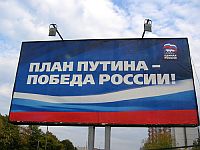
United Russia campaign billboard declaring "Putin's Plan - Russia's Victory!" Credit: MC Lipsko
Yevgeny Volk, a researcher at the Moscow office of the Heritage Foundation, a conservative U.S.-based think tank, said that in most democracies, the electoral process is known but the results are supposed so be unknown before election day.
“In Russia, however, the results are generally known well in advance, it is the electoral process that remains a mystery from year to year. The Kremlin’s persistent manipulation of the electoral process – ranging from smear campaigns and denying media access to the opposition, to United Russia’s failure to participate in public debates with other parties – has demonstrated the increased degradation of democratic processes in Russia,” Volk told IPS.
He added that “the number of parties participating in next month’s parliamentary election is not indicative of democratic growth, rather it is a mere show demonstrating a weak and divided opposition and the increasing popularity of radical, ultra-nationalist fringe groups.”
Last weekend, the police broke up anti-Kremlin demonstrations eight days ahead of the election in Moscow and St. Petersburg and several small towns, which had been organised by the opposition coalition popularly called The Other Russia.
Police detained several members and one of the key leaders, along with noted chess champion Garry Kasparov. Riot police also detained Boris Nemtsov and Nikita Belykh, leaders of the Union of Right Forces, who are both running in a parliamentary election. They were later released.
But Kasparov was hastily charged with public order offences and police sources confirmed they would hold him for five days as an administrative punishment.
A local district court in Moscow found Kasparov guilty of violating the rules of holding rallies and of civil disobedience, the court’s spokesperson, Anna Usachyova, told local media.
“Kasparov was remanded to five-day police custody. The term begins from the moment of detention. He was placed under arrest in the courtroom,” she said.
The other cases, including the case of Alexander Averin, the press secretary of the banned Nationalist-Bolshevik party, are scheduled to be heard this week, Usachyova said.
Elena Ryabinina of the Memorial Human Rights Centre told IPS that rights activists this week also planned to send letters to Russian Human Rights Commissioner Vladimir Lukin, to the head of the Presidential Human Rights Council Ella Pamfilova, and to international human rights organisations, in addition to calling an extraordinary meeting of the Moscow Helsinki Group, Memorial and All-Russia Civil Congress to discuss pre-election abuses of civil liberties in the country.
The Kremlin has mounted an aggressive campaign to gain victory for Putin’s United Russia party, a move the opposition believes is aimed at ensuring that Putin can continue to govern the country behind the scenes even after he relinquishes his post as president next May.
The constitution prevents him from serving three consecutive terms, but President Putin has been personally involved in the campaign, carrying it to Russia’s southern regions. One distinctive feature of the campaign is billboards that are conspicuously displayed with United Russia’s slogan, “Putin’s Plan is Russia’s Victory,” along the main streets throughout the country.
Supporters say they will not give up the fight. “I have been elected to the legislative assembly twice, both times through the United Russia party list. After all, now I find my responsibility in the electoral district, Krasnodar, more challenging and served as part of the debt of gratitude I owe my constituency and represented their interests as the member of federal parliament,” a staunch member of the United Russia party, Akhmed Bilalov, told IPS.
This Sunday, an estimated 100 million Russian voters will elect 450 deputies to the State Duma, the lower chamber of lawmakers. Unlike every parliamentary election since 1993, all the deputies are being chosen from lists compiled by the leaders of 11 parties formally registered to run in the election. The 450 seats would be distributed on a proportional basis among parties that receive at least seven percent of the vote.
The Russian Central Electoral Commission says that 11 parties have been registered for the elections: the Agrarian Party of Russia, Civil Force, the Democratic Party of Russia, the Communist Party of Russia, the Union of Right Forces, the Party of Social Justice, the Liberal Democratic Party of Russia (LDPR), A Just Russia, Patriots of Russia, United Russia, and Yabloko.
According the Electoral Commission, political parties that gain seats in the fifth State Duma would have the right to nominate their candidate for president without collecting signatures.
Opinion polls indicate that only two to four parties are likely to garner seats in the next parliament: United Russia, the Communist Party, LDPR and Just Russia, in that order.
At a meeting with representatives of the United Russia party, Putin said that increasing pensions would be one of the most important challenges of Russia’s future. He said that his party had made infrastructure development one of its priorities, as well as national projects to develop education, healthcare and the agriculture sector.
The president expressed his hope that the next parliament would continue to implement current development plans.
“You could ask yourselves then, why did I decide in this situation to head the United Russia party? The results we have achieved recently were made possible in large part because in my practical work, that I have the support of United Russia in the parliament, and this was very important,” Putin said.
“If people vote for United Russia, if the overwhelming majority of citizens vote for this party, this will give me the moral right to hold accountable those who will be working in the legislative chamber and the government for the implementation of the decisions made today,” he said.
 Print
|
Print
|




