Wednesday, September 9, 2026



News and Views from the Global South
Q&A: ‘If the WSF Didn’t Exist, It Would Be Necessary To Create It’
Interview with Aminata Dramane Traoré
- Aminata Dramane Traoré, one of the leaders of the anti-globalisation movement in Mali, reckons that the World Social Forum (WSF) is a representative movement that is essential to the common struggle of people oppressed by a “violent world economy” which often flouts fundamental rights.
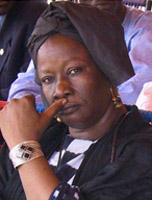
Aminata Dramane Traoré Credit:
There is still much to be done to shed light on the relationship “between the destructive nature of neoliberalism and armed conflicts,” Traoré said.
IPS: Various WSF-related events are being planned for Jan. 26, to coincide with the Word Economic Forum (WEF) in Davos, Switzerland this year.
Aminata Dramane Traoré: That is why I will be in Geneva on the Jan. 26, where in close collaboration with other groups, including “Les Jardins de Cocagne”, I will present the findings of the forum which we have just organised here looking at African emigration to Europe and the risks of Economic Partnership Agreements (EPAs) which are currently the bone of contention between Europe and Africa.
IPS: When the forum resumes next year, the WSF process will have been underway for almost a decade. How has the forum succeeded in this time – and where has it failed?
ADT: The WSF has been and continues to be a privileged event – with civil society mobilisation that is unprecedented – all over the planet. If it didn’t exist, it would have to be created so that it could stand up to a violent economic order that is often indifferent to people’s economic, political, social and cultural rights.
The WSF is all the more necessary because democracy has significantly lost its meaning, regarding power to the people, through the people and for the people. Multinationals’ interests determine the policies of rich countries, which in turn use conditionalities to influence the policies of indebted and dependent countries in the South. Local democracies – as is evidenced by numerous wars linked to local elections – are purely a formality, without any real links to macroeconomic stakes and geo-strategic interests.
In this dramatic situation, the questions raised by the WSF have greatly contributed to awakening the consciences of the populations as well as certain political leaders, who are now starting to admit that our debates deal with the essentials. This is how an alliance around the EPAs debate has been woven between certain leaders, and particularly President Abdoulaye Wade [of Senegal], and some members of critical civil society, who found an echo to their claims, in the taking of official positions against EPAs.
The African political class also admits that, in comparison to the external debt burden and to the agricultural subsidies of rich countries, the margins to manoeuvre that it has obtained, though small, are in part the fruit of critical civil society raising its shield against globalisation. In other words, the WSF has not failed at all. What we have seen is only a pause to assess ground covered and to consolidate our foundations.
IPS: Do you believe the forum remains an appropriate venue to discuss the issues that have traditionally been highlighted at the WSF, such as problems associated with globalisation?
ADT: I believe that the WSF is not only the most appropriate venue to discuss globalisation related issues, but I also do not see any other venue or process or critical debate against this system, that has been done outside the WSF, with the same impact.
IPS: How might the forum evolve to deal with new challenges confronting civil society? What are the most pressing of these challenges, as far as Africa is concerned?
ADT: We remain attentive to the current developments, so much so that none of the challenges that defy humanity more and more have escaped the vigilance and discernment of the social movement’s actors.
With the issue of global warming – from the onset – the issue of the environment was noted on the WSF agenda. When we debated alternatives in the agricultural sector, potable water, energy sources and GMOs [genetically modified organisms] we were the forerunners in the critique of the impact of the globalisation on ecosystems.
It is the same with most of the conflicts, which have today cast a shadow on the whole world. We feared them and we calculated that as long as we do not find fair and credible responses to humanity’s evils, we are advancing towards endless internal and inter-state wars. The control of raw material sources by multinationals – which are connected to most of the conflicts – is one of the major themes of the African social movement.
We are currently reflecting on the modalities of how to anchor the movement and how it can be supported by most of the people from Africa, Asia, Europe and the world. We are also reflecting on the original forms of financial resource mobilisation.
IPS: Are you calling for the WSF to return to Africa next year?
ADT: Given our continent’s vulnerability to the evils of globalisation, another WSF would not be too much.
IPS: Assuming the forum is hosted on another continent, what innovative ways can African non-governmental organisations use to ensure representation at the next WSF? What fund-raising strategies could they turn to that perhaps haven’t been used before?
ADT: The African Social Forum is in the process of examining the modalities of income generation that can give social movements more autonomy. We are particularly thinking more about networks and processes which proceed partially from the movement itself, namely fair trade, mobilisation of artists and intellectuals, and also from other innovative responses which we are still mastering.
IPS: Do you think the WSF has a role in situations such as that currently unfolding in Kenya, over the disputed results of last month’s presidential election?
ADT: The situation in Kenya, in my opinion, has exposed the underlying nature of the dominant discourse on what Africa’s development should be. How can one not be surprised that a country so showcased and praised by the international community as a political and economic model, explodes so much because of a contested electoral process? The dominant media, which favours the ethnic dimension of the conflict, is deliberately mistaken about what is at stake. The pauperisation of Kenyans – whilst their leaders rake in glowing reports from the international community – shows that right there where the dominant model triumphs, people are slaving away.
As I see it, no African country has any form of shelter from this type of explosion, as long as [donors] and student states glorify themselves in the face of advances which are enriching the rich countries and their local associates. Those who truly oppose this situation should name the devastation of the market economy and challenge their competitors on this basis.
IPS: What practical steps could the WSF, its organisers, or groups that form part of its process take in such a situation?
ADT: There is still much to be done at the level of the WSF, in terms of shedding light on the relationship between the destructive nature of neoliberalism and armed conflicts. If we had attained our objectives at this level, Kenya, where the WSF met in January 2007, should not have had the blood bath we have just witnessed.
 Print
|
Print
|