
Monday, October 26, 2026



News and Views from the Global South
BRAZIL: 'Social Circus' Turns Young Lives Right Side Up
Fabiana Frayssinet
- Standing on your head, walking on stilts, juggling and doing balancing acts – life often seems like a circus metaphor. And for one Brazilian social organisation that is exactly what it is.
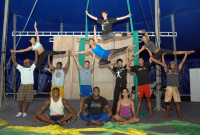
Youngsters learning the circus arts. Credit: Courtesy of Crescer e Viver.
A four-masted circus tent covering an area of 768 square metres marks the place where the non-governmental organisation "Crescer e Viver" (Grow and Live) carries out its social and cultural work.
The group, coordinated by Junior Perim, uses the circus as a tool to develop the physical abilities of young people aged from seven to 24, but above all as a social tool.
Perim calls what they do "social circus," that is "using the expression of circus art as an educational tool, for personal and human development, to build young people's creativity and inner lives."
Life has not been easy for Dijefferson da Silva, today one of the circus' best trapeze artists. He used to wash cars at the parking lot that is now home to the circus.
Although he carries his excess weight with elegance, he was turned away by many circus schools. But now his extra kilos not only do not hamper his movements, but he makes use of them to keep his balance, grip the bar, and fall with gravitational grace from the high trapeze.
The challenge, to Dijefferson, is much weightier than his few extra kilos.
"I am a circus artist," he says with pride, adding that "this was a great leap in my life" from being a car washer, where he was exposed on a daily basis to the dangers of the streets.
The trapeze gave him a different perspective, hanging from it like a bat with his head down, but so did the cultural programme.
"When you put a youngster on a trapeze, you can say: 'see how you can look at the world another way? Now you can change it,'" said Perim.
And it is a different world, for young people born without any prospects in life, children and teenagers from communities "where they live with violence, crime, the drug trade and the family problems that arise in Brazilian society, where wealth is concentrated in a few hands," he said. "These are young people who are used to conflict."
Perim, who as a boy slaughtered chickens at a poultry processing plant to get by, knows from experience, which he now applies to his circus techniques: juggling, acrobatics, and manipulating objects, among other skills.
That is why he conceived this project as an arena where what matters is to accept challenges, overcome difficulties and, often, walk the tightrope.
Many of his students have gone on to success in international circuses or at the National Circus School, the benchmark for the circus arts in Brazil. Others take jobs in theatre or dance troupes, thanks to their experience with Crescer e Viver.
But the goal goes beyond the circus ring, to include "building values like respect, a sense of community, and the importance of studying, of learning how to develop skills and knowledge," Perim said.
The performance is "continuous," and so is the "learning process." In this project, social criteria prevail over technical and artistic merit, even for taking part in a circus show, put on by the group at affordable prices, for which the performers receive fees.
Youngsters who did not miss school, who participated in activities, and who were able to live together with the other members of the community without creating conflicts, are rewarded by appearing in the final performance.
Vinicius Daumas, a professional clown who conceived the project with Perim and is the educational coordinator of the circus school, said that nothing was chosen at random.
"Here we do juggling, stilt-walking, trampolining, acrobatics – all of which are ways in which a human being sets him or herself constant challenges," said Daumas, who introduces himself as a "clown" before mentioning that he is the project's "educational coordinator." "The students have to maintain their balance on a wooden stick a metre-and-a-half long, turn a somersault and land in place, and juggle with objects," none of which is easy inside or outside the circus world, he said.
But on the outside there are no fantasies. "You have to juggle the accounts to pay the bills, and you often have to walk a tightrope to make a decision; and trust in others, establishing contact with them, is vital," he stressed.
According to Daumas, the circus teaches these things better than anything else. And the results, in the end, are transformed into a spectacular performance.
These young people, formerly marginalised, now shine before an audience that showers them with applause. Aline Figueiredo, an acrobat, says that what she feels when performing in the ring is "surreal."
"With the adrenaline rush of fear, having to keep your balance without falling, having to maintain a posture, seeing the people down below, it's fantastic. It's like saying, 'look at me, people! I'm here!'" Daumas said.
Perhaps, said Perim, that is precisely the point: "We're here – we are visible."
 Print
|
Print
|



Pictures for this story
This story includes downloadable print-quality images -- Copyright IPS, to be used exclusively with this story.


