Tuesday, August 25, 2026



News and Views from the Global South
ENVIRONMENT-AUSTRALIA: Harvesting Stormwater as Drought Bites Hard
Stephen de Tarczynski
- With large parts of southern and eastern Australia enduring an ongoing drought, the regional centre of Orange – some 260 km west of the nation’s largest city, Sydney – is developing Australia’s first scheme to harvest stormwater in order to service the town’s requirements.
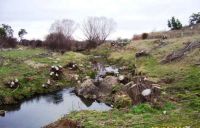
Stormwater Harvesting Site. Credit: Orange City Council
He told IPS that while the Blackmans Swamp Creek Stormwater Harvesting project offers a “fairly quick solution” to Orange’s water crisis – the town’s two reservoirs are currently at 40.5 percent capacity, up from a low of 27 percent in early September following seasonal rains – the council wants the program to become a permanent fixture to help drought-proof the town.
And such provisions may well be required, with Orange hitherto relying solely on surface water run-off to rural catchments.
A statement on the drought issued Nov.5 by the Bureau of Meteorology’s National Climate Centre (NCC) implied that drought-like conditions will become the norm rather than the exception as the effects of climate change take hold.
“The combination of record heat and widespread drought during the past five to ten years over large parts of southern and eastern Australia is without historical precedent and is, at least partly, a result of climate change,” said the NCC.
Orange’s plan involves trapping water from Blackmans Swamp Creek northeast of the town, extracting and treating it before the water is eventually added to the town’s main drinking water dam.
But while Orange’s roughly 40,000 residents may soon have more water available for use with the first harvesting planned for March 2009 – the town is currently under level 5 water restrictions which severely limit water-use by private households, with fines of up to AUD 2,000 (1,351 US dollars) for those who fail to comply – concerns have been raised regarding the water quality.
Orange citizens have been airing their views on the project on a website – linked to the council’s own site – established for that purpose. Among the concerns raised is that water which runs off roads, footpaths and parks will not be suitable to drink, even though an overwhelming 85.7 percent of respondents to a survey on the site say they would be happy to drink stormwater.
Acknowledging the disquiet, however, Devitt says that the council has been working hard to convince people that the water will be safe. “Obviously, there were concerns about drinking the water that runs off the street and all the stuff that goes with it,” he says.
Devitt points out that the council ran a two-day workshop with “various government authorities” and “environmental agencies” including the New South Wales state government’s departments of health and water and energy.
“As a result of that we’ve got quite robust processes in place to guard against any contamination,” says Devitt.
Geolyse, a local consultancy firm which undertook a review of environmental factors on behalf of Orange Council, expects the water to be of a high quality.
“Available data indicates that the quality of this water compares favourably with typical values for an urbanised catchment,” says the report prepared by Geolyse, released in July.
But while the indications are that the water will indeed be safe to drink, people downstream from Orange – including farmers and graziers who use water from the creek system – are worried that stormwater harvesting will have a detrimental impact on them.
“We’re just very fearful that it is really going to restrict our access to flows, particularly during the drier months of the year in the summer months,” says apple grower Ian Pearce, echoing concerns of irrigators elsewhere in the Murray-Darling Basin – Australia’s most important agricultural region – regarding water access.
Although his orchard does not front the creek, Pearce has a licence authorising him to pump water to his property about one kilometre away.
Pearce regards this water as his “insurance policy”, preferring to use dams and bore-water on his own property.
“But in the last five or six years when it’s just been horrendously dry we haven’t been getting any run-offs into our dams and we have been very reliant on our creek licence for our water supply,” he told IPS.
It is a concern that other stakeholders are aware of. While Geolyse acknowledges that the stormwater harvesting project “must have a downstream impact”, it argues that the development can be implemented “without the risk of serious or irreversible” damage to the environment.
“The challenge will be to adaptively manage the scheme’s use so that this impact is not significant and that the needs of downstream users and the aquatic environment are not comprised,” says the consultants’ July report.
The council – which is funding the A 4.9 million (3.30 million US dollars) project in combination with the state government – is also keen to offset such unease.
In a statement released last month, Orange Mayor Reg Kidd indicated that up to 2,200 megalitres could be harvested – equivalent to more than 200 days of the town’s water usage – from the 12,000 megalitres that flow down the watercourse each year on average.
“Limiting the harvesting ensures environmental flows are maintained and downstream users who rely on water for their livelihood and lifestyle are not adversely affected,” said the mayor.
It is a position supported by the council’s technical director. “The main determinant, I suppose, is that the project only harvests when there’s excess water in the creek, effectively. For 80 percent of the time the creek system will operate as normal,” says Devitt.
But while Pearce is not opposed to stormwater harvesting per se, he remains unconvinced that the Blackmans Swamp creek system – which he describes as “already highly-stressed” – can cope.
“We can see a merit in stormwater harvesting as a concept but we’re opposed in the way it’s proposed to be implemented and we really want to see a better management regime of the whole process,” he says.
 Print
|
Print
|