
Thursday, August 27, 2026



News and Views from the Global South
Q&A: ''The One Goal is to End Homelessness''
Stephen de Tarczynski interviews Mel Young, president of the Homeless World Cup
- The week-long Homeless World Cup football competition came to a dramatic climax here on Dec.7, with Afghanistan and Zambia, respectively, winning the men’s and women’s competitions in what was the sixth edition of the annual tournament. But while the competition provides players with the opportunity to represent their country and gives spectators a chance to appreciate some exhilarating street soccer, the Homeless World Cup’s president and co-founder, Mel Young, told IPS that ending homelessness is the real goal.
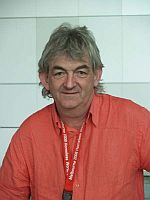
Mel Young Credit: Stephen de Tarczynski/IPS
The competition has grown exponentially since it was first held in Austria in 2003, when 18 teams competed. Since then, the cup has been hosted by Sweden, Scotland, South Africa and Denmark. This year saw a separate women’s competition played for the first time, with eight nations participating.
While the Homeless World Cup – which is to be played in Milan, Italy in 2009 – has triggered grass-roots street football programmes involving in excess of 30,000 people across more than 60 countries, it also appears that most players get far more out of the competition than merely travelling to a foreign country to participate in a football tournament.
Organisers point to research which indicates that more than 70 percent of Homeless World Cup players make significant, positive changes in their lives, including moving into homes, jobs or education and addressing drug and alcohol issues.
Mel Young, a 55-year-old Scotsman and president and co-founder of the competition – along with Harald Schmied – spoke with IPS writer, Stephen de Tarczynski, at the Homeless World Cup.
IPS: The advertising slogan for the 2008 Homeless World Cup is ’56 teams, one goal.’ What is that one goal? Mel Young: The one goal is to end homelessness. The goal is that afterwards people are not homeless anymore. Personally, I don’t think there should be any homelessness in the world and this is a practical way, a grass-roots way of creating a change.
IPS: Is ending homelessness achievable? MY: It would appear to be impossible because there are one billion people homeless in the world, but I don’t see why it shouldn’t be. I think we have to change our attitude towards it and towards poverty. We’ve created a system where the rich get richer, the poor get poorer, where one person is richer than one country and where people die because they can’t get to water. Now, that’s not sustainable for the world. We are very resourceful people. The human race is incredibly resourceful.
If we put our minds to it we can do a lot and so if we decide to end homelessness, we can end homelessness. I think it’s just a question of priority and it’s a question of values in the world. I think that in some ways this global financial crisis that’s happening at the moment is maybe asking some questions of us all about what we are actually doing here and asking us about the kind of values that we should have. And maybe we need to return to some of these basics.
IPS: So the world needs a change in values? MY: Yeah, I think actually that human beings are good at heart, but it’s not always expressed in the systems that we create. I always say this, but I do a lot of talks and so on to people, from very rich and powerful people on the one hand to very poor people, to students, to old people, to everybody, and I have yet [to hear anyone answer in the affirmative] when I say ‘does anybody think that homelessness is a good idea?’ Not one person in all the years has said yes.
Nobody thinks it’s a good idea, so why do we have it? We don’t think it’s right but the system somehow creates it, for which we are all responsible. So, it’s some fault in the system and we need to change that.
IPS: The Homeless World Cup has grown to a large competition, with 56 teams from all over the world in Melbourne to compete. How much does it cost to run the cup? MY: Well, you’re talking about a budget of around two million Euros and whichever way you want to look at it, you could say that is a lot of money. It is. Or you could say that’s no money. It isn’t. Because if you compare it with the cost of the Olympics it’s 0.00001 percent of the budget. It’s one UEFA Champions’ League match. In proportion it’s nothing. But I think it’s right that we spend this money for two or three reasons. One, we get the outcomes. I can give statistics that show the cost of a person who is homeless is 40,000 US dollars in New York and 150,000 dollars in Britain. To keep them homeless every year just costs a fortune. If they’re not homeless you’ve saved that money. Therefore, by investing that two million Euros you actually are saving, potentially, hundreds of millions because it’s not only about the players that are here, it’s about the 30,000 to 40,000 that we have in the projects globally.
IPS: And that is very much part of it, right? For all the media attention that the actual Homeless World Cup receives, it’s fundamentally about the other 30,000 or 40,000 people around the world who are participating in street soccer, isn’t it? MY: Absolutely. I mean, this is really one week of the year. It’s our year-end celebration, if you like. Everybody’s aiming to get here, it’s part of a process. But it’s one week. For the other 51 weeks of the year there are a lot more people involved and we have many mini world cups, if you like, called national championships. These countries have all had national championships, which a lot more players have participated in. To get to the national championships there have been city championships. There are kinds of little pyramids all built on top of one another and this is just the end of it. But we do this because of the initial reaction. When you speak to homeless people in the street, you say ‘maybe you could play in the next world cup final’ and they see it as something that’s possible for them and then they go through the process.
IPS: The first Homeless World Cup was played in 2003. Have you been surprised at the growth that the competition has achieved in such a short time? MY: Staggered. I never, ever imagined it would be anything like this. It’s way beyond anything I imagined, in size, in terms of impact but also in things like media interest. That’s been a side that’s interesting because media normally present homeless people as negatives and they now present them as positives. And I think that goes the same for people who are watching the games. Those people who are watching and applauding are watching a football match, actually, whereas yesterday they might have crossed the road if they had seen a homeless person, to avoid them. So, that’s been staggering. It’s all amazing to me, but we keep doing it and I’m very ambitious about it. Simply for this reason: it works. We can do the research and we have lots of anecdotal stores about players changing their lives, so we keep doing it.
IPS: Do those significant life changes come just from football? Is it just because of being involved in the sport itself? MY: It’s about the sport initially and within the sport it’s a psychological change that’s taking place…Soccer is a very simple game to do, anybody can do it. It’s a round ball, people kick it around. You can kick it in the street, you can play it anyway and you can be rubbish at it or you can be brilliant at it. But the sport is about a psychological change taking place. When you’re homeless you’re very isolated. You’re out there and you’re lonely and [change takes place when] you come and you have to kick a ball. As soon as I kick the ball to you, there is a connection. And how I kick the ball to you in a game against somebody else matters. So, you matter now and you build that up in terms of team.
If you look at sport it’s all about teamwork, it’s all about inclusion and support. It’s almost like many of these people, maybe, are on the outer [in terms of their families] and we are creating families around football, something in which they can belong. That is a very, very powerful tool. Many of these people have absolutely wrecked self-esteem and are very low on confidence. When you’re like that, even if opportunities emerge like potentially having a house or potentially having a job, you don’t get it because you don’t have the confidence, so it’s about instilling confidence and that’s very important.
IPS: Was the accessibility of soccer a major factor when you chose to develop the idea of a homeless competition of football rather than a different sport? MY: I have a genuine view that any sport will work but football is international, everybody understands it. Even in countries where they don’t really play it it’s understood. We wanted it to be international and one of the reasons we came to it was because there was going to be an issue about language. And this is an international language. Just kicking a ball around the place you don’t need to speak the same tongue. That’s the reason we chose it.
 Print
|
Print
|



Pictures for this story
This story includes downloadable print-quality images -- Copyright IPS, to be used exclusively with this story.


