
Friday, October 16, 2026



News and Views from the Global South
WATER-NAMIBIA: Policy to Create a Water Scarcity?
Servaas van den Bosch
- Several 20 litre buckets of water are crammed inside the small enclosure around the only tap in Epingiro, a small gathering of kraals in the Kavango woodlands in northern Namibia.
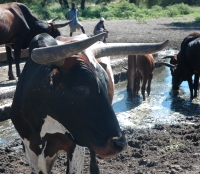
Sanga cattle at the water point. Though cattle consume the most water, the poor may be subsidising water for richer livestock owners. Credit: Servaas van den Bosch/IPS
Normally the tap is locked, to prevent people from neighbouring settlements from stealing water while the villagers are away. But today the ‘pompa boy’ in charge forgot to lock the tap and, rather than queuing up after a long day of work the women prefer to just pick up their buckets on the way home.
Ever since the government has started its reform of the rural water supply, water has become a scarce commodity, says Mukuya. Under the colonial South African administration, water was free for people in the communal areas. It was one of the many mechanisms the apartheid regime put in place to control the rural population.
Now communities are organised in Water Point Associations (WPAs), governed by committees, tasked with regulating and collecting the levies for the water supply, explains Mukuya, while he tightens the tap to make sure not a drop is lost.
“The government has stopped buying fuel for the pumps as part of the reform programme. They still come in to fix the pump when it breaks, but that will also stop eventually.”
It is meant to lead to a paradigm shift. “Under the South Africans, water was used in a completely ecologically unsustainable manner”, says Dr. Thomas Falk, author of a soon to be published study on the impact of the decentralisation of the rural water supply that affects one million Namibians.
Commercial farmers were able to pump water at heavily subsidised rates and the mining industry used enormous amounts of water at low cost.
“These dynamics were reflected in the water consumption”, says Falk. “Although communities used a fraction compared to the commercial sector, a perception developed that water is an abundant, free resource, not a scarce good.”
Though the water situation in Namibia is believed to be extremely precarious – only the Sahara desert nations are more arid – astonishingly nobody knows exactly how little water there is.
“A quantitative analysis of available groundwater data is on the books, but will take three years to complete”, says Greg Christelis, deputy director of Geohydrology at the Ministry of Agriculture, Water and Forestry. He says there is no data indicating that aquifers are depleting countrywide, but acknowledges that existing studies are confined to particular geological sites.
“All we know is that bush encroachment has a large effect on the groundwater table. In areas where bush is removed, recharge is much higher.”
Bush encroachment is the most common form of land degradation in Namibia with roughly 26 million hectares of rangeland affected.
The Water Supply and Sanitation Sector Policy of 2008 identifies an ‘environmentally sound utilisation of resources’ as one of the cornerstones of a reformed rural water supply, but the lack of comparative data makes it difficult to put a price tag on this.
The reform policy has arguably helped to conserve water as communities have to bear the brunt of unsustainable use themselves. In Epingiro the villagers only run the diesel pump that operates the borehole once a week. “If there is a lot of rain, like now, many people will rather trap rainwater for household use and let the cattle find water in the bush”, says Robert Mukuya.
But in the dry season, the 100 villagers and their 800 head of cattle have no choice but to rely on the borehole. It takes approximately 25 litres of expensive diesel to fill up the two large reservoirs for a month. On top of this come extra costs for belts, engine oil and the salaries for the two pompa boys that regulate the water supply and carry out small repairs.
One of these, Valentinus Kasere, explains that it is a mission to get the 500 Namibian dollars – 50 dollars U.S. – needed for the monthly water supply from the villagers. The rule set by the Epingiro WPA is that every household pays N$15 and households with cattle pay N$25 extra, but this rule is not often adhered to and even more rarely enforced.
“We will never refuse anybody access to water, if a person cannot pay, the community will have to make a plan.” While teen herders appear with their cattle at the water point, Valentinus and his colleague Hausiku Joseph struggle to open the lock from the tap that fills the drinking trough. They outline the measures that are taken to cut costs and conserve water.
“The pump, for instance, only pumps at night to prevent overheating and we regulate the amount of water that people can take on any given day. And if the manual pump in the neighbouring village breaks down – as it often does – we will charge N$2 per drum to supply water to those people.”
Apart from the locks, there is a stick fence around the water point to prevent the Sanga cattle with their sharp horns from damaging the facilities. In areas with a lot of wildlife, solid concrete enclosures are needed to prevent thirsty elephants from demolishing the community’s lifeline.
More than half of the boreholes in rural areas are operated by diesel pumps, a quarter use windmills and almost another quarter is dependent on manual pumps. Solar operated pumps compose only a tiny fraction of the total: while they cost almost nothing to use, they are expensive to purchase and not always technologically feasible.
The government has decreed that up to five percent of household income should be set aside for water, but for people in extreme poverty who often have no formal income whatsoever, this is an arbitrary standard, says Thomas Falk.
As a result of the reforms, people minimise their water use. According to the statistics many people in the rural areas get by on only ten litres of water per day, while the World Health Organisation has set the bar at 25 litres as a minimum required daily need for washing, cooking, cleaning and bathing.
Decentralisation may have reduced water consumption, but it appears to be doing so at the cost of quality of life for the poor while the effect on the environment remains unclear, say researchers.
Falk: “There is no way to measure how much water is conserved, because no one can sit at the water point and count buckets. And even then, there would be no data to compare with.”
So does the reform only conserve water indirectly and through burdening the weakest stakeholders, while leaving the commercial users of water alone?
Falk: “The logic behind the reform is that both commercial and communal users should pay for operation and maintenance of the water supply. The emphasis is more on efficiency than on ecological sustainability.”
“Mines get a quantity of water allocated based on an environmental impact assessment, which in theory limits their consumption. Although these rules arguably go a long way to conserve water, it is important to note that the resource itself is not taxed.”
An evaluation report on various donor projects by the European Commission in 2008 concluded: “There appears to be little co-operation between water supply and sanitation scheme planners and the providers of water; merely an assumption that water is, or will be, available.”
 Print
|
Print
|



Pictures for this story
This story includes downloadable print-quality images -- Copyright IPS, to be used exclusively with this story.


