Languages
Friday, October 2, 2026



News and Views from the Global South
Opinion

Private and Public Spheres: Sweden and Mugabe
The war in Ukraine continues unabated; young men are sacrificed on battlefields, towns laid waste by aerial attacks, the threat of nuclear disasters is looming. People within an often formerly friendly inclined Europe are now wondering if Vladimir Putin has gone insane. The war in Ukraine is generally called “Putin’s war” and in April 2021 Putin signed a legislation providing him the right to run for two more consecutive terms, thus he could stay in power till 2036.
Supporting Conflict Prevention & Social Cohesion in Mauritania
Deep in the heart of Southeastern Mauritania lies the district and town of Bassikounou, nestled on the border with neighboring Mali, over 1,200 kilometers from the capital city of Nouakchott.
Can Carbon Trading Stop Global Heating?
As our planet continues to heat up at an alarming rate, carbon credits, markets and trading have been promoted as effective measures to combat global warming. While there is an urgent need to curb planetary heating, growing reliance on this innovation is problematic, to say the least.
Water – a Weapon of War or a Tool for Peace?
The role of water in conflicts is changing, with more attacks against environmental and civilian infrastructure. Dr Martina Klimes of the Stockholm International Water Institute (SIWI) recently held a lecture describing the shifting security landscape and how water can be both a weapon and a victim of war – and sometimes a tool for peace.
The Ukraine War – Will it Ever End?
There seems to be no end in sight to the war in Ukraine. On the contrary it continues to escalate. The latest ratchet up has been the decision by the USA to supply the Ukrainian army with cluster bombs. These are nasty weapons which scatter and explode over a wide area. They are specifically designed to kill people rather that destroy infrastructure, military installations or communication hubs. They also have a sting in the tail – some of the bomblets remain unexploded, effectively becoming anti-personnel mines. These can turn wide swathes of territory into virtual no-go areas.
Re-thinking Disability Inclusion for the SDGs
This year marks halfway towards the Sustainable Development Goals (SDGs), an ambitious agenda which set out to transform our world. We have always known that the goals cannot be realized without the inclusion of persons with disabilities. From poverty to inequality, climate to health the promise to leave no-one behind is the bedrock of the SDG call to action.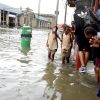
Shielding the Vulnerable: The Potential Role of Insurance in Protecting the Most Vulnerable
Small Island Developing States (or SIDS) have been talking about loss and damage in an insurance context since the creation of the UNFCCC. The original 1990s outline of the UNFCCC included the proposal for an international insurance fund that would compensate low-lying countries for losses from rising sea levels in the future, however, this fund was never adopted in the final text.
Prigozhin: An Outsider With an Army
The Wagner uprising – despite its short duration – has demonstrated the vulnerability of Putin's power system. In the past, the oligarch Yevgeny Prigozhin seemed like a dark, mysterious figure somewhere from the depths of the Kremlin's web of secrets. This also has to do with the fact that he did those 'jobs' for the Russian government that took place in a semi-official grey area — such as mercenary assignments in Syria or Africa, or even before that the operation of the Petersburg troll factory with a network of fake media and disinformation machinery.
Cloud Lingers over Sierra Leone’s Election
People went to the polls in Sierra Leone on 24 June to pick a president, parliament and municipal representatives. Results were quickly announced and the president sworn in for a second term. But a cloud of doubt lingers.
The Grand Narrative of Private Finance: Over-Reliance on Attracting Investment is Undermining Change at World Bank
One message that was repeated throughout last month’s summit on a so-called “New Global Financing Pact” was that developing countries urgently need mass financing to tackle the climate and biodiversity emergency. And there is not enough of it in public coffers.
Guatemala Clings to Democratic Promise
When Guatemalans went to the polls on 25 June, distrust and disillusionment were rife. First place in the presidential contest was claimed by none of the candidates: it went to invalid votes, at 17 per cent. Many didn’t bother, resulting in an abstention rate over 40 per cent.
Recognising Human Rights Defenders as Remarkable Agents of Positive Change
In recent years, the global landscape for human rights defenders (HRDs) has become more difficult and complex, with both new and heightened challenges. With hundreds of defenders killed every year, the scale and magnitude of threats faced by HRDs is unprecedented.
Transformative Change of our Relationship with Nature: Key to Saving Global Biodiversity
To most people, ‘transformative change’ is an abstract academic catchphrase. But transformative change is far more than that. It is the foundational response necessary to address the global crisis of biodiversity loss that threatens the wellbeing of every person in every community – and every species in every region.
Climate Change and Development
There is little doubt that human activity is accelerating climate change. Our activities are causing global warming and potentially disastrous climate change.
How the Security Council can Better Pursue Accountability for International Crimes Against Children
All my life was wasted, said Anwar*, as he told me recently about his traumatic experiences living under the Islamic State (IS) armed group in Northeast Syria. Around 2018, when Anwar was 14 or 15 years old, his father, a member of IS, forced Anwar to train with the group as a young teenager. He even made Anwar watch as he inflicted brutal punishments on people who broke IS’ rules.
Gender-Based Violence: Why Victims Do Not Leave
In almost every conversation I’ve had about gender-based violence (GBV), the question “why don’t they leave?” inevitably comes up. After many years of working in this space, I have learned that the answer is not as simple as we think. The nature of GBV is quite complex. Numerous layers and factors affect individuals both internally and externally.
Mobilizing Private Capital for Adaptation: the Silent Climate Need
In the climate change discourse, “mitigation” (namely, reducing greenhouse gas emissions) often dominates. This is particularly true when the discussion turns to the mobilization of the massive amounts of private capital needed to achieve our climate objections. But “adaptation” — namely, action to respond to the impacts of climate change that are already happening, as well as prepare for future impacts — also faces large funding needs.
The Need for More Funding, Especially to Women, Towards Climate Adaptation Goals
There is a significant funding gap for climate adaptation – especially for women. Public financing will not be sufficient to close this gap, but it will be crucial for supporting the most vulnerable and facilitating private sector investments where funding and support is needed most.
The Common Good, or Transactional Religion?
For the last 30 odd years, I have maintained that religions matter. I noted the reasons for why they matter, and always listed how they matter ---as social service providers, as first responders in humanitarian crisis; as mediators in tensions and conflicts, as upholders of common good and the values of humanity; as protectors of children and of the most vulnerable; and even as political actors.
The USA’s Systemic Racism includes Its Wars
A recent Justice Department report concluded that “systemic” racial bias in the Minneapolis Police Department “made what happened to George Floyd possible.”
Out-Trumping the Trump
It’s been seven months since Florida Governor Ron DeSantis celebrated a brilliant re-election victory in the midst of an otherwise mixed Republican midterm performance. He had come in with nearly 20 per cent more votes than Democrat Charlie Crist.« Previous Page — Next Page »


The views expressed in these articles are those of the authors and do not necessarily represent the views of, and should not be attributed to, IPS-Inter Press Service

The Week with IPS

NEXT STOP - SDGs
Tracking global progress towards a sustainable world
Tracking global progress towards a sustainable world
