Languages
Sunday, November 8, 2026



News and Views from the Global South
WISDOM OF ANCIENT MAYA FOR MODERN CIVILISATION IN CRISIS
Given the unmistakeable signs that the earth cannot survive the intensified exploitation of her resources, the assault on the dignity of her children, and the exclusion and condemnation to starvation of millions of humans, it is essential that we seek inspiration in other civilisations that offer ecological wisdom, writes Leonardo Boff, a Brazilian writer, liberation theologist, and a comissioner and author of the Earth Charter. In this article for IPS, Boff writes that the Maya believe that the universe is built of and sustained by cosmic energies and that the basic duality between creation and disintegration (we would say between chaos and cosmos) confers dynamism on this universal process. Human well-being derives from our synchronisation with this process and our profound respect for all living beings. Thus human beings feel they are part of Mother Earth and enjoy her beauty and protection. Death is not the enemy but a more profound immersion in the universe. Whereas for us, work is essentially the production of goods and wealth, often disappointing and uncreative, for the Maya, work is helping Mother Earth, who gives us all we need to live, an activity that does not enslave people but allows them to express their abilities and shape their lives. This practical wisdom has great validity for this critical phase of our history. All that helps maintain the equilibrium of the Earth and its vitality should be valued and recognised as a form of regeneration and salvation.
Indians Close Ranks Against Dams in the Amazon
Between Bolivia's uncertainty and Brazil's haste, the Madera River Hydroelectric Complex is advancing -- and the alarm is sounding among indigenous communities and environmental activists in the two countries.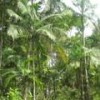
Afro-Brazilian Communities Recover Juçara Palm
Residents of what were once communities escaped slaves known as "quilombos" in Brazil are no longer cutting down the juçara palm to extract its tasty heart, and are seeking other ways to make their livelihood from this tree.Ecobreves – VENEZUELA: Exotic Plague Advances
The "ácaro rojo" (Raoiella indica), an insect measuring just 0.3 millimeters, has devastated several hundred hectares planted with coconut palms on Venezuela's northwest and northeast coast, reports the government's autonomous agricultural health service.Ecobreves – CHILE: Uniting Against Salmon Farms
Business leaders, artisanal fishers, tourism operators, students and citizen organizations in Puerto Natales, in the southern Chilean region of Magallanes, have created the Salmon-Farm Free Patagonia Association.Ecobreves – CUBA: Regional Network for Sustainable Forests
Cuba officially joined the Regional Network of Model Forests of Latin America and the Caribbean (LAC-Net) on Jul. 5 through a project to cultivate tropical plants on 30,000 hectares in the central province of Villa Clara.Ecobreves – HONDURAS: Fighting Chagas Disease
Honduras is working with Canada to put together 60 million dollars in funding for ecological and health projects in areas where Chagas disease is endemic. The illness has spread from rural areas to urban areas of the capital.U.S. LAGS BEHIND WORLD OPINION IN LINGERING SUPPORT FOR DEATH PENALTY
It's not easy to explain why, virtually alone among advanced industrial democracies, the United States holds on to the practice of capital punishment. The United Nations General Assembly recently passed a worldwide moratorium on capital punishment and most advanced industrial democracies have outlawed the death penalty. Capital punishment is coming to be seen in much of the world as an ultimate abuse of human rights. In continuing to embrace the practice, the United States finds itself aligned with nations whose human rights records it routinely condemns -China, Iran, Pakistan and Saudi Arabia. Why it persists in this globally unpopular policy and why the American public continues to support it by two-thirds majorities- is a source of puzzlement., writes Mark Sommer, host of A World of Possibilities, an award-winning, internationally syndicated radio program. Today, 35 states have capital punishment laws on their books but just ten maintain active execution programs. A number of Midwestern and Northeastern states have abolished capital punishment. About 3,350 people languish today on \"death row,\" and keeping them there is an immensely expensive proposition. The great majority are poor and a significant number are mentally disturbed. More than 40 percent are African American (four times their proportion in the general population), and disproportionate numbers are Native American, Latino, and Asian. Most experts on the death penalty decline to speculate as to why the United States hold so firmly to capital punishment. It's not enough to say that it's a tenet of conservatism in an era of conservative ascendancy since recent surveys reveal that even Barack Obama, an unapologetic liberal, finds it necessary to support the death penalty in cases in which “the community is justified in expressing the full measure of its outrage.\"AFRICA: TREES VS DESERTS
Conserving the Congo forest, and indeed all of our forests in Africa, and accelerating forestation efforts is vital to our survival on a continent where the Sahara Desert is expanding to the North and the Kalahari Desert expands to the Southwest, writes Wangari Maathai, 2004 Nobel Peace Laureate, Goodwill Ambassador for the Congo Forest, and founder of the Green Belt Movement. In this article, Maathai writes that for this reason the Congo Basin Forest Fund was launched in London on June 17. The Congo Basin Forest is the world\'s second largest forest ecosystem and considered the planet\'s second lung, after the Amazon. It provides food, shelter, and livelihood for over 50 million people. Covering 200 million hectares and including approximately one-fifth of the world\'s remaining closed-canopy tropical forest, it is also a very significant carbon store with a vital role in regulating the regional climate.Today, in the Congo Basin rainforest increased logging, changing patterns of agriculture, population growth, and the oil and mining industries are all leading to ever greater deforestation.GEORGE W. BUSH DESERVES NOBEL PEACE PRIZE
The next Nobel Peace Prize should be awarded to George W. Bush, writes Roberto Savio, founder and president emeritus of IPS. In this column, Savio writes that in just eight years, US president George Bush has managed to profoundly change his country and the world. I doubt that as president Obama would be able to motivate the formation of an opposition as vast as that of the World Social Forum at Porto Alegre. The clamour of hundreds of thousands of people against imperialism and for a different world was the result of the radicalisation produced in this period. Without it, the creation of a global civil society would have been far slower. The first major contribution of Bush was to demonstrate that unilateralism can no longer work in a world that is increasingly multipolar. He definitively disproved the theory that war can resolve conflict and demonstrated that there can be no consensus to govern without respect for international law. The failure to ratify a single international treaty (starting with Kyoto) has aroused growing irritation and as a consequence the treaty against cluster bombs has been ratified by almost every country on earth.
Profit in Watching — Not Hunting — Whales
More than one million tourists will go whale watching this year in Latin American waters, an activity that is exciting for the public and profitable for tour operators.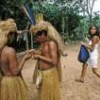
Mining Companies Venture into the Peruvian Amazon
The violent tensions arising from the mining boom in Peru could move from the mountains to the Amazon jungles, warn officials, activists and indigenous leaders.
Fighting Climate Change Demands Cooperation Now and Beyond 2012
Nobody is negotiating or making concessions ahead of deadline, says Raúl Estrada Oyuela, one of the authors of the Kyoto Protocol on Climate Change, in this exclusive column for Tierramérica.Ecobreves – MEXICO: Studying Fungus as Insecticide
Mexican scientists are researching different types of fungus that kill harmful insects without hurting the environment.Ecobreves – BRAZIL: A Promise Not to Buy Amazon Soybeans
Supermarket chains and the vegetable oil industry in Brazil have promised for another year not to purchase soybeans grown in recently deforested areas of the Amazon.Ecobreves – HONDURAS: Government Sets Sights on Wind Energy
The Honduran government plans to sign a contract at year end with a U.S. company to generate the first 100 megawatts of wind energy in this Central American country, in the southern region of Cerro de Hula.Ecobreves – MERCOSUR: How to Adapt to Climate Change
The vulnerabilities of the Southern Cone Common Market (Mercosur) to climate change were the subject of debate by meteorologists and environmentalists gathered in the Argentine capital.
The Global Food Crisis and the Latin American Paradox
As world leaders left the Rome Summit with plans to aid the world’s poor struggling with record food prices, it is important to consider some unique characteristics of Latin American and Caribbean countries. High commodity prices present an opportunity for the region to increase food supply while confronting the urgent challenge to help those most in need during this crisis.A HISTORIC CROSSROADS FOR BOLIVIA AND EVO MORALES
The social movement of Bolivia remains integrated with President Morales as its symbol, but the government does not seem able to build a new collective identity and a new social order to accommodate it, writes Jose Enrique Pinelo, an activist in Bolivia\'s social movements since 1970. In this article, Pinelo writes that Morales\' project for change must be reflected in the new Political Constitution of the State. The task of government was to convene a Constituent Assembly, redact the constitution, and submit it to popular vote. However, for more than a year the government has lost its political initiative and the Assembly has ceased its work. Morales was charged with safeguarding the strategic character of this process but because of the advance of the opposition, he used it as a tactical negotiating piece. He has called for a recall referendum on the mandate of the president, vice president, and the department prefects to be held on August 10. Thus far it doesn\'t seem likely that the constitutional process will succeed.A WAR ON POVERTY OR A WAR ON THE POOR?
The latest Human Development Report 2007/2008 of the UNDP on climate change forecasts that in less than 20 years, 2.4 billion human beings will live in shanty towns and poor suburbs that lack water and sanitation and suffer high rates of infant mortality, writes Riccardo Petrella, founder of the International Committee for a World Water Contract, is professor emeritus at the Catholic University of Louvain. In this article for IPS, Petrella writes that the world\'s major political challenge for the next thirty years and beyond is guaranteeing the right to a human life for all: in other words, the complete eradication of poverty from the world, and more precisely, the elimination of those approaches and processes which have led to the mass pauperisation of the world\'s populations. The solution involves a total and radical redefinition of the future of cities in which cities have to be given back to citizens. The author calls shifting the investment and use of local and global resources towards the generation of collective wealth in poor suburbs, namely the production of communal goods: water, health, education, housing, agriculture for local needs, renewable energies, energy saving, etc. This will involve a battle for the global restructuring of the current financial system, whose latest, umpteenth crisis proves such change is absolutely necessary.Ecobreves – HONDURAS: Human Rights Charges Against Gas Company
Environmental organizations of the Caribbean region of Omoa, in an effort to oust a polluting Mexican gas company, have knocked on the doors of the Honduran Human Rights Commissioner.« Previous Page — Next Page »





The Week with IPS

NEXT STOP - SDGs
Tracking global progress towards a sustainable world
Tracking global progress towards a sustainable world
