Languages
Sunday, November 8, 2026



News and Views from the Global South
Ecobreves – HONDURAS: Human Rights Charges Against Gas Company
Environmental organizations of the Caribbean region of Omoa, in an effort to oust a polluting Mexican gas company, have knocked on the doors of the Honduran Human Rights Commissioner.
Mexicans Protest Canadian Mining Company
Controversy about gold mining in Cerro de San Pedro, Mexico, shifted to a hotel in Toronto, Canada, venue of a shareholders meeting from the Metallica company, owner of the mine.
Mobile Phones Change Birds' Tune
As they continually adapt to their environment, wild birds in Europe have learned to imitate the ringtones of mobile telephones, say experts.Ecobreves – BRAZIL: New Rules for Oil Spill Cleanup
Brazil's National Environment Council has adopted new rules to prevent and deal with oil spills in national waters, updating legislation from 2001.Ecobreves – VENEZUELA: Eye on Desertification
The Venezuelan government has launched a plan to fight desertification, which begins with a diagnosis and description of each of its 24 regions.IT PAYS OFF TO INVEST IN WOMEN’S HEALTH
(By Thoraya Ahmed Obaid anf Theresa Shaver) Every minute of every day a woman dies in childbirth. Not from a disease that couldn't be cured. Or from complications that couldn't be treated. Almost always she dies because she didn't receive the most basic life-saving care, write Thoraya Ahmed Obaid, Executive Director of the United Nations Population Fund (UNFPA) and Theresa Shaver, Director of The White Ribbon Alliance fro Safe Motherhood. While the advances of medical care antibiotics, better obstetric procedures and control of infections sent maternal death ratios plummeting in the 20th century in rich countries, complications in pregnancy and childbirth remain the leading killer of women in Africa and South Asia. This is despite numerous pledges by world leaders spanning two decades, and a commitment to work together to meet the United Nations Millennium Development Goal 5 to improve maternal health, get universal access to reproductive health and reduce maternal death by 75 per cent by 2015. At current rates of change, this goal will not be met until 2076 at the earliest in Asia... and many years later in Africa. The tragedy of a mother lost, while shattering to every family, is not suffered equally by the rich and poor. Even though 15 per cent of pregnant women worldwide experience life-threatening complications, a woman's lifetime risk of dying from such complications is 1 in 26 in Africa, compared to 1 in 7300 in developed countries.CHANGING GAMES IN THE GLOBAL CASINO
At last, the world is seeing the difference between money and real wealth, between \"demand\" in markets and the real needs of people without money, writes Hazel Henderson, author of Ethical Markets: Growing The Green Economy, president of the independent Ethical Markets Media, LLC, and co-creator of the Calvert-Henderson Quality of Life Indicators. In this article Henderson writes that there is growing outrage and demand for reform of the games of traders, speculators, hedge funds, private equity, and even pension funds and charitable foundation and university portfolio managers, which drive up prices of oil and food, and leave the poor unable to afford to eat. The author calls for numerous reforms of the global financial casino, including taxing the 90 percent of speculation in today\'s USD2 trillion of daily currency trading; curbing the USD260 billion in index funds tied to oil and other commodities; reducing the 16-to-1 leverage allowed in oil and commodity trading by raising margin requirements.
How to Atone for Beef's Sins
Cattle consume many kilos of feed for each kilo of meat they produce and they are an enormous source of greenhouse gases in Argentina, Brazil and Uruguay.
Hake Could Disappear from Argentina's Seas
Electronic systems to track fishing, support for industrialization and environmental certification as a market incentive are among the recommended steps to save the hake.Ecobreves – MEXICO: Last Gasp of Rare Porpoise
Efforts are failing to prevent the extinction of the vaquita (Phocoena sinus), a rare species of porpoise that is native to Mexico. From 1999 to 2008, its population has plummeted from 600 to 150 animals.Ecobreves – BRAZIL: Tepid Project on Climate Change
Brazil has a project in place to create a National Climate Change Policy, defined by interministerial commissions and sent to Congress as part of the government's celebrations of World Environment Day, Jun. 5.Ecobreves – HONDURAS: Eye on Waste Management Bill
The Honduran Congress is to debate a law to regulate and recycle waste, especially in urban zones, parliament president Roberto Micheletti told Tierramérica.BOLIVIA TEETERS BETWEEN DEMOCRATIC LAW AND FRATRICIDAL WAR
Bolivia today is split as much by geography as by psychology. Radical groups on both sides are driving the country towards a solution that solves nothing but rather encourages a general conflagration of passions and hatred that eclipses reason and threatens to destroy the hard-won democratic peace, writes Guillermo Bedregal Gutierrez, an ex-parliamentarian and ex-foreign minister of Bolivia. In this analysis, the author writes that the logic of this polarisation could drag the country into an irrational battle of inflamed factions whose only method is \'\'resolution through disaster\'\'. President Evo Morales, an auto-didact mestizo union leader from Cochabamba who defeated the political establishment with over 50 percent of the popular vote, is inspired by a \'\'revolutionary\'\' radical and iconoclastic idea and reads history through a lens of spite and resentment. On August 10 a recall referendum will be held to revoke or reaffirm the mandate of the current government and the Bolivian congress. This foolish vote will only further divide the country and fan radical passions, which could lead to the secessionist division of Bolivia. The country is passing through a moment -often unremarked- of confrontation and irrationality in which the valour of Democratic Peace is ever more absent.THE EMERGENCE OF THE SOUTH
A fundamental transformation has taken place in the structure of the world economy. The dominant feature of this transformation is the emergence of the South. Indeed, the global expansion of the past five years has been more broad-based than even before. This has allowed many developing countries to become major players in trade and investment, wrires Supachai Panitchpakdi, Secretary-General of United Nations Conference on Trade and Development (UNCTAD) and ex Director-General of the World Trade Organization. Between 1990 and 2006, the real exports of developing countries nearly tripled, while those of developed countries grew by only 75%. Similarly, the share of developing countries in world exports rose from 24% to 37%. During the same period, our data show that the developing countries\' share of all inward foreign direct investment (FDI) doubled, from 18% to 36%; and perhaps more surprising, their share of outward investment tripled, from 5% to 15%. The geographical distribution of skills is also shifting. In 1990, for example, developed countries accounted for 40% of all technical tertiary enrolments globally; 10 years later, that share had dropped to 28%. The unprecedented expansion in South-South economic linkages has been demand-driven. In other words, South-South cooperation has been guided primarily by viable economic factors and not by political considerations, as had been the case in the past. In many cases, demand for South-South business ties increased despite relatively higher tariff barriers imposed by partner countries.
Cooperatives Turn Idle Landed Estates Green
A small dairy cooperative is harvesting its first achievement in the middle of the savannah in Venezuela, a country dependent on food imports.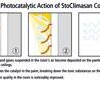
Paint that Purifies the Air
German scientists have developed an interior paint that, through a process that imitates photosynthesis, breaks down and eliminates toxic materials from the air.Ecobreves – WORLD ENVIRONMENT DAY: Fighting Climate Changing Emissions
World Environment Day was accompanied June 5 by a call to "kick the habit" of producing carbon dioxide, the principal gas associated with climate change.Ecobreves – BRAZIL: Dengue Vaccine by 2010?
A vaccine that could be effective against four strains of dengue will be available in Brazil in 2010, announced the Butantan Institute, a government research center in Sao Paulo state.Ecobreves – VENEZUELA: Two More Birds on Verge of Extinction
The tiny Carrizal seedeater (Amaurospiza carrizalensis) and the chululú tachirense (Grallaria chthonia) have been added to the World Conservation Union's (IUCN) Red List as birds in critical danger of extinction in Venezuela.Ecobreves – CUBA: Saharan Dust Inhibits Hurricanes
Dust from the Sahara Desert that reaches the tropics of the Atlantic Ocean and Caribbean Sea could attenuate the formation and intensity of hurricanes, especially in July and August.Ecobreves – HONDURAS: Environmentalists Join Forest Authority
Groups united in the Olancho Environmentalist Movement (MAO), led by Catholic priest Andrés Tamayo, won inclusion in a temporary commission that will design the policies of the recently created Forest Conservation Institute of Honduras.« Previous Page — Next Page »





The Week with IPS

NEXT STOP - SDGs
Tracking global progress towards a sustainable world
Tracking global progress towards a sustainable world
