Tuesday, October 20, 2026



News and Views from the Global South

Paint that Purifies the Air
- German scientists have developed an interior paint that, through a process that imitates photosynthesis, breaks down and eliminates toxic materials from the air.
- Courtesy of Sto AG
This pioneering discovery is already being utilized with success in building interiors, and can also be used on exterior surfaces.
“It is about imitating the marvelous process of photosynthesis and, in a similar way to how a plant does it, causes a reaction based on sunlight that eliminates harmful substances,” Horst Kisch, professor of chemistry and head of the inorganic chemistry team at Germany's University of Erlangen, told Tierramérica.
The paint is able to break down compounds like carbon monoxide, formaldehyde, dichloroethylene, benzene and nitrogen oxides. And it does so in a way that does not produce contaminants.
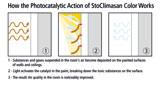
The discovery is based on the pigment titanium dioxide, which for some time has been used in dental products and in paints, but which in this case acts as a photocatalyst: it triggers certain chemical reactions stimulated by light.
The reactions of this pigment, which are normally blocked when used in products like toothpaste, are seen as positive factors and served as the beginning point for research.
Without manipulation, the pigment absorbs energy from ultraviolet rays, making the surface active and, in contact with the air, produces oxygen links that trigger reactions which break down toxic molecules into completely harmless particles.
The achievement of Kisch and his team of scientists was to modify the structure of the titanium dioxide pigment so that it reacts even in low light, such as on cloudy days and or under artificial light.
“It is a very important development that the materials react with daylight and thus can degrade particles present in the air. And professor Kisch has really been the first to achieve it,” chemistry doctorate Detlef Bahnemann, of the Institute of Technical Chemistry at the University of Hanover, told Tierramérica.
“It is a matter of health, especially if we think that (paint) can disintegrate the toxic particles created by cigarettes, or by emissions of gases like formaldehyde, which can come from some furniture,” said Bahnemann.
 |
|
Credit: Courtesy of Sto AG
  |
According to the researchers, in a test conducted in an office, the application of this paint to the interior walls achieved an 80-percent reduction in the concentration of harmful substances.
The paint is already available for sale, under the name StoClimasan (for interiors) and StoPhotosan (for exteriors). The price can be up to five times that of conventional paints.
A 15-litre can of interior paint in Germany costs the equivalent of about 280 dollars, and covers about 100 square meters. Exterior paint costs 320 dollars and is enough to cover just 80 square meters.
The high prices appear to be the main obstacle to its widespread use, especially in public places.
In Bahnemann's opinion, this problem could be tackled with appropriate government intervention: “It should be realized how important it is to use this type of pain in public spaces. Its higher cost is absolutely justified.”
“Think about its environmental contribution, that it breaks down substances like nitrogen oxides, sulfur oxides, or different gases that come from combustion processes, whether from electrical power plants, automobiles or chimneys,” he said.
Research to achieve these results took just five years. “We are particularly proud that in so short a time we could apply an advance in basic research in a technical product,” said Kisch.
As for the use of the product on exteriors, the scientists themselves recognize that it remains difficult to measure its effectiveness.
But there are already more than a hundred German companies researching ways, using the same principle, to achieve products that can be applied to other surfaces, such as furniture, tiles or carpets, and which can purify not only the air but the surfaces themselves.
For their original contribution, the invention was recognized with the latest Innovation Prize, sponsored by the German Ministry of Economy.
 Print
|
Print
|