Languages
Saturday, September 19, 2026



News and Views from the Global South
Active Citizens

Community Solutions Combat Water Shortages in Peru’s Highlands
The lack of water is so severe in Peru's highlands that farming families are forced to sell their livestock because they cannot feed them. "There is no grass or fodder to feed them," says Fermina Quispe, a Quechua farmer from a rural community located at 4,200 meters above sea level.
How to Defend the Environment and Survive in the Attempt, as a Woman in Mexico
The defense of the right to water led Gema Pacheco to become involved in environmental struggles in the southern Mexican state of Oaxaca, an area threatened by drought, land degradation, megaprojects, mining and deforestation.
Bringing the Piratininga Lagoon Back to Life in Brazil
Houses with balconies facing the street or the surrounding hills, when they are not hidden behind high walls, reflect a neighborhood where people live on the shore of a lagoon but reject the landscape it offers.
Silent Struggles: Unraveling Korea’s Startling Elderly Suicide Surge
Growing up in a culture that values respect for elders, I was acutely aware of the importance of caring for our aging population. However, my journey to understanding the gravity of this issue truly began with a personal anecdote. I watched my grandmother, a pillar of strength throughout my childhood, gradually withdraw from the vibrant world in which she once thrived. The cheerful twinkle in her eyes began to dim, replaced by an eerie sense of isolation.
The Frogs Are Drying Up! Let’s Explore What We Can Do!
Have you ever seen a dried frog? We have, and it’s making us rethink our impact on the environment. Frogs are incredibly sensitive to dry conditions, and they are facing the threat of extinction due to global warming. Amphibians, like frogs, make up a significant portion of endangered species, with 41 percent vulnerable compared to only 25 percent for mammals like polar bears.
The Issue Preventing Female Students in Thailand from Flourishing: No, It’s Not Just the Poverty You’re Thinking Of
Four acrylic panels stood like soldiers around the perimeter of my body, bolted upright by the men who installed them, light proudly bouncing off the inherent gloss on those walls as I sat on the toilet.
Ecuadorians Vote to Preserve Yasuní National Park, but Implementation Is the Problem
The decision reached by Ecuadorians to put an end to oil production in Yasuní National Park, in a popular referendum in August, was a triumph for civil society and a global milestone in environmental democracy. But when it comes to implementation, the result is less promising.
Are Many Children in Japan Going Hungry? How Can We Help?
Picture this: It’s the scorching days of summer, and kids are flocking to the nearby mall, eager to bask in the cool air and hang out with friends. But among the laughter and chatter, one girl stands alone in the food court.
Innovative Family Farm in Cuba Uses Mix of Clean Energies
Combining technologies and innovations to take advantage of solar, wind, hydro and biomass potential has made the Finca del Medio farm an example in Cuba in the use of clean energies, which are the basis of its agroecological and environmental sanitation practices.
Iran: One Year on, What’s Changed?
It’s a year since a photo of 22-year-old Mahsa Amini – bruised and in a coma she would never recover from after being arrested by the morality police for her supposedly improperly worn hijab – went viral, sending people onto the streets.
Multilingual #AfghanGirlsVoices Campaign to Return Millions Back to School
A Taliban edict is rolling back time in Afghanistan after access to education for all Afghan girls over the age of 12 was indefinitely suspended on September 18, 2021. Afghanistan is the only country in the world where girls are forbidden from attending school beyond the primary level, leaving more than 1.1 million girls and young women without access to formal education.
Treated Wastewater Is a Growing Source of Irrigation in Chile’s Arid North
The reuse of treated wastewater in vulnerable rural areas of Chile's arid north is emerging as a new resource for the inhabitants of this long, narrow South American country.
Youth Rally for Peace Through Climate Justice at the UN
“What do we want? Climate justice! When do we want it? Now!” youth chanted in an unusually lively conference at the United Nations Headquarters.
El Salvador Is Making Little Effort to Eradicate Illiteracy
El Salvador's efforts to improve the educational level in the country seem to be falling short, with rundown schools, especially in rural areas, and little progress in overcoming illiteracy.
Mexico’s Interoceanic Corridor Lacks Water
Due to insufficient pressure water does not make it up to Elliot Escobar's house in the Mexican municipality of Matías Romero, where he lives on the second floor, so he pipes it up with a hose from his sister's home, located on the first floor of the house shared by the two families.
Social Activists Demand Real Equality for Chilean Women
Women social activists recognize that gender equality is gaining ground in Chile, but maintain that there is still a long way to go to turn into reality the promises to "level the playing field" between women and men, while they highlight the importance of addressing the issue of care work.
International Youth Day 2023

Today, the world is embarking on a green transition. A shift towards an environmentally sustainable and climate-friendly world is critical.

“No” to Sex Education Fuels Early Pregnancies in Central America
Pregnancies among girls and adolescents continue unabated in Central America, where legislation to prevent them, when it exists, is a dead letter, and governments are influenced by conservative sectors opposed to sex education in schools.
Vulnerable Women Suffer the Worst Face of Discrimination in Argentina
Remi Cáceres experienced gender-based violence firsthand. She struggled, got out and today helps other women in Argentina to find an escape valve. But because she is in a wheelchair and is a foreign national, she says the process was even more painful and arduous: "Being a migrant with a disability, it's two or three times harder. You have to empower yourself and it's very difficult."
Biodigesters Light Up Clean Energy Stoves in Rural El Salvador
A new technology that has arrived in rural villages in El Salvador makes it possible for small farming families to generate biogas with their feces and use it for cooking - something that at first sounded to them like science fiction and also a bit smelly.
Mandela Day Reminder to Stand Witness to Human Rights Defenders
As human rights increasingly deteriorate, rights defenders are being violently suppressed. Abducted, detained, tortured, and humiliated, many now live one day at a time. They have been told, in no uncertain times, that anything could happen. They are now asking the global community to stand as a witness.« Previous Page — Next Page »


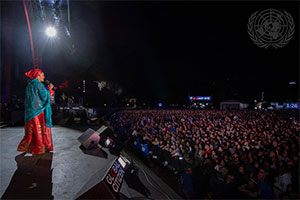 Global Citizen Festival in New York. Credit: UN Photo/Eskinder Debebe
Active citizens are committed to social change because they know that it is achievable. However, major political challenges face active citizens across the world. For example, in authoritarian regimes in Latin America where the hegemonic party has been in power for decades on end, protestors and human rights activists face enormous repression and struggle to materialize their advocacy into concrete results. The same can be said for Africans, where a shift towards elected government in recent decades has yet to translate into an effective voice in decision-making. Now, the Strengthening Citizen Demand for Good Governance, which uses evidence-based approaches – funded by DFID's Governance and Transparency Fund – seeks to raise their voices.
In 2025, the CIVICUS Monitor’s People Power Under Attack report revealed that civic freedoms are severely limited in 122 of 198 countries and territories, and only 7.2% of the global population now lives in countries where civic space is open. Through partnership with the Overseas Development Institute (ODI) and CIVICUS, IPS reporters across the continent will seek to define the extent and limits of state capability, government accountability and the responsiveness of leaders to the needs of citizens.

The Week with IPS

NEXT STOP - SDGs
Tracking global progress towards a sustainable world
Tracking global progress towards a sustainable world
