Languages
Monday, September 21, 2026



News and Views from the Global South
Active Citizens

Mandela Day Reminder to Stand Witness to Human Rights Defenders
As human rights increasingly deteriorate, rights defenders are being violently suppressed. Abducted, detained, tortured, and humiliated, many now live one day at a time. They have been told, in no uncertain times, that anything could happen. They are now asking the global community to stand as a witness.
‘Passion Seeds’ Fertilize Brazil’s Semiarid Northeast
Zé Pequeno cried when he learned that the heirloom seeds he had inherited from his father were contaminated by the transgenic corn his neighbor had brought from the south. Fortunately, he was able to salvage the native seeds because he had shared them with other neighbors.
Human Rights Concerns Ahead of Zimbabwe Polls
Zimbabwe holds general elections next month amid growing human rights and press freedom concerns in what analysts say could mar conditions for undisputed poll results.
Women Recyclers in Bolivia Build Hope, Demand Recognition
They haul many kilos of recyclable materials on their backs but receive little in return. These Bolivian women who help clean up the environment from dawn to dusk are fighting for recognition of their work and social and labor rights.
The Dark Side of Wind and Solar Farms as Sustainable Energy in Brazil
"Anxiety, insomnia and depression have become widespread. We don't sleep well, I wake up three, four times a night," complained Brazilian farmer Roselma de Melo Oliveira, 35, who has lived 160 meters from a wind turbine for eight years.
Wood Smoke Continues to Make Women Sick in El Salvador
Using a few dry sticks as fuel, Margarita Ramos of El Salvador lit the fire in her wood stove and set about frying two fish, occasionally fanning the flame, aware that the smoke she inhaled could affect her health.
Women in Peru’s Poor Urban Areas Combat the Crisis at the Cost of Their Wellbeing
At five in the morning, when fog covers the streets and the cold pinches hard, Mercedes Marcahuachi is already on her feet ready to go to work in Pachacútec, the most populated area of the municipality of Ventanilla, in the province of Callao, known for being home to Peru's largest seaport.
Gender-Based Violence: Why Victims Do Not Leave
In almost every conversation I’ve had about gender-based violence (GBV), the question “why don’t they leave?” inevitably comes up. After many years of working in this space, I have learned that the answer is not as simple as we think. The nature of GBV is quite complex. Numerous layers and factors affect individuals both internally and externally.
Women Suffer Harassment and Discrimination on Chile’s Public Transport
Sexual harassment and discrimination are daily realities for women on public transport in Chile and also an obstacle for plans to expand mass transit in order to reduce pollution in several cities in this South American country.
Biodigesters Boost Family Farming in Brazil
"The biodigester really gives a huge boost to those who have the courage to do things," said Maria das Dores Alves da Silva, based on her own experience as a 63-year-old small farmer.
Medical Abortion Expands Women’s Rights in Argentina
Viviana Mazur is a doctor at the Santojanni Hospital in Mataderos, a working-class neighborhood in Buenos Aires. She has witnessed the advances in women's rights in Argentina, where until 2020 abortion was only allowed on two grounds, while it is now available on demand up to 14 weeks of pregnancy.
Central America Fails to Acknowledge or Legislate in Favor of LGBTI Community
There is still a long way to go before the LGBTI population in Central America stops being discriminated against and begins to make progress in gaining recognition of their full rights, including the possibility of changing their name to match their gender identity, in the case of trans people.
Healthy Homes – A Right of Rural Families in Peru
Adopting a “healthy housing” approach is improving the living conditions of rural Peruvian women like Martina Santa Cruz, a 34-year-old farmer who lives with her husband and two children in the village of Sacllo, 2,959 meters above sea level in the Andes highlands municipality of Calca.
Peru’s Agro-Export Boom Has not Boosted Human Development
Peru’s agro-export industry is growing steadily and reached record levels in 2022. But this has not had a favorable impact on human development in this South American country, where high levels of inequality, poverty, childhood anemia and malnutrition persist, as well as complaints about the poor quality of employment in the sector.
Kenyan Scientist’s Trend-Setting Research into Health Benefits of Snails
Snails and slime are usually followed by the thought ‘EEW!’ from most people … some might even scream at seeing a snail near them. For Dr Paul Kinoti, however, these slimy creatures could earn him international recognition because his research on snails landed his institution, Jomo Kenyatta University of Agriculture and Technology (JKUAT), a Ksh. 127 million (USD 1 million) grant.[related_articles]
Menstrual Health and Hygiene Is Unaffordable for Poor Girls and Women in Latin America
Menstrual hygiene management is elusive for millions of poor women and girls in Latin America, who suffer because their living conditions make it difficult or impossible for them to access resources and services that could make menstruation a simple normal part of life.
Cooperatives in Argentina Help Drive Expansion of Renewable Energy
When the residents of Armstrong, a town of 15,000 in western Argentina, began to meet to discuss a renewable energy project, they agreed that there could be many positive effects and that it was not just a question of doing their bit in the global effort to mitigate climate change.
Women’s Cooperatives Work to Sustain the Social Fabric in Argentina
Nearby is an agroecological garden and a plant nursery, further on there are pens for raising pigs and chickens, and close by, in an old one-story house with a tiled roof, twelve women sew pants and blouses. All of this is happening in a portion of a public park near Buenos Aires, where popular cooperatives are fighting the impact of Argentina's long-drawn-out socioeconomic crisis.
Cuba: Elections Without Choices
The uncertainty that’s the hallmark of a democratic election was absent on 26 March, the day Cubans were summoned to appoint members of the National Assembly of People’s Power, the country’s legislative body. A vote did take place that day – people went to the polls and put a ballot in a box. But was this really an election? Cubans weren’t able to choose their representatives – their only option was to ratify those selected to stand, or abstain.
Andean Indigenous Women’s Knowledge Combats Food Insecurity in Peru
Paulina Locumbe, a 42-year-old peasant farmer who lives in the Andes highlands of southern Peru, learned as a child to harvest and dry crops, one of the ancestral practices with which she combats the food insecurity that affects millions in this Andean country.
The LGBTIQ+ Community Still Oppressed in Venezuela
The vulnerability and struggles of the LGBTIQ+ community in Venezuela were once again highlighted when the Supreme Court finally annulled the military code statute that punished, with one to three years in prison, members of the military who committed " acts against nature.”« Previous Page — Next Page »


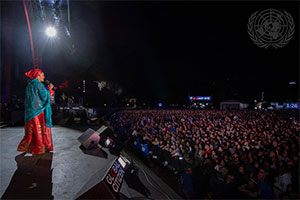 Global Citizen Festival in New York. Credit: UN Photo/Eskinder Debebe
Active citizens are committed to social change because they know that it is achievable. However, major political challenges face active citizens across the world. For example, in authoritarian regimes in Latin America where the hegemonic party has been in power for decades on end, protestors and human rights activists face enormous repression and struggle to materialize their advocacy into concrete results. The same can be said for Africans, where a shift towards elected government in recent decades has yet to translate into an effective voice in decision-making. Now, the Strengthening Citizen Demand for Good Governance, which uses evidence-based approaches – funded by DFID's Governance and Transparency Fund – seeks to raise their voices.
In 2025, the CIVICUS Monitor’s People Power Under Attack report revealed that civic freedoms are severely limited in 122 of 198 countries and territories, and only 7.2% of the global population now lives in countries where civic space is open. Through partnership with the Overseas Development Institute (ODI) and CIVICUS, IPS reporters across the continent will seek to define the extent and limits of state capability, government accountability and the responsiveness of leaders to the needs of citizens.

The Week with IPS

NEXT STOP - SDGs
Tracking global progress towards a sustainable world
Tracking global progress towards a sustainable world
