Languages
Sunday, September 20, 2026



News and Views from the Global South
Active Citizens

Beatriz v. El Salvador Case Could Set Precedent on Abortion in Latin America
An open hearing in the Inter-American Court of Human Rights in the Beatriz v. El Salvador case is raising hopes that this country and other Latin American nations might overturn or at least mitigate the severe laws that criminalize abortion.
BRAC International Signs MoU with Rwanda to Empower People in Extreme Poverty
Last week, BRAC International signed a Memorandum of Understanding (MoU) with the Government of Rwanda under the Ministry of Local Government (MINALOC) to support efforts to empower people in extreme poverty to develop sustainable livelihoods and break the poverty trap long term. This is part of the Government’s broader efforts to eradicate extreme poverty by 2030.
Civic Space – the Bedrock of Democracy – is Scarce & Contested
On 29 and 30 March, the US government, in partnership with Costa Rica, Netherlands, South Korea and Zambia, will co-host the second virtual Summit for Democracy. Several elected leaders and state representatives will come together to highlight achievements in advancing democratic principles.
Digital Gender Gap in Latin America Reflects Discrimination Against Women
The digital gender gap is multifactorial in Latin America and as long as countries fail to address discrimination against women, inequality will be reflected in the digital space, excluding them from access to opportunities and enjoyment of their rights.
Indigenous Conflicts over Land Spread, Fueling Debate in Argentina
In 1994 Argentina recognized in the constitution the ethnic and cultural pre-existence of indigenous peoples. However, enforcement of respect for their rights has fallen short and almost 30 years later the question of land is generating growing conflicts, which sometimes pit native communities against the rest of society.
Venezuela Drafts Legal Stranglehold on NGOs
The Venezuelan parliament, in the hands of the ruling party, is moving towards passing a law to control non-governmental organizations (NGOs) so that, in practice, they could not exist independently.
Russia and Ukraine: Civil Society Repression and Response
Over the year since the start of Russia’s war on Ukraine, on one side of the border civil society has shown itself to be a vital part of the effort to save lives and protect rights – but on the other, it’s been repressed more ruthlessly than ever.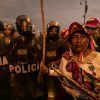
Privilege and Centralism in Lima Goad Protesters in Peru
The current political and social upheaval in Peru is not a temporary problem, but has to do with deeply-rooted inequality and social hierarchies, according to historian José Carlos Agüero.
NGOs Campaign for a Torture-Free UN Trade Treaty
Hinting at “Western hypocrisy”, a senior UN official once told a group of reporters, perhaps half-jokingly: “When you go on one of those sight-seeing tours in Europe, they will show you their palaces and castles-- but never their medieval prisons or torture chambers.”
Pact Protecting Environmentalists Suffers Threats in Mexico
In the municipality of Papantla, in the southeastern Mexican state of Veracruz, the non-governmental Regional Coordinator of Solidarity Action in Defense of the Huasteca-Totonacapan Territory (Corason) works with local communities on empowering organizations, advocacy capacity in policies and litigation strategies.
Management of Protected Areas Is a Latin American Priority for 2023
The environmental priority for South America in 2023 can be summed up in the management of its terrestrial and marine protected areas, together with the challenges of the extractivist economy and the transition to a green economy with priority attention to the most vulnerable populations.
Solar Energy Useless Without Good Batteries in Brazil’s Amazon Jungle
“Our electric power is of bad quality, it ruins electrical appliances,” complained Jesus Mota, 63. “In other places it works well, not here. Just because we are indigenous,” protested his wife, Adélia Augusto da Silva, of the same age.
Chile’s Mapuche Indians Hurt by Rejection of a Plurinational Constitution
Mapuche indigenous leaders were hit hard by what they see as a collective defeat: the rejection in a September referendum of a plurinational, intercultural constitution proposed to Chile by an unprecedented constituent assembly with gender parity and indigenous representatives.
Unstoppable Gas Leaks in Mexico
A dark mole dots the brown earth, among the green scrub at this spot in southeastern Mexico. A repetitive “glug, glug,” a noise sounding like a thirsty animal, and an intense stench lead to this site, hidden in the undergrowth, where a broken pipe has created a pool of dense oil.
Deportees Start Businesses to Overcome Unemployment in El Salvador
While grilling several portions of chicken and pork, Salvadoran cook Oscar Sosa said he was proud that through his own efforts he had managed to set up a small food business after he was deported back to El Salvador from the United States.
COP15: Unsustainable Infrastructure Threatens Biodiversity
Created in 2016, the Mexican Caribbean Biosphere Reserve (MCBR) hosts 1900 species of animals and plants and contains half of the Mesoamerican Barrier Reef System, the second largest in the world after Australia's Great Barrier Reef.
Solar Energy Benefits Children and Indigenous People in Northern Brazil
Solar energy is booming in Roraima, a state in the far north of Brazil, to the benefit of indigenous people and children in its capital, Boa Vista, and helping to provide a stable energy supply to the entire populace, who suffer frequent electricity shortages and blackouts.
A Little Land Helps Indigenous Venezuelans Integrate in Brazil
A group of Warao families are, through their own efforts, paving the way for the integration of indigenous Venezuelans in Brazil, five years after the start of the wave of their migration to the border state of Roraima.
Volunteerism: Path to Achieve UN’s Agenda 2030
The International Volunteer Day, a worldwide event commemorated every year on the 5th of December, comes at the end of a long line of special commemorations, each of them relevant and paramount to achieve the UN’s Agenda 2030.
The World Cup of Opportunity
The sun is shining, and the temperature sits at an idyllic 28 degrees Celsius. The Uber driver taking me to work is from Pakistan and devastated about the recent loss to England in the T20 Cricket World Cup final in Australia.
Pandemic Aggravated Violence against Women in Latin America
Violence against women has failed to decline in the Latin American region after the sharp rise recorded during the COVID-19 pandemic, while preventing the causes of such violence remains a major challenge.« Previous Page — Next Page »


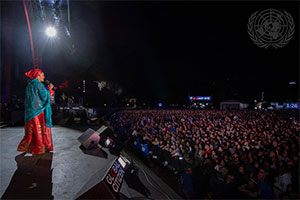 Global Citizen Festival in New York. Credit: UN Photo/Eskinder Debebe
Active citizens are committed to social change because they know that it is achievable. However, major political challenges face active citizens across the world. For example, in authoritarian regimes in Latin America where the hegemonic party has been in power for decades on end, protestors and human rights activists face enormous repression and struggle to materialize their advocacy into concrete results. The same can be said for Africans, where a shift towards elected government in recent decades has yet to translate into an effective voice in decision-making. Now, the Strengthening Citizen Demand for Good Governance, which uses evidence-based approaches – funded by DFID's Governance and Transparency Fund – seeks to raise their voices.
In 2025, the CIVICUS Monitor’s People Power Under Attack report revealed that civic freedoms are severely limited in 122 of 198 countries and territories, and only 7.2% of the global population now lives in countries where civic space is open. Through partnership with the Overseas Development Institute (ODI) and CIVICUS, IPS reporters across the continent will seek to define the extent and limits of state capability, government accountability and the responsiveness of leaders to the needs of citizens.

The Week with IPS

NEXT STOP - SDGs
Tracking global progress towards a sustainable world
Tracking global progress towards a sustainable world
