Languages
Wednesday, November 25, 2026



News and Views from the Global South
Civil Society
RIGHTS-JAPAN: Lifer’s Case Tells Migrant Workers’ Plight
A Nepalese worker serving life for a murder he denies committing has become the rallying point for activists lobbying for the rights of migrant labour.
Farmers’ Networks Urge Government Action Against Land Grabbing
Civil society organisations and global farmers' networks are gathered in Rome this week to ask governments to stop the "disastrous practice of land grabbing", ahead of next week's Committee on World Food Security.CAMBODIA: Resignation Raises Doubts Over Khmer Rouge Tribunal
The United Nations must address a "crisis of confidence" at the beleaguered Khmer Rouge war crimes tribunal in Cambodia following the resignation of a controversial judge, critics say.GERMANY: Anti-Nuclear Exhibit Calls for Culture of Peace
The question which is safer - the heavily armed world we live in now, or a world in which all peoples' basic needs are met - is one core issue of an antinuclear exhibition that has reached Germany after touring more than 220 cities in 28 countries.INDIA: Unauthorised Clinical Trials on Bhopal Victims
Ajay Shrivastav from Bhopal, the central Indian city that witnessed one of the worst industrial disasters of the world in 1984 from a deadly gas leak, is an angry man seeking justice.“The Death Penalty Has No Dissuasive Effect”
Capital punishment continues to exist because in some countries people are barraged with propaganda depicting it as a curb on crime, which it is not, said Federico Mayor Zaragoza, chair of an international commission against the death penalty that inaugurated its new headquarters in Geneva Monday.DEATH PENALTY: Arab League Asked to Intervene
Campaigners from around the world have called upon the Arab League and on the African Commission on Human and People's Rights to explore the possibility of adopting regional protocols to abolish the death penalty.
U.S.: Backlash Swells Against New “Gilded Age”
The encampment of disenchanted young protesters in New York City's financial district has exposed growing anger around the United States over rising inequality and a stubborn jobs crisis.
INDIA: Microcredit Fights to Regain Credibility
As microcredit institutions - once touted as the vital ‘last mile' in extending credit to poor rural women -fight a government backlash that has encouraged honest borrowers to turn defaulters, hopes for revival hinge on a new bill awaiting passage in India's parliament.SPAIN: Streets Paved with Evicted Families
As the number of apartments and houses left empty in Spain due to failure to make mortgage or rental payments climbs, tens of thousands of families, including many immigrants, are living on the streets, in shantytowns, or crowded into seedy boarding houses.
Around the Globe, Workers Demand Decent Jobs
The modern English word "economy" is derived from the Greek "oikonomia", meaning "household management".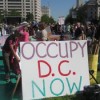
U.S.: “Leaderless” Protest Movement Continues to Snowball
"First they ignore you, then they ridicule you, then they fight you – then you win," a middle-aged man yells into the microphone from a makeshift stage erected at the far end of Freedom Plaza in Washington, DC.
NAMIBIA: Skulls Repatriated – But No Official German Apology
A delegation of Namibian government representatives and leaders of the indigenous Herero and Nama people who came to Germany to repatriate 20 skulls of their ancestors were once again disappointed in their hopes for dialogue and an official apology.
Q&A: Carving Out a New Aid Order at Busan
Busan represents the possibility of an aid revolution – a time in history where an encompassing, inclusive aid framework may be possible. This is according to Tony Tujan, director of IBON International, a capacity development non- governmental organisation.
SPAIN: ‘Indignant’ Protests Heat Up Election Campaign
"Ex dockyard worker, now a beggar" reads the sign displayed by a man in a spotless shirt who is panhandling near a square in this southern Spanish city where dozens of demonstrators are chanting: "The bank always wins and I'm against this!" and "What's going on? We have no homes!"HONDURAS: Putting Defence In the Hands of Civilians
Prominent academics and activists say one of the main pending challenges in Honduras is a resumption of the demilitarisation of the country and the strengthening of civilian control over defence policy that was brought to an abrupt halt by the June 2009 coup d'etat.Moana Nui Set to “Undress” APEC
This November, when the Asia-Pacific Economic Cooperation (APEC) forum holds its annual rotating summit in Honolulu, it will attract more than the attention of the world's media.
Q&A: Africa’s Legislated Civil Society Crackdown
Assassinations, intimidation and disappearances were the manifestations of civil society repression in Africa, but this may be changing as the crackdown on civil society is becoming more formally accepted and increasingly "by the book", according to Ingrid Srinath, secretary general of the global civil society network, CIVICUS.
Occupy Wall Street: “It Is a Revolution”
Since Sep. 17, hundreds of demonstrators in the Occupy Wall Street movement have transformed the quiet Zucotti Park in lower Manhattan from a place where Wall Street traders once relaxed during lunch breaks into a demonstration camp.RIGHTS-U.S.: Outrage Persists over Davis’s Execution
During the last days of Troy Davis's life, activists intensified what was already significant pressure on both U.S. President Barack Obama and the U.S. Department of Justice (USDOJ), a federal agency under Obama's purview, to save Davis, but Obama declined to act.UZBEKISTAN: Don’t Let Logistics Trump Rights, Groups Tell Clinton
A broad coalition of 20 human rights, labour and consumer groups is appealing to the administration of President Barack Obama not to renew military aid and sales to Uzbekistan, widely considered one of the world's most repressive dictatorships.« Previous Page — Next Page »


 Representatives of Civil Society, Sierra Leone. Credit: UN Photo/Eskinder Debebe
Civil society faces mounting threats worldwide, even as it remains essential for democratic accountability, especially in countries struggling with economic instability and social inequality. However, at the same time, nations with weak democratic governance structures also systemically suppress the power of civil society. Human rights activists across the Global South frequently challenge issues such as political persecution and gender oppression, but in return face state-sanctioned punishment for their advocacy. Imprisonment and exile are common mechanisms of punishment that seek to erode the strength of civil society. The 2026 World Press Freedom Index has reached its lowest level in 25 years, with more than half of the world’s countries now falling into the "difficult" or “very serious” category for press freedom. IPS seeks to highlight the work of civil society across the Global South as well as the challenges that they face.
Updated by Yilan Batista and Shuli Wong August 2026

The Week with IPS

NEXT STOP - SDGs
Tracking global progress towards a sustainable world
