Languages
Wednesday, September 16, 2026



News and Views from the Global South
Civil Society

Mayurbhanj Kai Chutney: From Forests to Global Food Tables
On a scorching May morning, Gajendra Madhei, a farmer from Mamudiya village, arrives at the local bazaar in Udula, a town in Odisha's Mayurbhanj district. He displays freshly caught red weaver ants, known locally as kai pimpudi, in the bustling tribal market. Thanks to the recent recognition of Mayurbhanj's Kai chutney, or red weaver ant chutney, with a Geographical Indication (GI) tag awarded in January, his business of selling the raw ants has seen a significant surge in profitability.
Argentina: Civil Society’s Urgent Call to Protect Rights
Between the Mafia and the State, I prefer the Mafia. The mafia has codes, it keeps its promises, it doesn't lie, it's competitive. If a company pollutes a river, where is the damage? The sale of organs is a market like any other. Abortion should be considered “aggravated murder”.
A Warming Planet is Global, Adaptation is Local & Resilience People-Specific
The summer of 2024 has shattered heat records, starkly illustrating the harsh realities of our warming planet. In India alone, the heatwave has claimed over 100 lives and caused more than 40,000 cases of heatstroke in recent months, according to data from India’s Health Ministry. This extreme weather event has further burdened the poor and vulnerable, exacerbating the social and economic toll of disasters.
Special Report: Exposing Afghanistan’s Pervasive, Methodical System of Gender Oppression
The UN Special Rapporteur’s annual report on human rights in Afghanistan lays bare the alarming phenomenon of an institutionalized system of discrimination, segregation, disrespect for human dignity and exclusion of women and girls. In the new report, Richard Bennett, the UN’s Special Rapporteur, provides an intersectional analysis of the establishment and enforcement of this institutionalized system of unparalleled gender oppression. It paints a picture of a worsening situation for women and girls.
IRAQ: ‘Tolerance for Abuses Against LGBTQI+ People Has Now Been Made Explicit Through Legislation’
CIVICUS discusses the criminalisation of same-sex relations in Iraq with Sarah Sanbar, researcher at Human Rights Watch’s Middle East and North Africa division.

UN Climate Talks: Setting Sail to Plunder the Ocean
Despite the evident and increasing urgency of the climate crisis, the June intersessional meeting of the UNFCCC closed with little to show for two full weeks of negotiation.
Kashmir Frontier Woman Leads the Way in Breaking Down Patriarchy
Smelling the toxic smoke coming from burned powder kegs and helplessly watching fields turn into smoke and ash is traumatic. Rushing to the government's safe houses and leaving your homes, belongings and cattle behind whenever the armies of India and Pakistan trade fire is inexplicable. Then came climate-change-induced weather unpredictability.
Thailand’s LGBTQI+ Rights Breakthrough
At the height of 2024 Pride season, decades of civil society campaigning came to fruition in Thailand. With 130 votes for and only four against, on 18 June the Senate passed the Marriage Equality Bill. With a few strokes of the pen, the bill tweaked the language of the Civil and Commercial Code, replacing gendered references such as ‘man’ and ‘woman’ with gender-neutral ones such as ‘persons’ and ‘spouses’. It now goes for formal assent to King Maha Vajiralongkorn and will take effect 120 days after publication in the official bulletin.
Youth-Led Protests Force Kenyan President’s Hand Over Tax Bill
In a historic first, Kenya's youth have mobilized in large-scale protests to demand that the political establishment listen to them. The Finance Bill 2024, which proposed new taxes across several sectors, was the catalyst for the protests, igniting outrage among a youth demographic that feels betrayed by decades of political promises. These protests, driven by economic and social grievances, escalated dramatically, culminating in clashes with police that led to numerous deaths and widespread unrest.
Georgia’s LGBT+ Law Could Lead to Violent Repression, Rights Group Warns
“If this legislation passes, LGBT+ people simply aren’t going to be able to live here.” The warning from Tamar Jakeli, an LGBT+ activist and Director of Tbilisi Pride in Tbilisi, Georgia, is stark, but others in the country’s LGBT+ community agree, accurate.
Worse Than Genocide: Killing Truth
There have been many genocides throughout history, but the first to be displayed on TV in all its sickening horror before the entire world is the Israeli genocide against the civilians of Gaza.
Violent Deaths by “Small Arms & Light Weapons”: UN Chief’s Warning Dead on Target
Perhaps two of the biggest misnomers in military jargon are “small arms” and “light weapons” which are the primary weapons of death and destruction in ongoing civil wars and military conflicts, mostly in Asia, the Middle East and Africa. In a statement last week, at the opening session of the Fourth Review Conference of the Programme of Action on Small Arms and Light Weapons (SALW), UN Secretary-General Antonio Guterres was dead on target when he said there is nothing “small” or “ight” about the damage these weapons cause.
When U.S. Officials Show You Who They Are, Believe Them
"When someone shows you who they are,” Maya Angelou said, “believe them the first time." That should apply to foreign-policy elites who show you who they are, time after time.
Peoples’ Climate Vote Shows Global Support for Stronger Climate Action
The global public opinion research on climate change reveals that 80 percent, or four out of five, of people globally want their governments to take stronger action to tackle the climate crisis.
New Caledonia: Time to Talk about Decolonisation
The violence that rocked New Caledonia last month has subsided. French President Emmanuel Macron has recently announced the suspension of changes to voting rights in the Pacific island nation, annexed by his country in 1853. His attempt to introduce these changes sparked weeks of violence.
Free Speech Under Siege—across West Africa
Authoritarian overreach is re-defining itself across West Africa, fuelled by armed conflicts, military coups, and electoral manipulation and violence, as the region experiences a decline in democracy.
Conflict Deprives Children of Education in Northern Syrian IDP Camps
Twelve-year-old Walid Al-Hussein, displaced from the city of Kafranbel to a camp for internally displaced people (IDP) in northern Idlib on the border with Turkey, has given up his dream of becoming a lawyer. "The distance of schools from our home (in the camp) made me leave education and give up my dream and my mother's dream of becoming a lawyer who defends the rights of the oppressed," Al-Hussein told IPS.
Sawantwadi’s Traditional Handmade Toys Struggle for Survival
Sawantwadi in Maharashtra, on the western coast of India, bordering Goa, has always been known for its wooden toys. A picturesque town amid hills and lush greenery, Sawantwadi retains an old-world charm to this day. The regal Sawantwadi Palace holds pride of place, with colleges, schools, and temples cloistered around the periphery of the lake, which was once an extension of the royal grounds. In the centre of the town is the Ubha Bazaar, or Hanging Market, which houses rows of shops selling the iconic wooden toys that are a hallmark of Sawantwadi.
Haiti: Transitional Administration Faces Stern Test
There’s been recent change in violence-torn Haiti – but whether much-needed progress results remains to be seen. Acting prime minister Garry Conille was sworn in on 3 June. A former UN official who briefly served as prime minister over a decade ago, Conille was the compromise choice of the Transitional Presidential Council. The Council formed in April to temporarily assume the functions of the presidency following the resignation of de facto leader Ariel Henry.
African Activists Call on the West to Finance Climate Action
As the technical session of the global climate negotiations enters the final stretch in Bonn, Germany, climate activists from Africa have expressed fears that negotiators from the developed world are dragging their feet in a way to avoid paying their fair share to tackle the climate crisis. “I think we will be unfair to the snail if we say that the Bonn talks have all along moved at a snail pace,” quipped Mohammed Adow, the Director, Power Shift Africa.
Turning the Tide: Health Community Turns to UNFCCC for Inclusivity
There is a rapid realization that climate change is impacting health, which is why the recently adopted World Health Organization's Climate Change and Health Resolution is considered pivotal.« Previous Page — Next Page »


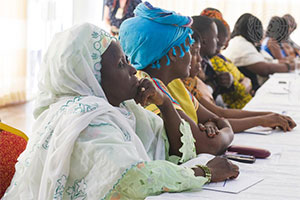 Representatives of Civil Society, Sierra Leone. Credit: UN Photo/Eskinder Debebe
Civil society faces mounting threats worldwide, even as it remains essential for democratic accountability, especially in countries struggling with economic instability and social inequality. However, at the same time, nations with weak democratic governance structures also systemically suppress the power of civil society. Human rights activists across the Global South frequently challenge issues such as political persecution and gender oppression, but in return face state-sanctioned punishment for their advocacy. Imprisonment and exile are common mechanisms of punishment that seek to erode the strength of civil society. The 2026 World Press Freedom Index has reached its lowest level in 25 years, with more than half of the world’s countries now falling into the "difficult" or “very serious” category for press freedom. IPS seeks to highlight the work of civil society across the Global South as well as the challenges that they face.
Updated by Yilan Batista and Shuli Wong August 2026

The Week with IPS

NEXT STOP - SDGs
Tracking global progress towards a sustainable world
Tracking global progress towards a sustainable world
