Languages
Tuesday, October 13, 2026



News and Views from the Global South
Aid

Want to Help Nepal Recover from the Quake? Cancel its Debt, Says Rights Group
The death toll has now passed 3,300, and there is no telling how much farther it will climb. Search and rescue operations in Nepal entered their third day Monday, as the government and international aid agencies scramble to cope with the aftermath of a 7.8-magnitude earthquake that struck this South Asian nation on Apr. 25.
Grenada Braces for Impacts of Climate Change
Henry Prince has lived in this fishing village for more than six decades. Prince, 67, who depends on the sea for his livelihood, said he has been catching fewer and fewer fish, and the decrease is taking a financial toll on him and other fisher folk throughout the island nation of Grenada.
Middle East Conflicts Trigger New U.S.-Russia Arms Race
The escalating military conflicts in the Middle East – and the month-long aerial bombings of Yemen by an Arab coalition led by Saudi Arabia – have triggered a new arms race in the politically-volatile region.Push to Privatise Education in Global South Challenged
The multinational education and publishing company Pearson PLC was challenged during its annual general meeting on Apr. 24 by representatives of civil society and trade union groups over various profit-driven programmes aimed at expanding private education in numerous countries in the global South.
Opinion: To Solve Hunger, Start with Soil
Peter looked confused as he recounted how he’d painstakingly planted potatoes to sell and to feed his family of eight, only to find that when harvest time rolled around he had been greeted with tiny tubers not much bigger than golf balls.
U.N. Helpless as Crises Rage in 10 Critical Hot Spots
The United Nations is fighting a losing battle against a rash of political and humanitarian crises in 10 of the world’s critical “hot spots.”
Opinion: Realising Unfinished Business of MDGs : A Call for Greater Action and Investment for Malaria
Later this week, communities around the world will commemorate World Malaria Day for the last time in the context of the global development priorities set in 2000.
Instead of Scaling up Funding for Education, Major Donors Are Cutting Back
Despite commitments by the international community to achieve universal primary education by 2015, funds for education have been decreasing over the past ten years, according to a report released Friday by the global advocacy campaign ‘A World at School’.
Clean Cookstoves Could Change the Lives of Millions in Nepal
 When 26-year-old Laxmi married into the Archaya household in Chhaimale village, Pharping, south of Nepal’s capital Kathmandu, she didn’t think she would be spending half the day in the kitchen inhaling smoke from the stove.

U.N. Struggles to Cope with New Humanitarian Crisis in Yemen
The United Nations, which is providing humanitarian aid to over 50 million refugees worldwide, is struggling to cope with a new crisis in hand: death and destruction in Yemen.
Investigation Tears Veil Off World Bank’s “Promise” to Eradicate Poverty
An expose published Thursday by the International Consortium of Investigative Journalists (ICIJ) and its media partners has revealed that in the course of a single decade, 3.4 million people were evicted from their homes, torn away from their lands or otherwise displaced by projects funded by the World Bank.
Clean Cookstoves Could Change the Lives of Millions in Nepal
When 26-year-old Laxmi married into the Archaya household in Chhaimale village, Pharping, south of Nepal’s capital Kathmandu, she didn’t think she would be spending half the day in the kitchen inhaling smoke from the stove.
Cyclone Pam Worsens Hardship in Port Vila’s Urban Settlements
Severe Tropical Cyclone Pam, which swept through the South Pacific Island state of Vanuatu in mid-March, has deepened hardships faced by people living in the informal settlements of the capital, Port Vila. Winds of up to 340 kph and torrential rain shattered precarious homes, cut off fragile public services and flooded communities with unsealed roads, poor drainage and sanitation.
781 Million People Can’t Read this Story
If you are reading this article, consider yourself one of the lucky ones; lucky enough to have received an education, or to be secure in the knowledge that your child will receive one. Lucky enough to be literate in a world where – more often than not – the ability to read and write can mean the difference between a decent life and abject poverty.At Least 18 Already Killed in Yarmouk Attacks: Amnesty International
At least 18 civilians have already been killed in the attack on the Syrian refugee camp of Yarmouk, according to Amnesty International.Development Aid Flows to Poorest Countries Still Falling
Development aid flows were stable in 2014, after hitting an all-time high in 2013, but aid to the poorest countries continued to fall, according to new figures released on Apr. 8 by the OECD Development Assistance Committee (DAC).Threats to Afghan Women Rights Defenders Being Met with Blind Eye
Women human rights defenders in Afghanistan face mounting violence but are being abandoned by their own government – and the international community is doing far too little to ease their plight – despite the significant gains they have fought to achieve, says Amnesty International in a new report released Apr. 7.Situation in Besieged Yarmouk Camp ‘One of the Most Severe Ever’
The head of the United Nations agency for Palestinian refugees has described the situation inside the Syrian refugee camp of Yarmouk, under attack by Islamic State (IS) militants, as “one of the most severe ever” for the already spartan camp.
U.N.’s Next Stop: Humanitarian Summit to Resolve Exploding Refugee Crisis
As the world's spreading humanitarian crisis threatens to spill beyond the borders of Syria and Iraq into Libya and Yemen, the United Nations is already setting its sights on the first World Humanitarian Summit scheduled to take place in Istanbul next year.
Millions of Dollars for Climate Financing but Barely One Cent for Women
The statistics tell the story: in some parts of the world, four times as many women as men die during floods; in some instances women are 14 times more likely to die during natural disasters than men.
Pledges for Humanitarian Aid to Syria Fall Short of Target by Billions
When United Nations Secretary-General Ban Ki-moon stood before 78 potential donors at the Bayan Palace in Kuwait Tuesday, his appeal for funds had an ominous ring to it: the Syrian people, he remarked, "are victims of the worst humanitarian crisis of our time."« Previous Page — Next Page »





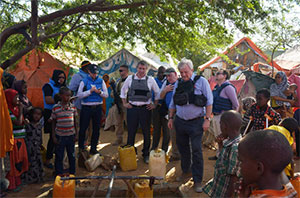 UN Emergency Relief Coordinator Visits Somalia. Credit: UN Photo/Tobin Jones
In recent years, conflicts have broken out across the world with no sign of slowing down or stopping. In times like this, millions of people globally are in dire need of humanitarian aid. Famine, warfare, natural disasters, and economic decline plague a host of nations, including Palestine, Sudan, Chad, Lebanon, and Haiti, to name a few. Humanitarian aid provides millions of people with critical services including healthcare, food, clean drinking water, psychosocial support, housing, and access to education. UN agencies such as the UNDP, UNICEF, the World Food Programme (WFP), UNHCR, UNRWA, and UNEP work with the UN Office for the Coordination of Humanitarian Aid (OCHA) and local organizations to come up with the best possible strategies to support affected communities. At the same time, humanitarian aid and those working on the frontlines are consistently threatened by both actors directly involved in conflict as well as those who are meant to contribute to the international humanitarian regime at large. The near-collapse of United States international aid structures in 2025, including the termination of 83% of USAID’s 6,300 global initiatives, has left millions of people without access to vital humanitarian assistance. 98 million people in 2025, only 65% of people targeted for humanitarian assistance, received the help they needed. In contrast, 123 million people received some form of humanitarian assistance in 2024, and OCHA’s 2026 Global Humanitarian Overview estimates that 239 million people are in need of assistance in 2026. IPS is well-positioned to discuss current initiatives to provide aid and relief through in-depth reporting and opinion content.

The Week with IPS

NEXT STOP - SDGs
Tracking global progress towards a sustainable world
Tracking global progress towards a sustainable world
